


Bots and Ghosts: Detecting Automation and Location Spoofing at Scale
 Naushad UzZaman
Sophisticated narrative influence operations use automated accounts and location masking to appear legitimate. Detecting both requires explainable narrative intelligence that reveals not just what the system found, but why it reached that conclusion, giving analysts the transparent reasoning they need to validate findings, build trust, and take action.


By Blackbird.AI Co-Founder and CTO Naushad UzZaman
Quick Answers
- What is the dual attribution problem? It is the pair of questions an analyst must answer about a suspect account: whether the account is automated, and where the actor operates from, rather than where the profile or VPN claims. Most detection systems answer one question and treat the other as a black box, which leaves analysts with an incomplete picture.
- How does Blackbird.AI detect bots? The approach reads behavioral signals that are hard to fake. Posting cadence separates human circadian rhythms from machine uniformity, accounts for metadata flags, follower ratios, and amplification-built profiles, and network structure reveals which communities engage with an account. An LLM reasoning layer then produces a justification an analyst can evaluate.
- How does the system detect location spoofing? Posting patterns reveal the timezone of real activity, since peak hours persist even when a profile lies about its location. Language consistency between bio and content surfaces constructed identities, and network structure reveals the communities to which an actor belongs. Network signatures resist manipulation because an authentic-looking network takes months of consistent behavior to build.
- Why does explainability matter in narrative intelligence? A score or label is not enough when an analyst briefs a board, justifies a policy decision, or builds a case for executive action. Transparent reasoning lets analysts validate findings, catch the edge cases where automated systems fail, and act with confidence. The goal is actionable intelligence that strengthens human judgment rather than replacing it.
When a foreign influence operation targets your audience, the first thing they do is disappear.
Automated bot accounts push content at inhuman speed while mimicking organic behavior. Human operators route through VPNs, proxy infrastructure, and app stores in countries they don’t live in. By the time content reaches your platform, both the bot and the state-backed operative look indistinguishable from a legitimate user in Ohio.
Platform metadata says “United States.” The posting pattern says bot. The network indicates a large overseas nation-state.
LEARN: What Is Narrative Intelligence?
This is the dual attribution problem we’ve been solving at Blackbird.AI. Two questions, both essential:
Is this account automated? Bots, coordinated networks, and inauthentic amplification drive harmful narratives at scale. Knowing which accounts are real changes how you interpret everything they touch.
Where is this actor actually operating from? Not where their profile claims. Not where their VPN terminates. Where they actually are, and whether they’re actively hiding it.
Most detection systems treat both questions as black boxes. You get a score. Maybe a label. But when an analyst needs to act on that information, when it matters for a report, a policy decision, or a national security assessment, a number isn’t enough.
They need to understand why.
Why does this account look automated? What signals point to a specific geographic origin? What makes us confident that the stated location is real or a lie?
Explainability isn’t a nice-to-have. It’s how analysts validate findings. It’s how you build trust in intelligence products. And it’s how you catch the edge cases where automated systems get it wrong.
Blackbird.AI’s approach combines behavioral signals that are genuinely hard to fake.
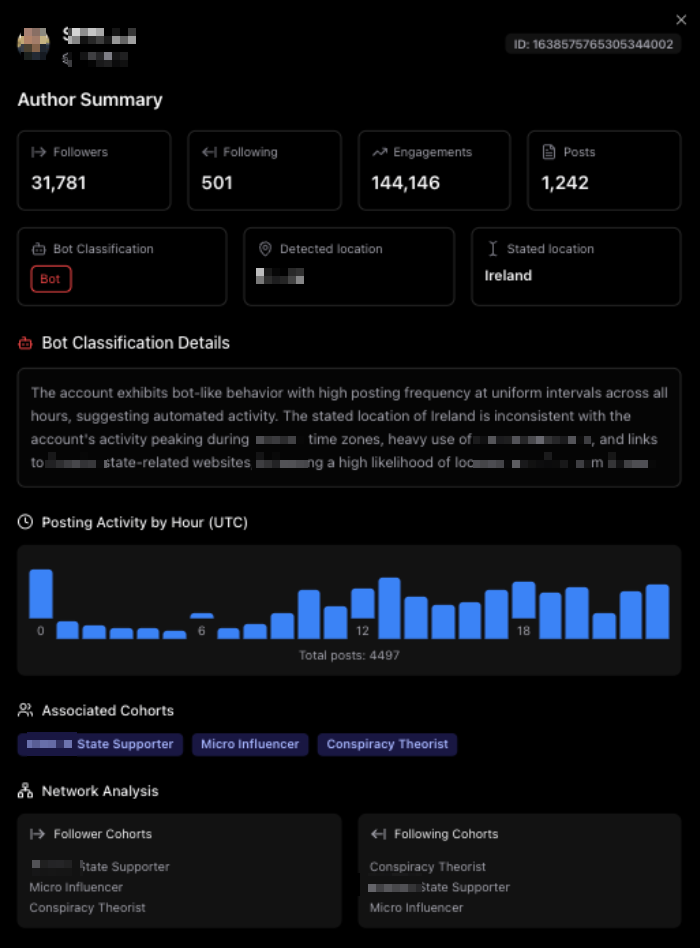
For bot detection:
Posting cadence tells a story. Humans show circadian rhythms, clustered activity, and the natural ebb and flow of attention. Bots show uniformity: posts distributed too evenly across hours, activity that never sleeps, bursts that align with campaign schedules rather than human schedules.
Account metadata adds context. Follower-to-following ratios, account age versus volume, and the telltale signs of accounts created for amplification rather than real participation and engagement.
For location spoofing:
Posting patterns reveal timezone. Not the timezone in profile settings, but when someone’s actually active. Peak hours don’t lie, even when profiles do.
Language patterns matter, but not just which language. The consistency between bio and content. The subtle mismatches that surface when a profile is constructed rather than lived.
For both:
Network structure. This is where it gets interesting.
Who follows this account? Who do they follow? What communities do they belong to — not by what they say, but by who engages with them?
Network signatures are exceptionally difficult to manipulate at scale. You can flip a bot switch or change your profile location in seconds. Building an authentic-looking network that matches your claimed identity takes months of consistent behavior that most operations can’t sustain.
We feed these signals to an LLM-based reasoning layer. Not for the classification itself, but for the explanation. The model sees behavioral evidence and produces a justification that an analyst can evaluate.
For a suspected bot: “Posting distribution nearly uniform across 24 hours with no sleep pattern. Account created 3 months ago with 47,000 tweets. Follower network concentrated in known amplification clusters.”
For a suspected spoofer: “Peak activity occurs during business hours in Eastern European timezones despite claimed U.S. location. The follower network is heavily concentrated within native-language political communities. Language switching pattern inconsistent with a native English speaker.”
That’s not a score. That’s a finding an analyst can investigate, challenge, and build on.
The validation question is tricky, and we’re honest about it.
When you’re building a system designed to detect deception, you can’t validate it against data the adversaries control. Platform location metadata is useful context, but sophisticated actors know how to manipulate it.
So we look at where platform data and our predictions diverge, and ask: who’s right?
In regions where we’d expect heavy operational security, where adversaries have every incentive to mask their origin, that divergence is substantial. The platform says United States. Our signals say otherwise.
We can’t prove ground truth in every case. But the pattern is consistent, and it aligns with what we know about how influence operations actually work.
The Way Forward: Three Key Takeaways for Organization Leaders
1. Attribution is a dual problem, and you need answers to both questions. Knowing an account is automated tells you amplification tactics matter. Knowing that an operator masks their location tells you operational security and intent matter. Both questions require answers. Systems answering only one question give you an incomplete picture.
2. Explainability is not optional when the stakes are real. Black-box scores might work elsewhere. They do not work when you brief a board, justify a policy decision, or build a case requiring executive action. Your analysts need to understand why a detection system reached its conclusion, and so do the stakeholders acting on that intelligence.
3. Build systems that enhance human judgment. The most sophisticated adversaries will always find new evasion tactics. Organizations staying ahead give analysts better tools. Technology should make expert judgment more effective, not attempt to replace it.
The influence operations targeting your organization today are more sophisticated than last year. Your detection capabilities need to keep pace, not just through more data, but through better reasoning.
The goal is actionable intelligence with transparent reasoning.
When an analyst can see the evidence, evaluate the logic, and understand the limitations, they can make better decisions. That’s the actual job.
We’re building tools that make human judgment more effective, not tools that replace it.
Naushad UzZaman • Chief Technology Officer
Naushad is the CTO and Co-founder of Blackbird.AI and leads a team of highly skilled experts, data scientists, and engineers who discover emergent threats to get ahead of real-world harm. UzZaman is responsible for developing Blackbird.AI’s Narrative Intelligence Platform, and along with his team, he has built a unique series of scalable ML, generative AI, and network analysis solutions that detect rare risk signals of threats.
Naushad is the CTO and Co-founder of Blackbird.AI and leads a team of highly skilled experts, data scientists, and engineers who discover emergent threats to get ahead of real-world harm. UzZaman is responsible for developing Blackbird.AI’s Narrative Intelligence Platform, and along with his team, he has built a unique series of scalable ML, generative AI, and network analysis solutions that detect rare risk signals of threats.
About Blackbird.AI

Blackbird.AI is the Narrative Intelligence Detection and Response company protecting executives, organizations, and institutions from narrative-based disinformation attacks that cause financial, operational, reputational, and physical harm. Blackbird.AI’s Constellation Platform identifies the actors, networks, bots, and communities driving them; and turns those signals into early warning, decision intelligence, and coordinated response. Blackbird.AI brings Narrative Intelligence into the workflows where teams already operate, including cybersecurity, communications, legal, executive, and public-sector environments, with agentic response capabilities and MCP-enabled integrations that help organizations act faster. Founded by AI experts, threat intelligence analysts, and national security professionals, Blackbird.AI helps customers defend trust, strengthen resilience, and Own The Narrative. To learn more, visit Blackbird.AI.