
Manipulated Narratives Cost Billions. RAV3N Recon Detects Them in Minutes.
From influencer blowups to executive targeting and short-seller attacks, narrative threats have wiped out billions in market value and put lives at risk. RAV3N Recon monitors years of public content and rapidly delivers a robust narrative risk assessment.

Dall-E 3
Quick Answers
- What is RAV3N Recon? It is a Blackbird.AI tool that detects narrative risk before it becomes a crisis by scanning up to two years of public content across social media, news, alternative platforms, and the dark web. A full narrative risk assessment takes 4 to 11 minutes and requires only a name and social handles as input.
- Why is influencer vetting a $32 billion blind spot? Influencer marketing is set to hit $32 billion in 2025, growing at 33% annually, yet brands have almost no visibility into what their partners say online. Fama’s 2024 report found that 47% of influencers carry content posing significant reputational risk, and cases like the athletic shoe brand partnership that cost more than $2 billion were visible in public content long before the brand acted.
- How does RAV3N Recon differ from social listening? Social listening reports what individual people are saying, while RAV3N Recon identifies emerging narratives and assesses whether they represent real risk. The unit of analysis is the narrative rather than the individual post, and every risk score traces back to real content and engagement data across 26 risk categories, scored on volume, reach, and severity.
- Why does executive protection need narrative monitoring? The Security Executive Council has documented 424 attacks on corporate executives since 2003, with 2025 doubling the 2024 total, and CEOs accounting for 64% of cases. Online vilification builds up before someone acts on it, yet most executive security spending focuses on physical protection rather than the narrative signals that come first.
When a major sportswear company signed a 10-year partnership with one of the world’s most influential entertainers, the deal looked like a sure thing. When the relationship collapsed over antisemitic posts on social media, the financial damage exceeded $2 billion in lost revenue and unsold inventory. The risk signals were public throughout. No one was looking at the narrative level.
There’s a new class of threat that most companies aren’t equipped to see. Not malware. Not data breaches. Weaponized narratives: stories designed to tank stock value, endanger executives, and blow up brand partnerships overnight. The common thread is that none of these organizations was aware that the narrative existed until the damage was done. Narrative intelligence is built to close that gap.
Blackbird.AI built RAV3N Recon to help organizations detect narrative risk before it becomes a crisis.
LEARN MORE: RAV3N RECON
The Problem (Why This Matters)
Influencer Partnerships Are a $32B Blind Spot
Influencer marketing hit $32B in 2025, growing at 33% annually. That represents $32B flowing through partnerships where brands have almost no visibility into what their partners are saying online. According to Fama’s 2024 report on influencer misconduct, 47% of influencers have content that poses significant reputational risk to brand partners, and 12% have 50 or more instances of problematic content. Nearly half the people brands pay to represent them carry a risk no one has checked. Brands find out after signing the deal. Never before.
Chiara Ferragni “Pandorogate” (2023–2024)
Italy’s top influencer promoted branded pandoro cakes, suggesting that proceeds would go to a children’s hospital. More than €1M went to her companies instead. She received €400K in personal fines and €675K in company fines, lost an estimated €10M in brand value, and stepped down from corporate boards. Italy passed the “Ferragni Law” regulating influencers with 1M or more followers. Her social content was the risk signal. It was all public.
An Athletic Shoe Brand (2022–2025)
An influencer posted antisemitic content on his own social accounts. The athletic shoe company terminated its 10-year partnership. Total financial impact exceeded $2B, including an estimated $1.3B in lost revenue in 2023 and €1.2B in unsold sneaker inventory. All of it was visible on his social media long before the athletic shoe company acted. A narrative risk assessment on his public content would have flagged extreme risk across multiple categories before the deal was signed.
A Fitness Apparel Brand (2025)
A fitness apparel brand ended its contract with one of America’s top influencers over political comments made on social media. Backlash came from both sides.
The takeaway: every one of these was knowable before it became a crisis. The risk was sitting in public content, in the social conversation, in the signals. Nobody was looking at the narrative level.
Executives Are Being Targeted and the Threats Start Online
The Security Executive Council has documented 424 attacks on corporate executives since 2003. The trend is accelerating: 2025 has doubled 2024’s total. CEOs are the primary target, making up 64% of cases. The pattern keeps repeating: online vilification builds, then someone acts on it. The narrative is the early warning.
A Healthcare CEO (Dec 4, 2024)
Was shot outside a NYC hotel. But here’s what matters for this conversation: over 100,000 “Haha” reactions on the company’s social media condolence post. The suspected shooter was celebrated as a “folk hero” across social media. The company spent $1.7M on executive security that year and hired a defamation law firm 2 months later. The anti-insurance-exec narrative had been building publicly for months.
A Large Coffee Brand CEO (2026)
A large coffee brand expanded its personal security measures amid rising populist anger targeting corporate leaders. No single incident triggered the decision. A sustained online narrative environment made the threat level unacceptable.
Crypto “Wrench Attacks” (2025)
There have been 72 verified physical attacks on crypto executives in 2025, up 75% year-over-year, resulting in $41M in losses. Ledger co-founder David Balland had a finger severed in a €10M ransom demand. The targeting comes from digital visibility. Online footprints put executives on a map.NYC Mayor deepfakes (Feb 2026): AI-generated images falsely placed the mayor with Jeffrey Epstein. An influencer amplified them to 4.4M followers. Global reach in hours. Fabricated narratives about a public figure spread faster than any correction could travel. All of it on social media. (CBS News)
The Spending Response
According to Harvard Law’s analysis of executive security spending, 31.3% of S&P 500 companies offer executive security perks, up from 24.5% in 2023. Median spending hit $94,276, more than double the 2021 level. Intel went from $3,000 to $250,000 in a single year.
All that money goes to physical protection. Almost none of it covers the narrative signals that come before the threat. Bob Hayes, who leads research at the Security Executive Council, has noted that the real difficulty is figuring out how to evaluate and find the needle in the haystack.
Short Sellers and Threat Actors Weaponize Narratives for Profit
Narratives are no longer just reputation problems. They are tools for financial manipulation and organized attacks. They play out in public, across social media and news, where they are detectable to anyone looking.
Hindenburg vs. Adani Group (January 2023)
A short-seller report alleging stock manipulation wiped $153B from Adani Group’s market value. Hindenburg made $4.1M on the trade. Adani called it a disinformation campaign. India’s securities regulator alleged the report contained inaccurate statements meant to mislead. The narrative did $153B in damage regardless.
One narrative wiped $153B in market value. Another racked up 36.8M impressions before anyone realized it was fake. Both were visible on public platforms throughout.
What RAV3N Recon Does About It
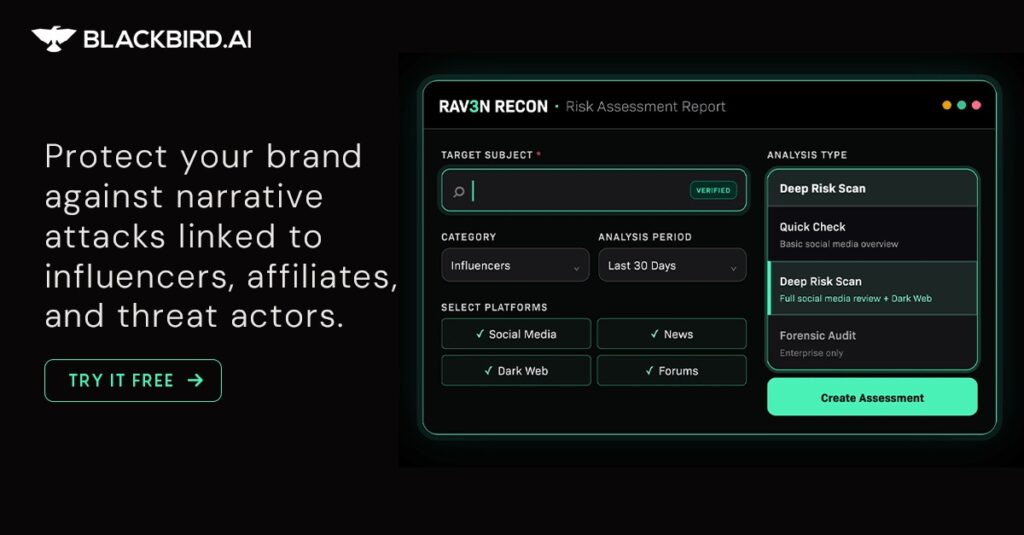
RAV3N Recon scans up to two years of content across social media, news, alternative platforms, and the dark web. A full narrative risk assessment takes 4 to 11 minutes.
How It Works
The input is a name and social handles. Nothing else is required.
RAV3N Recon scans across social networks, news sites, and dark web sources in parallel. It analyzes everything, including images, video, and audio. The system evaluates content people post, share, and say across 26 risk categories spanning six areas: Advocacy, Lifestyle, Tone, Physical Threats, Risky Promotion, and Sensitive Material. Each category is scored on volume, reach, and severity.
Entity disambiguation ensures the right person is identified. If you search for John Taylor, CFO of Acme Corp, a three-layer filtering system (automated rules, a cache of prior lookups, then AI verification for difficult matches) delivers the correct results. In testing, this cut false-positive risk categories from 17 down to 3.
Output is actionable: an interactive dashboard, a PDF executive briefing, an editable DOCX, and a narrative threat matrix that links each score to specific posts and includes engagement data. The entire system is powered by the RAV3N Risk LLM, Blackbird’s own model built for narrative threat detection.
What Makes This Different from Social Listening
Social listening reports what individual people are saying. RAV3N Recon identifies the narratives forming and whether they represent real risk. The unit of analysis is the narrative, not the individual post. It identifies the persuasive storylines shaping how audiences interpret events. Every risk score traces back to real content with real engagement data.
Who Uses It
A CMO about to sign a $5M influencer deal runs a RAV3N Recon first. Ten minutes later, they know if there’s a Ferragni-style risk buried in the influencer’s content history. A security team protecting C-suite executives uses Recon to monitor the online narrative environment around their leaders, spotting vilification trends before they escalate to physical threats. A threat intelligence analyst profiles an actor targeting the company, going beyond technical IOCs to understand the narratives being pushed and where they gain traction.
A General Counsel running M&A due diligence gets a RAV3N Recon narrative risk assessment in minutes, not weeks, at a fraction of the $75K–$300K that traditional engagements cost. A risk committee receives ongoing monitoring using a scoring method they can explain to the board. Every number traces back to real content.
A Security Operations Center (SOC) running a RAV3N Recon narrative risk assessment search on threat actors or nation states that are responsible for cyber attacks. Knowing who is behind narrative attacks in advance of cyber attacks can significantly reduce geopolitical risk, impact to operations, executive risk, and brand trust. A physical security team protecting C-suite executives uses RAV3N Recon to monitor the online narrative environment around their leaders. They spot vilification trends before they escalate to physical threats.
A risk committee gets ongoing RAV3N Report monitoring with a scoring method they can actually explain to the board. Every number traces back to real content.
Market Validation: Why Now
The Detection Gap
Gartner predicts enterprise spending on disinformation will exceed $30B by 2028. Gartner also named Blackbird.AI the “Company to Beat” for Disinformation Narrative Intelligence in December 2025. Forrester named Blackbird.AI the only notable provider for protection against narrative attacks in their External Threat Intelligence Service Providers Landscape, Q1 2025.
The World Economic Forum ranked disinformation as the #1 short-term global risk in 2024 and 2025, and #2 in 2026. Three consecutive years at the top.
According to the RAV3N Report 2026, 58% of organizations have been targeted by narrative attacks. Only 18% are confident they can detect them. That is a 40-point gap between how exposed companies are and how prepared they think they are.
The Way Forward: Key Takeaways for Organization Leaders
Closing the gap requires treating narrative intelligence as operational infrastructure. Here are four actionable takeaways to help leaders get started with narrative intelligence.
- Embed narrative risk assessment into existing due diligence workflows. RAV3N Recon delivers a full risk assessment in 4 to 11 minutes across 26 risk categories. Security teams, general counsel, and risk committees can integrate narrative screening into influencer vetting, M&A due diligence, executive protection protocols, and partnership evaluations at a fraction of the cost and timeline of traditional engagements.
- Assign ownership for narrative threat detection. Narrative attacks cross organizational boundaries, hitting brand, security, legal, and investor relations simultaneously. Designate a cross-functional owner, whether that is the CISO, chief communications officer, or chief risk officer, with authority to act on narrative intelligence before a crisis forces reactive decision-making.
- Audit your current detection capability against the threat landscape. The World Economic Forum has ranked disinformation as the top short-term global risk for three consecutive years. Gartner projects enterprise spending on disinformation defense will exceed $30 billion by 2028. If your organization lacks dedicated narrative-detection tools, that gap is a liability with quantifiable costs to market value, executive safety, and brand trust.
- Start with a baseline. Request a confidential narrative risk report [TK LINK] to understand your organization’s current exposure. Whether the concern is a specific partnership, an executive’s threat profile, or broader brand vulnerability, the narrative signals already exist in public data. The question is whether your organization can see them before they escalate.
The threats that cause the most damage are the ones that build in plain sight. RAV3N Recon was designed to make them visible before the damage is done.

Naushad UzZaman • Chief Technology Officer
Naushad is the CTO and Co-founder of Blackbird.AI and leads a team of highly skilled experts, data scientists, and engineers who discover emergent threats to get ahead of real-world harm. UzZaman is responsible for developing Blackbird.AI’s Narrative Intelligence Platform, and along with his team, he has built a unique series of scalable ML, generative AI, and network analysis solutions that detect rare risk signals of threats.
Naushad is the CTO and Co-founder of Blackbird.AI and leads a team of highly skilled experts, data scientists, and engineers who discover emergent threats to get ahead of real-world harm. UzZaman is responsible for developing Blackbird.AI’s Narrative Intelligence Platform, and along with his team, he has built a unique series of scalable ML, generative AI, and network analysis solutions that detect rare risk signals of threats.
About Blackbird.AI

Blackbird.AI is the Narrative Intelligence Detection and Response company protecting executives, organizations, and institutions from narrative-based disinformation attacks that cause financial, operational, reputational, and physical harm. Blackbird.AI’s Constellation Platform identifies the actors, networks, bots, and communities driving them; and turns those signals into early warning, decision intelligence, and coordinated response. Blackbird.AI brings Narrative Intelligence into the workflows where teams already operate, including cybersecurity, communications, legal, executive, and public-sector environments, with agentic response capabilities and MCP-enabled integrations that help organizations act faster. Founded by AI experts, threat intelligence analysts, and national security professionals, Blackbird.AI helps customers defend trust, strengthen resilience, and Own The Narrative. To learn more, visit Blackbird.AI.