
What Communications Leaders Need to Know About Narrative Intelligence

Narrative attacks target executives, erode brand trust, and destabilize stock prices before legacy monitoring tools detect the threat. New Gartner research confirms that CCOs must adopt narrative intelligence to protect their organizations from coordinated disinformation campaigns across digital platforms, the dark web, and emerging media ecosystems.

Dall-E 3
Quick Answers
- Why do CCOs need narrative intelligence? A single coordinated campaign can target a CEO with fabricated quotes, tank a stock price through synthetic amplification, or erode brand equity in hours. Legacy media monitoring and sentiment tracking measure what is being said but cannot reveal who is behind a narrative, whether it is organic or coordinated, or how it will spread across digital ecosystems.
- What is the social monitoring blind spot? Social listening tools answer narrow questions about sentiment and coverage volume at the level of individual posts. They do not identify the narratives targeting executives, where a narrative originated, whether a bot network is amplifying it, or how fast it is crossing platforms, and they do not scan the dark web, Telegram, niche forums, or unindexed sites where campaigns take shape.
- What does the Gartner research find? The report found that 79% of enterprises have encountered misinformation, disinformation, or malinformation in the last three years, and half reported a direct impact on their reputation. The World Economic Forum estimates disinformation costs companies around $39 billion in stock market losses each year, yet only 14% of communications leaders intend to invest in narrative intelligence platforms by February 2027.
- What should communication leaders do? Assess whether existing tools can identify emerging narratives, determine their origins, and map amplification networks, and then invest in narrative intelligence as a risk-mitigation layer framed around crises averted and executive reputation protected. Build cross-functional workflows or a fusion center that routes intelligence across communications, security, legal, and executive teams.
Narrative attacks have become a top concern for executive teams and communication leaders across industries. A single coordinated campaign can target a CEO with fabricated quotes, tank a company’s stock price through synthetic amplification, or erode years of brand equity in hours. The organizations hit hardest share a common vulnerability: their communications teams lack the tools to detect these threats before they reach critical mass. Legacy media monitoring and sentiment-tracking platforms were built for social listening, measuring what is being said. They cannot reveal who is behind a narrative, whether it is organic or coordinated, or how it will spread across digital ecosystems.
Organizations face crisis narratives tied to customer incidents, partner disputes, or product defects. They face brand reputation attacks fueled by false claims about products, calls for boycotts, or manufactured controversy. Stock manipulation campaigns use burner account networks and bot-driven amplification to pressure share prices through platforms like Reddit’s r/wallstreetbets. Cyber attack narratives amplify the severity and financial impact of security breaches, complicating disclosure obligations. Geopolitical risk narratives pose a threat to business continuity for companies with global supply chains, employees, and customer bases.
“CCOs are adopting narrative intelligence tools to help overcome inadequate legacy monitoring amid accelerating AI-fueled disinformation. NI tools help CCOs safeguard and enhance their organization’s reputation by analyzing online narratives, origin of content, and the spread of disinformation.”
— Gartner, What CCOs Need to Know About Narrative Intelligence, February 2026
A new Gartner report, What CCOs Need to Know About Narrative Intelligence, confirms what many communication leaders have experienced firsthand: the gap between traditional social monitoring and the current threat landscape is a material business risk. The report finds that 79% of enterprises have encountered misinformation, disinformation, or malinformation issues in the last three years. Half reported direct reputation impact. The World Economic Forum estimates that disinformation costs companies around $39 billion in stock market losses each year. For CCOs, closing this gap requires a new category of technology: narrative intelligence.
The Social Monitoring Blind Spot
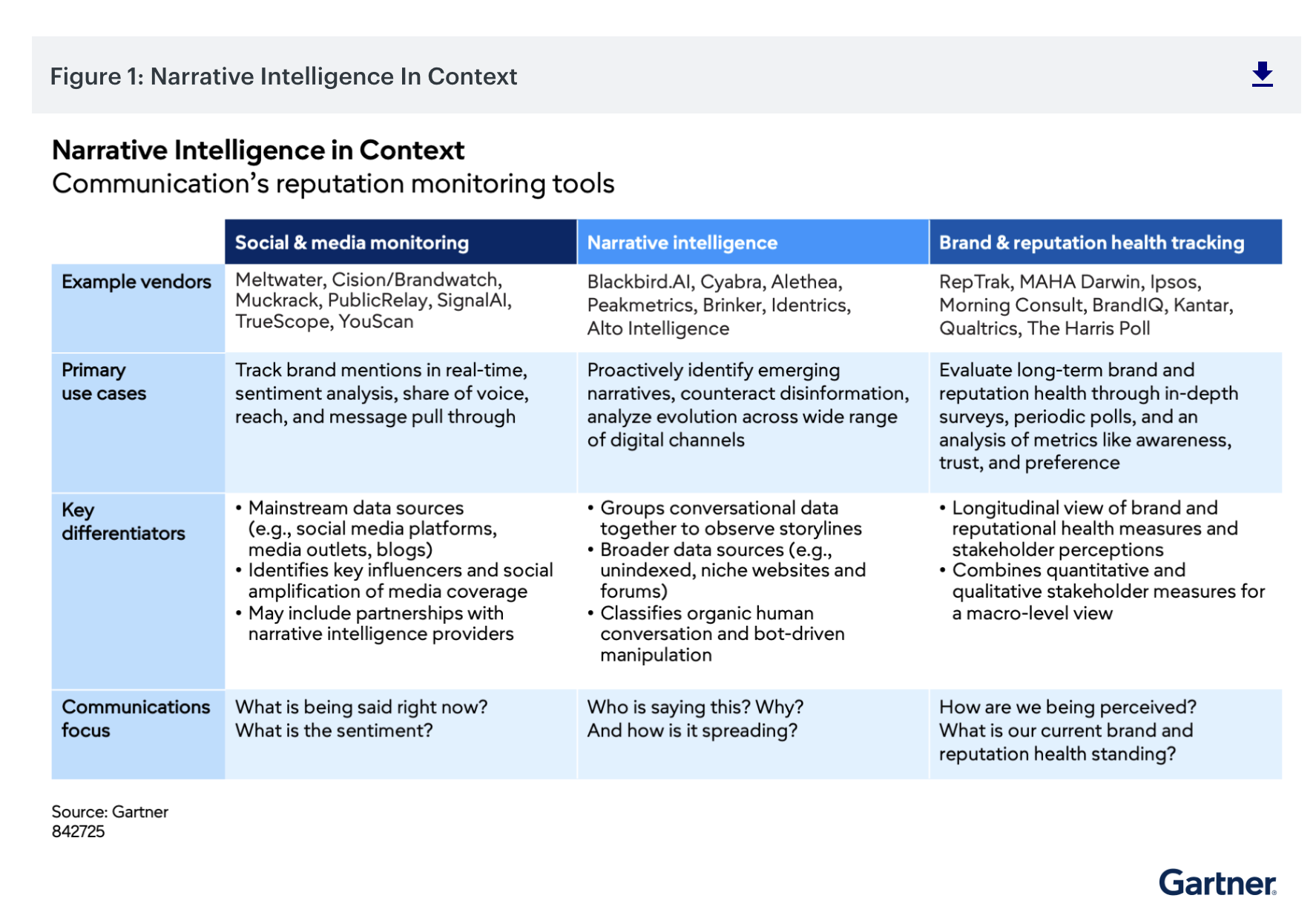
Most CCOs operate with social listening platforms, media tracking tools, and brand health dashboards. These systems answer a narrow set of questions: What is the sentiment? How much coverage did we receive? What are people saying right now at the individual post level? They do not answer the questions that matter most when an organization faces a narrative attack: Whate are the harmful narratives targeting my executives and brand? Where did this originate? Is a bot network amplifying it? Which threat actors are coordinating? How fast is it crossing platforms?
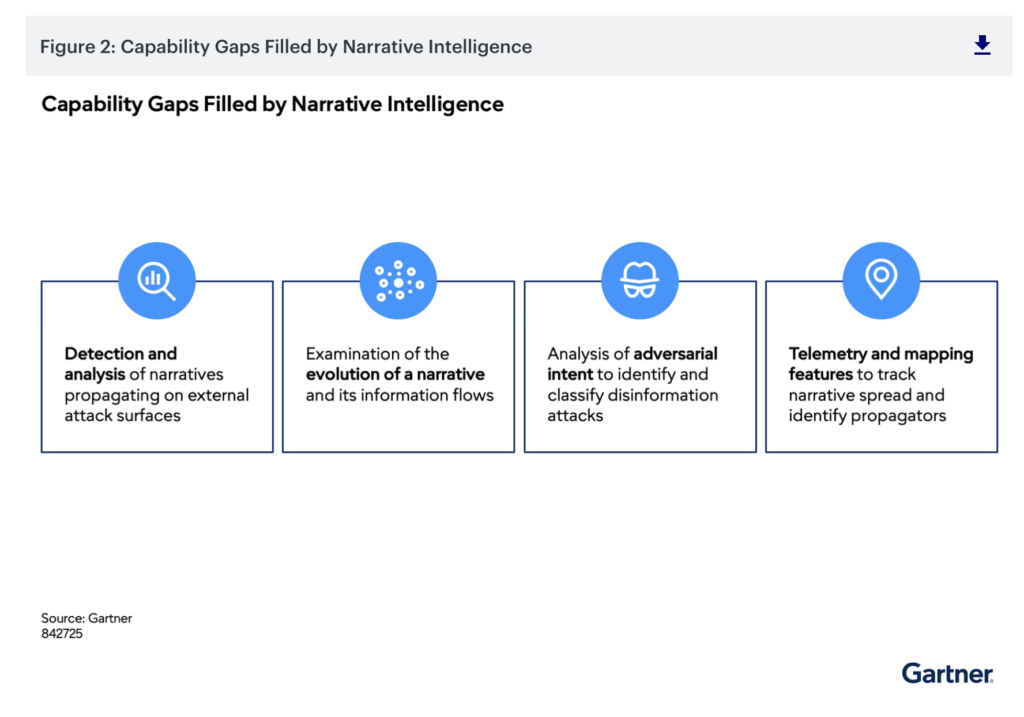
Gartner draws a clear line between these legacy capabilities and what narrative intelligence provides. Traditional monitoring tools signal that a crisis is underway. Narrative intelligence identifies narratives building in momentum, the sources behind them, and their information flows before a crisis takes hold. The difference between detecting a narrative at 10,000 impressions and at 10 million is between a contained response and a full organizational crisis.
“CCOs’ reliance on traditional and social media monitoring tools to manage reputation is inadequate to manage the current risk environment. Widespread distrust in institutions, societal polarization, and increasingly sophisticated AI capabilities in the hands of bad actors has created a critical new layer of reputation management and intelligence for CCOs to navigate. NI tools are turning into an essential technology that provides CCOs with visibility and insight into online narratives about their organization, executives and industry that traditional monitoring and cybersecurity tools don’t provide.”
— Gartner, What CCOs Need to Know About Narrative Intelligence
The blind spot extends well beyond traditional and social media. Threat actors operate across the dark web, messaging platforms such as Telegram, niche forums, and unindexed websites. Coordinated conversations emerge across these digital surfaces, questioning a company’s transparency, business practices, and leadership. Legacy monitoring tools do not scan these channels. Narrative intelligence platforms do, providing detection and classification across the full spectrum of digital environments where campaigns take shape.
How Narrative Attacks Target Executives and Organizations
Narrative attacks do not target organizations in the abstract. They target people. CEOs, board members, and senior leaders are primary vectors for reputation attacks because their credibility is the organization’s credibility. A deepfake video of a CEO, a fabricated statement attributed to a board member, or a coordinated campaign designed to undermine an executive’s integrity can do more damage than a product recall. Executives who take public positions on geopolitical issues, strategic initiatives, or corporate responsibility face additional exposure. Their statements become raw material for adversarial actors who can reframe, distort, and amplify them across networks at scale. These narrative attacks can also fuel physical attacks, so getting advance notice is critical to the safety of your executive team.
“CCOs play an important role in the identification of mis- and disinformation. 84% of CCOs agree that the Communications function is primarily responsible for ensuring accurate information about their organization is available for both internal and external audiences.”
— Gartner, What CCOs Need to Know About Narrative Intelligence
The scope of this responsibility falls squarely on communications leadership. CCOs own the mandate to ensure accurate information reaches both internal and external audiences. That mandate now extends into adversarial territory where bad actors use generative AI to produce synthetic content at low cost, distribute it through bot networks, and exploit algorithmic amplification to reach target audiences in hours.
The Cost of a Reactive Posture
Organizations that rely on traditional monitoring learn about harmful narratives only after a critical mass of stakeholders has been reached. At that point, the narrative has been amplified, screenshots have been shared, and the story has entered mainstream media coverage. The damage is done.
The reactive approach carries direct financial costs. Crisis communications agencies charge premium rates. Legal teams engage. Investor relations scrambles to contain fallout. Sales teams field questions from concerned customers. The entire organization shifts into damage control, diverting resources from strategic priorities. Studies show that companies can lose up to 22% of their market value during a reputational crisis, and recovery for organizations with weak reputation foundations takes significantly longer than for those with proactive defenses in place.
Narrative intelligence changes this equation. It enables CCOs to detect threats early, quantify risk through predictive analytics, and develop counter-narrative messaging before a story reaches mainstream audiences. With this capability, communications teams can brief stakeholders across legal, PR, investor relations, and executive leadership on timely, data-driven insights rather than scrambling to assemble facts after a crisis is underway.
“79% of enterprises have encountered misinformation, disinformation, or
malinformation (MDMI) issues in the last three years.”
— Gartner, What CCOs Need to Know About Narrative Intelligence
The opportunity to direct those investments toward narrative intelligence is significant. Yet only 14% of communications leaders intend to invest in narrative intelligence platforms by February 2027. That gap represents both a risk and a competitive advantage for organizations willing to move first.
The Fusion Center
Narrative intelligence tools serve multiple functions beyond communications. CISOs, risk managers, marketing leaders, and executive teams all benefit from the intelligence generated by these platforms. Forward-looking organizations are building cross-functional structures to capitalize on this. Some have established fusion centers that bring together communications, cybersecurity, legal, and executive leadership to share narrative risk intelligence and coordinate responses. This integrated approach ensures the organization can protect brand reputation, maintain transparency with stakeholders, and stay ahead of fast-moving public discourse during high-risk moments.
Gartner projects that by 2029, 45% of CCOs will adopt narrative intelligence technologies. The organizations that move first will have years of operational experience, refined workflows, and institutional knowledge that late adopters will struggle to replicate. Influence no longer arrives in neat spikes. It runs in the background, shaped by AI-generated content that can be created, tested, amplified, and adjusted on an ongoing basis. The old model of waiting for a story to break and then responding no longer reflects how influence works.
The Narrative Gap
Traditional social listening tools fail to detect disinformation narrative attacks, leaving a significant gap for organizations and their communication teams. Integrating with narrative intelligence platforms can close the gap by providing visibility into the attacks targeting leaders and organizations, the actors behind them, the networks amplifying them, and the automated activity that scales them.
Blackbird.AI’s Narrative Intelligence Platform uses AI and machine learning to detect and counter online narrative threats, giving CCOs the tools and automation needed to monitor, analyze, and respond to digital narrative risks alongside traditional cybersecurity threats. The platform enables security leaders to help their organizations make better strategic decisions during crises. Gartner recently named Blackbird.AI the Company to Beat for Disinformation Narrative Intelligence in its latest AI Vendor Race report.
The Way Forward – Key Takeaways For Communication Leaders
The threat environment has changed. AI-generated disinformation is cheaper to produce, harder to detect, and faster to distribute than ever before. CCOs must respond with tools and strategies that match the threat’s sophistication. Three priorities should guide the path forward:
- Assess the current capability gap. Evaluate whether existing monitoring tools can identify emerging narratives, determine their origin, classify adversarial intent, and map the networks amplifying them. If the answer is no, the organization is operating blind to its most significant reputation risks. Engage with CISOs and IT leaders to determine whether a narrative intelligence provider is already under contract elsewhere in the organization.
- Invest in narrative intelligence as a risk mitigation layer. Frame the investment in terms of organizational risk reduction: crises averted, executive reputation protected, stock price volatility minimized. Quantify the cost of inaction by examining the potential impact of a successful disinformation campaign on market value, customer trust, and regulatory scrutiny. Build shared funding models with security, risk, and executive leadership to distribute the investment across stakeholders who benefit.
- Build cross-functional intelligence workflows. Narrative intelligence generates insights relevant to security, risk, legal, marketing, and executive leadership. Establish processes that route intelligence to the right stakeholders and enable coordinated responses. Consider a fusion center model that brings together communications, cybersecurity, and executive teams to share narrative risk data and present a unified front during high-risk moments.
Organizations that treat disinformation as a reputational inconvenience will continue to absorb preventable damage. Those that recognize narrative attacks as a strategic threat will protect their executives, preserve stakeholder trust, and maintain competitive advantage. The question for CCOs is no longer whether to adopt narrative intelligence; it is whether to adopt it. It is how fast they can operationalize it across the enterprise.
Gartner, What Communication Leaders Need to Know About Narrative Intelligence By Amber Boyes, February 2026 Gartner is a trademark of Gartner, Inc. and/or its affiliates.

Dan Patterson • Head of Corporate Communications
Dan Patterson is a strategic communications leader driving impact at the intersection of artificial intelligence, cybersecurity, and media. At Blackbird.AI, Dan leads communication and content strategy that breaks down complex AI and cybersecurity concepts for diverse business audiences. Prior, he was the national tech correspondent for CBS News.
Dan Patterson is a strategic communications leader driving impact at the intersection of artificial intelligence, cybersecurity, and media. At Blackbird.AI, Dan leads communication and content strategy that breaks down complex AI and cybersecurity concepts for diverse business audiences. Prior, he was the national tech correspondent for CBS News.
About Blackbird.AI

Blackbird.AI is the Narrative Intelligence Detection and Response company protecting executives, organizations, and institutions from narrative-based disinformation attacks that cause financial, operational, reputational, and physical harm. Blackbird.AI’s Constellation Platform identifies the actors, networks, bots, and communities driving them; and turns those signals into early warning, decision intelligence, and coordinated response. Blackbird.AI brings Narrative Intelligence into the workflows where teams already operate, including cybersecurity, communications, legal, executive, and public-sector environments, with agentic response capabilities and MCP-enabled integrations that help organizations act faster. Founded by AI experts, threat intelligence analysts, and national security professionals, Blackbird.AI helps customers defend trust, strengthen resilience, and Own The Narrative. To learn more, visit Blackbird.AI.