
The Alien DNA Conspiracy: Why 23andMe & Ancestry.com Fears Went Viral
Millions of people trusted genetic databases with their most intimate biological data. Now, whistleblowers, intelligence agencies, and UFO disclosure portals are raising questions about who really has access and what they might be looking for.

Dall-E 3
We all want to know where our ancestors came from. That is why millions of people are willing to lavishly give up their DNA by spitting in a jar, waiting anxiously to discover they are 12% Irish, 4% Scandinavian, and somehow related to a guy named Bobby in South Dakota.
Nobody mails off a DNA kit expecting the results to come back: Congratulations. You may also be of extraterrestrial descent.
Although, if we’re being honest, it would make a lot of sense to me, and I would be relieved.
The reason this narrative keeps spreading is not that people suddenly think their neighbor is an alien. It is because the story triggers questions that remain genuinely unresolved:
- Who has access to and owns our DNA and biological data?
- What happens when genetic databases change hands?
- Why would organizations be interested in our private genetic information in the first place?
- Who really built the pyramids?
The recent UFO conversation has evolved from grainy photographs and mysterious lights in the sky to allegations involving DNA databases, whistleblowers, and government transparency portals. Somewhere in a government building, a person with a security clearance and a very serious job title is reportedly staring at a spreadsheet of ancestry results.
Your great-great-grandmother from the Azores?
Interesting.
Are you 4% Scandinavian?
Apparently, you may be of alien descent.
At Blackbird.AI, we track narratives going viral across social media and alternative media ecosystems. Some are rooted in legitimate news events. Others are built on claims and assumptions that have taken on lives of their own. The result is a perfect storm of uncertainty, curiosity, distrust, and imagination. In other words, the internet’s favorite ingredients.
READ: The RAV3N Report: 2026 State of Disinformation Narrative Intelligence
UAP Disclosure Goes Viral: What Our Constellation Data Uncovered
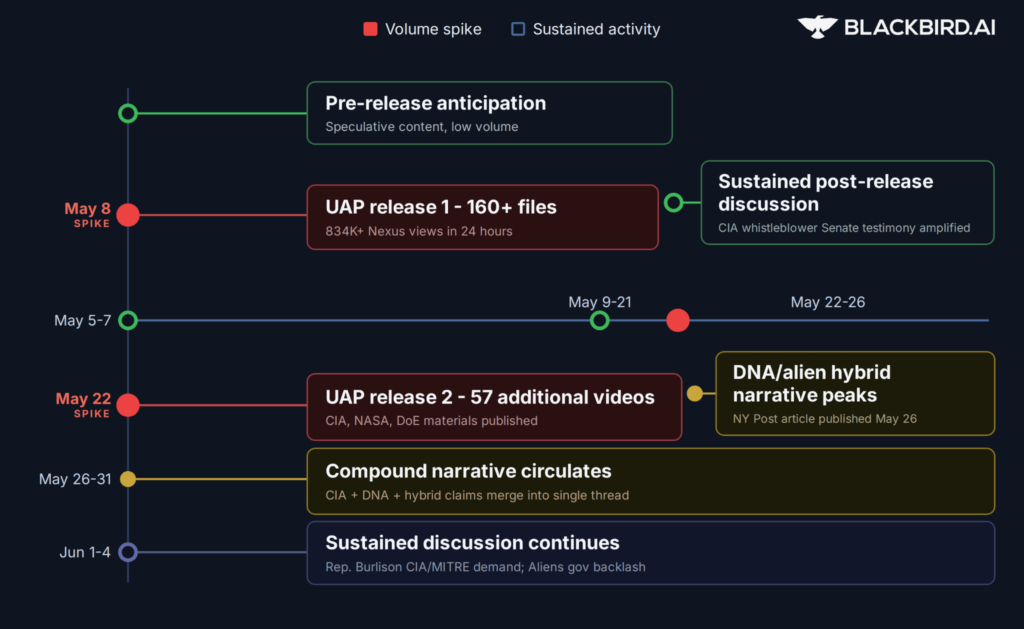
The Unidentified Anomalous Phenomena UAP/UFO disclosure conversation exploded across social media between May 5 and June 4, 2026
- 20.9M total views across 579 posts from 387 authors
- 7.37M views on the single highest-reach post (Daily Mail CIA/DNA/hybrid anchor)
- 6 distinct narratives identified in a single 30-day window
Social media dominated the data, with 20.9 million views, but additional platform activity meaningfully added to the total. News coverage of the Department of War’s first UAP file release on May 8 pulled 834,331 views in a single day on one platform alone. A secondary post capturing grassroots curiosity about claims of alien DNA added another 5,552 views, while a third post generated 38,000 more views. Ross Coulthart’s report on NewsNation, claiming the CIA holds backdoor access to consumer DNA databases like 23andMe and AncestryDNA, added 19,000 views on the streaming side.
The single highest-reach post of the entire period came from the Daily Mail, whose article linking the CIA to alien-human hybrid hunting via commercial DNA databases reached 7.37 million views on its own. That one post accounted for roughly a third of all social media traffic in the analysis window.
QUICK ANSWERS
- Are intelligence agencies actually using DNA databases to search for alien-human hybrids? A whistleblower claim reported by the New York Post alleges that intelligence agencies used data from 23andMe and Ancestry.com to search for unusual genetic markers. No public evidence has emerged confirming a formal federal program, but the allegation has amplified existing concerns about who has access to consumer genetic data and how it might be used.
- What details are in the latest government UFO disclosure? Through the PURSUE program, the Department of Defense has released a substantial collection of declassified files on Unidentified Anomalous Phenomena. The release includes videos, reports, and photographs that had been classified for decades. Reactions are split between those who see it as long-overdue transparency and those who view the structured, batched release as narrative management.
- Did a scientific study really find alien DNA in humans? A study examining so-called junk DNA and anomalous genetic sequences made carefully hedged claims and explicitly acknowledged that further research was needed. It did not conclude that humans have alien DNA. The information environment stripped those qualifications within days and amplified the story as confirmation of extraterrestrial ancestry.
- Why does the alien narrative keep spreading if there is no definitive proof? Because the underlying questions are real. Who owns our genetic data? What happens to it when a company goes bankrupt? Why are government agencies still classifying UAP material? The alien framing is the hook, but the driver is the legitimate distrust of institutions that have repeatedly withheld information.
- What is the actual risk these narratives pose to organizations? These narratives erode institutional trust at scale and create information environments where correcting the record is nearly impossible. Once a claim reaches viral velocity, debunking receives a fraction of the attention the original claim commanded. Organizations operating in data, defense, health, and government sectors face ongoing reputational exposure from narratives they did not create and cannot easily counter.
Narrative One: Intelligence Agencies and Genetic Database Accessibility
According to a whistleblower claim reported by the New York Post, intelligence agencies allegedly used genetic databases from 23andMe and Ancestry.com to search for what are being described as alien-human hybrids. The story exploded across social platforms because it combines four things that have become focal points of public distrust: government agencies, tech companies, personal data, and terms-of-service agreements that nobody really reads.
The allegation itself sounds almost perfectly engineered for virality.
- It has DNA.
- It has intelligence agencies.
- It has aliens.
- It is what the information ecosystem was built to devour.
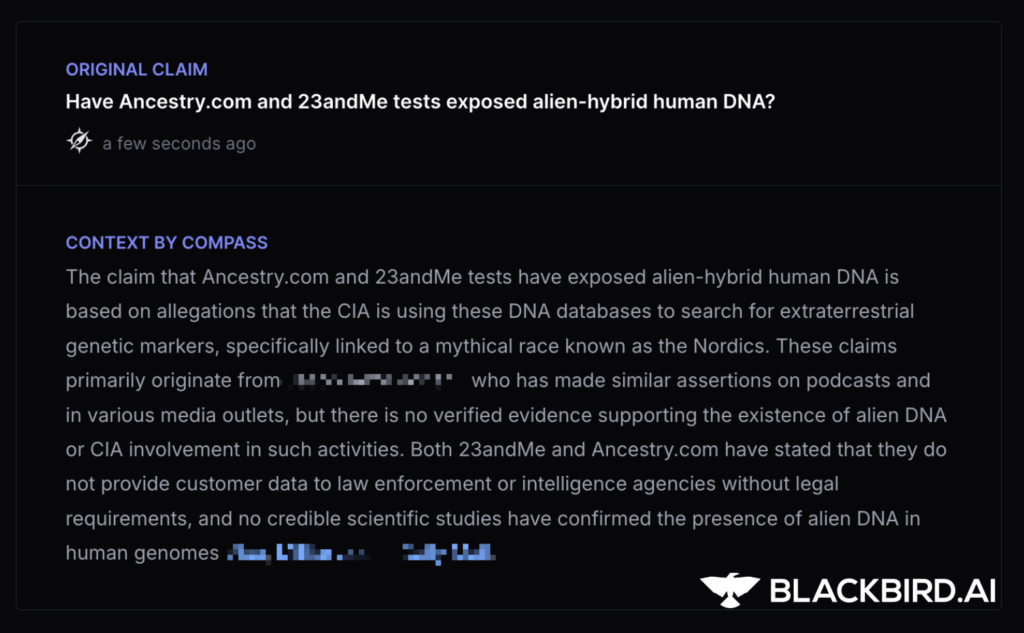
This claim was checked by Compass by Blackbird.AI.
The core allegation does not involve a public announcement of a federal program. It stems from second- and third-hand accounts involving former intelligence personnel, remote-viewing programs, and alleged efforts to identify unusual genetic markers. No public evidence has emerged demonstrating that consumer DNA databases were actually used for this purpose.
The narrative also arrives at a moment when concern about genetic data is already elevated. High-profile breaches and ongoing debates about who owns biological information have made people acutely sensitive to questions about who can access DNA and how it might be used. Half of America is now staring at their 23andMe login, wondering if their “unique genetic variants” were flagged for reasons beyond heritage. The other half is reconsidering whether to delete their accounts entirely.
What makes this narrative especially interesting is that it is not really about aliens. It is about trust. People are not asking whether their neighbor is part extraterrestrial. They are asking who has access to their data, who controls it, and how it might be used.
Narrative Two: Document Releases and the Limits of Institutional Trust
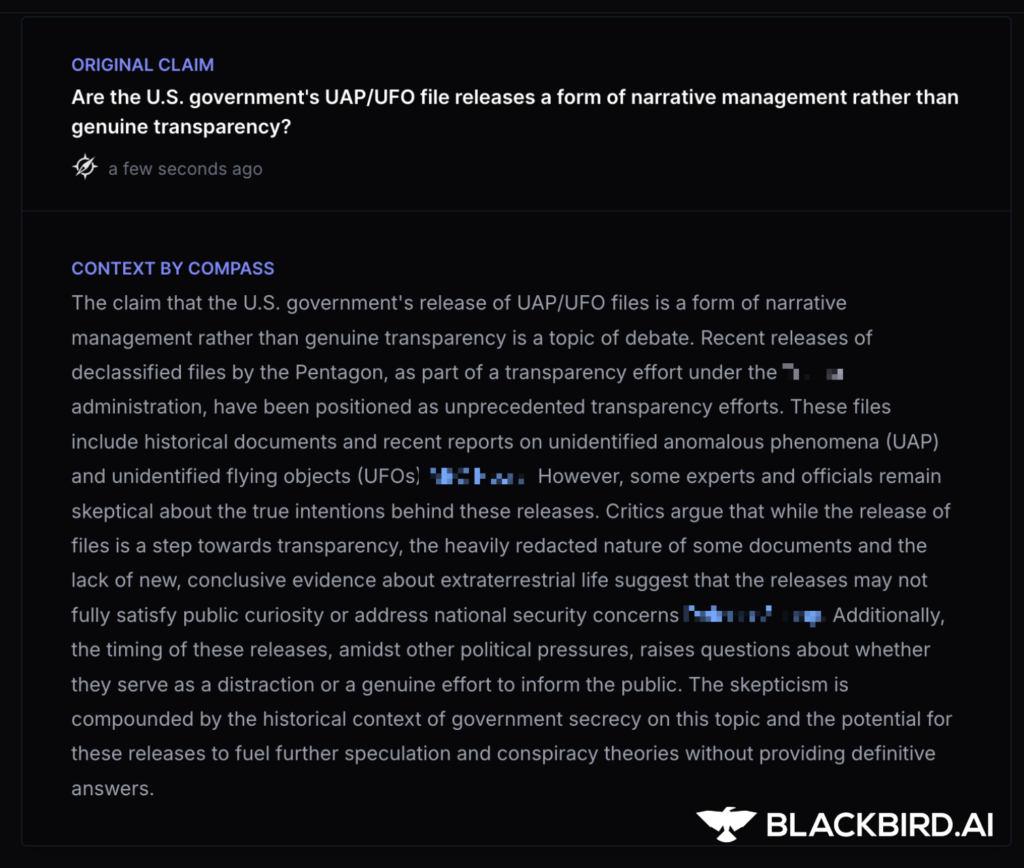
This claim was checked by Compass by Blackbird.AI.
The Department of Defense has released what it is calling a historic tranche of Unidentified Anomalous Phenomena files. The PURSUE program represents the government’s latest effort to provide public access to material that has been classified for decades. Hundreds of declassified files, videos, reports, and photographs have been made available through a government portal.
To some observers, this is exactly the transparency they have been requesting. To others, the timing and structure raise additional questions. Why now? Why these files? Why release information in structured batches? Those questions have fueled a growing narrative that the disclosures represent not transparency but narrative management.
It is worth noting that institutional information control is not a new tactic. In the 1980s, the KGB ran Operation Infektion, a coordinated campaign planting fabricated stories about HIV/AIDS as a U.S. bioweapon, complete with academic studies and films that journalists embraced as credible. Releasing information in structured, controlled batches has a long history as a tool of narrative management rather than transparency.
To be fair, there is almost no way to release decades of UFO-related documents that does not immediately generate new conspiracy theories. It is one of the few debates in which every possible answer somehow raises the same question.
From an information intelligence perspective, this dynamic is notable: the exact same government action is generating two completely opposite interpretations simultaneously. One audience sees accountability. Another sees narrative management. This is a predictable consequence of extended institutional secrecy. After decades of classification, releasing material through a public portal does not automatically restore confidence. Trust rebuilt through disclosure is a slow process.
The loudest narrative Blackbird.AI is tracking alongside the document release is the persistent question of what was reviewed and removed before the public accessed what remained. Whether justified or not, that question continues to drive discussion. Trust, once depleted, is difficult to rebuild through a single release cycle.
Narrative Three: Oversight, Surveillance, and Institutional Friction
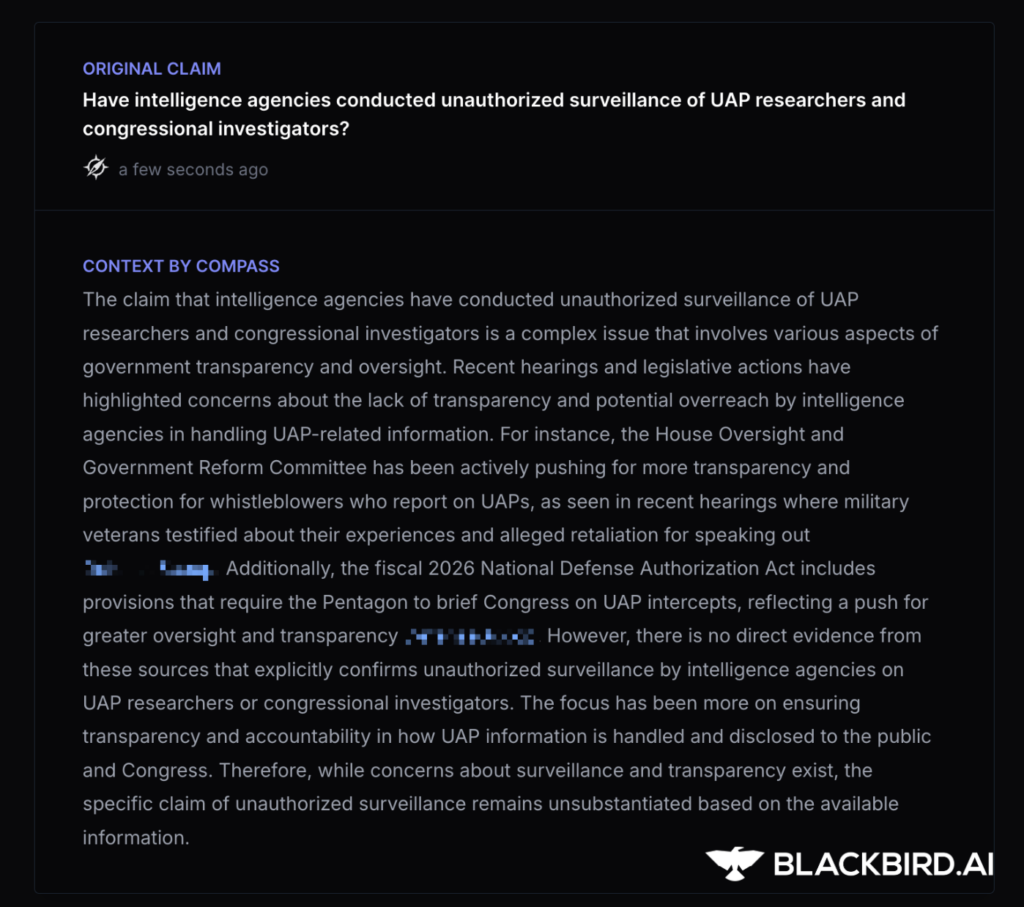
This claim was checked by Compass by Blackbird.AI.
Multiple researchers and witnesses involved in formal UAP investigations have alleged that intelligence agencies conducted unauthorized surveillance of investigators examining UAP activity. The oversight process is allegedly being monitored by the entity it is overseeing. Senators have sent letters. Committees have convened. Words like “illegal” and “obstruction” have entered the formal record.
This narrative gains traction from historical precedent, which is precisely what makes it resilient in the information environment. Evidence of institutional secrecy is interpreted as evidence of further secrecy. Absence of evidence becomes evidence of successful concealment. Counter-evidence is reframed as confirmation of a cover-up. At that point, the narrative becomes extremely difficult to challenge. It is the informational equivalent of arguing with someone who has already decided Mercury being in retrograde is responsible for their speeding ticket.
Narrative Four: The Distortion of Scientific Nuance and the Amplification Problem
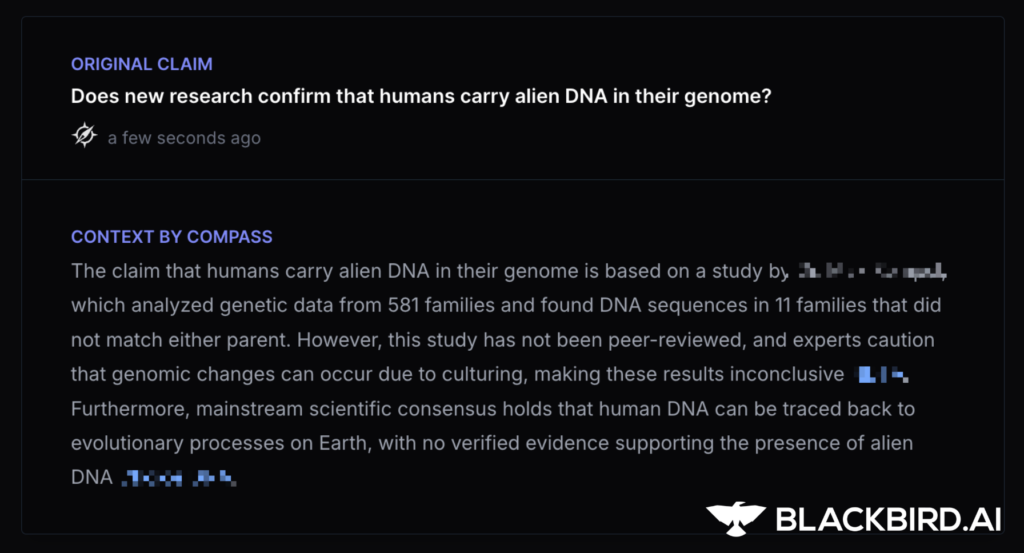
This claim was checked by Compass by Blackbird.AI.
A recent study examining so-called junk DNA and anomalous genetic sequences made careful, qualified claims as rigorous science does, using hedged language and explicitly acknowledging that further research is needed. The study did not conclude that humans have alien DNA. It raised questions about unexplained genetic material in the human genome.
The information environment transformed that nuance into certainty within days. The internet spends six minutes removing the disclaimer, and the floodgates open. A speculative and unverified study, The 1000 Genomes Project is amplified, and suddenly, a narrative is viral, and there is “new evidence of traces of alien genetic manipulation in humans”.
Blackbird.AI tracked the distortion in real time. Scientists routinely discover genetic mysteries and unknown biological mechanisms. That is not the same as confirming alien ancestry. But ambiguity creates opportunity in high-velocity information ecosystems. And suddenly, somebody’s uncle is posting that researchers have confirmed extraterrestrial bloodlines.
This pattern has deep roots. In 1938, Orson Welles broadcast a radio adaptation of H.G. Wells’ War of the Worlds as a series of fake news bulletins reporting an alien invasion of New Jersey. Listeners who tuned in late, missing the context, believed they were hearing a real news event. The result was documented panic and evacuation reports in several areas. The information environment then was radio; the mechanism was identical to what drives viral distortion today: content stripped of its framing and consumed without context. We wrote about how that broadcast became one of history’s most instructive narrative attacks.
More recently, in September 2023, journalist and ufologist Jaime Maussan presented two mummified figures with elongated skulls and three fingers to the Mexican Congress, claiming they were evidence of extraterrestrial life recovered near the Nazca lines in Peru. While the exhibition captured global interest, subsequent scientific analysis revealed the specimens were actually constructed from modified animal and human remains rather than being of extraterrestrial origin. Despite this discovery, the narrative had already firmly established itself within the public consciousness. The debunking received a fraction of the attention the original claim commanded. That case is documented in full here. It is a precise model for how fabricated physical “evidence” of alien life travels through the modern media ecosystem faster than any correction can follow.
The Real Story Has Never Been About Aliens (even if I want it to be)
The government has been releasing UAP-related files under formal congressional mandate. Some describe encounters that military and intelligence professionals themselves cannot fully explain. Whistleblowers have come forward under legal protection to make claims that have generated serious congressional attention. A commercial DNA company that millions of people trusted with their most intimate biological data went bankrupt, but the data exists somewhere. People are connecting those dots with the focused energy of audiences who have long concluded that relevant information has been withheld from them.
But these narratives are not fundamentally about extraterrestrials. They are about trust.
The real story is the growing gap between what people know, what they suspect, and what they believe is being withheld. The modern information environment often rewards and amplifies uncertainty.
Humans have always preferred answers, even questionable ones, to no answers at all. This explains why a post claiming that your 4% Scandinavian ancestry is proof of your extraterrestrial heritage will often outperform a carefully researched explanation based on genetic sequencing.
And sometimes it is a social media post explaining why your DNA results are definitely proof you are related to E.T., which, to be fair, is still more exciting and believable than being related to that guy Bobby in South Dakota.
Key Takeaways for Organization Leaders (alien and non-alien):
Understand that these narratives are proxies for institutional distrust, not just fringe content. When your organization operates in the data, business, defense, health, or government-adjacent sectors, you are on the very terrain where these narratives take root. Monitoring and understanding the information environment to protect your brand and executives is not optional.
The debunking cycle is structurally disadvantaged. Corrections consistently receive a fraction of the attention that original viral claims command. Organizations need proactive narrative intelligence detection and response, not reactive fact-checking, to stay ahead of claims that can damage trust before a response is even formulated.
Trust is rebuilt slowly and destroyed quickly. The document releases, the data breaches, and the whistleblower allegations are all amplifying a baseline of institutional skepticism that has been accumulating for years. Organizations that invest in transparent communication, data stewardship, and narrative monitoring are better positioned to survive the next information storm than those who react after the fact.
The information environment rewards velocity, certainty, and emotional resonance. Organizations that understand this dynamic can build resilience into their communications, cybersecurity posture, and stakeholder relationships before the next narrative cycle begins. Because it will.

Kandace Miller • VP Demand Gen
Currently, Kandace serves as Vice President of Demand Generation at Blackbird.AI, leading all revenue marketing strategy. Her work positions the company as a leading authority in addressing narrative attacks and strengthening information integrity across vital industries. Outside of work, Kandace is a self-taught pianist and composer. She has contributed to an array of studio work for various mainstream artists, composed film scores for documentaries, and performed at venues ranging from the Cannes Film Festival to the United Nations. Kandace holds a B.A. in Communications and Psychology from Hofstra University.
Currently, Kandace serves as Vice President of Demand Generation at Blackbird.AI, leading all revenue marketing strategy. Her work positions the company as a leading authority in addressing narrative attacks and strengthening information integrity across vital industries. Outside of work, Kandace is a self-taught pianist and composer. She has contributed to an array of studio work for various mainstream artists, composed film scores for documentaries, and performed at venues ranging from the Cannes Film Festival to the United Nations. Kandace holds a B.A. in Communications and Psychology from Hofstra University.

RAV3N Research •
The Blackbird.AI RAV3N Research Team is a cross-disciplinary unit of narrative intelligence analysts that publishes data-driven, evidence-based research on how narrative attacks created by misinformation and disinformation cause financial and reputational harm to public and private sector organizations, including global brands, Fortune 500 companies, government agencies, and executives. Using Blackbird.AI's Constellation Narrative Intelligence Platform, our analysts identify the influence behind narratives, the networks they touch, the anomalous bot behavior that scales them, and the cohorts and communities that connect them to surface the full picture of how narratives form and spread.
The Blackbird.AI RAV3N Research Team is a cross-disciplinary unit of narrative intelligence analysts that publishes data-driven, evidence-based research on how narrative attacks created by misinformation and disinformation cause financial and reputational harm to public and private sector organizations, including global brands, Fortune 500 companies, government agencies, and executives. Using Blackbird.AI's Constellation Narrative Intelligence Platform, our analysts identify the influence behind narratives, the networks they touch, the anomalous bot behavior that scales them, and the cohorts and communities that connect them to surface the full picture of how narratives form and spread.
About Blackbird.AI

Blackbird.AI is the Narrative Intelligence Detection and Response company protecting executives, organizations, and institutions from narrative-based disinformation attacks that cause financial, operational, reputational, and physical harm. Blackbird.AI’s Constellation Platform identifies the actors, networks, bots, and communities driving them; and turns those signals into early warning, decision intelligence, and coordinated response. Blackbird.AI brings Narrative Intelligence into the workflows where teams already operate, including cybersecurity, communications, legal, executive, and public-sector environments, with agentic response capabilities and MCP-enabled integrations that help organizations act faster. Founded by AI experts, threat intelligence analysts, and national security professionals, Blackbird.AI helps customers defend trust, strengthen resilience, and Own The Narrative. To learn more, visit Blackbird.AI.