
AI Bot Swarms Are Already Here. We Monitor Bot-Driven Narrative Attacks Daily.
 Jean-Christophe Hamoir
A new Science study warns of AI-driven influence operations. Blackbird.AI data show they have been operational for years, with bot ratios exceeding 35% in coordinated campaigns targeting institutions, organizations, and public discourse.

Dall-E 3
Quick Answers
- Are AI bot swarms a current threat or a future one? They are operational today. A recent Science study and a Wired investigation framed AI-driven influence operations as an emerging risk that may be tested ahead of the 2028 election cycle, but Blackbird.AI observes these systems daily across client environments, with bot ratios exceeding 35% in coordinated campaigns targeting institutions and public discourse.
- What makes modern AI swarms different from traditional botnets? The Science study identifies five advances: decentralized coordination across thousands of personas, network infiltration that maps social structures, human-level mimicry through photorealistic avatars and varied posting rhythms, self-optimization that runs millions of micro-tests for the most persuasive variants, and persistent 24/7 presence. Old bots copied and pasted messages, which made them easy to detect.
- What did the Blackbird.AI UK investigation find? Constellation analyzed 200,000 posts that generated 132 million engagements, with an overall bot ratio of 20%. Specific divisive narratives reached far higher synthetic amplification, with the claim that the UK is now a dangerous place at 35% and the narrative about safety for Jewish residents at 39%, which represents manufactured consensus rather than genuine public sentiment.
- What kind of detection do organizations need? They need behavioral pattern-based detection that analyzes metadata, posting rhythms, and network structures rather than content matching alone. This approach stays effective against AI-generated unique content because synthetic amplification networks leave behavioral signatures regardless of the words they use.
A recent Wired investigation warned that AI-powered disinformation swarms pose a threat to democratic institutions. Researchers cited in the article predict these systems “may be tested” ahead of the 2028 election cycle. A peer-reviewed study in Science proposed building an “AI Influence Observatory” to monitor these emerging threats.
The data tells us that these systems are operational today. At Blackbird.AI, we observe them daily across client environments. Our investigation into harmful narratives targeting London found bot ratios exceeding 35%, with millions of interactions artificially amplified by hyper-agenda-driven accounts. The threat is not hypothetical. It is measurable. It is damaging institutions, organizations, and public discourse right now.
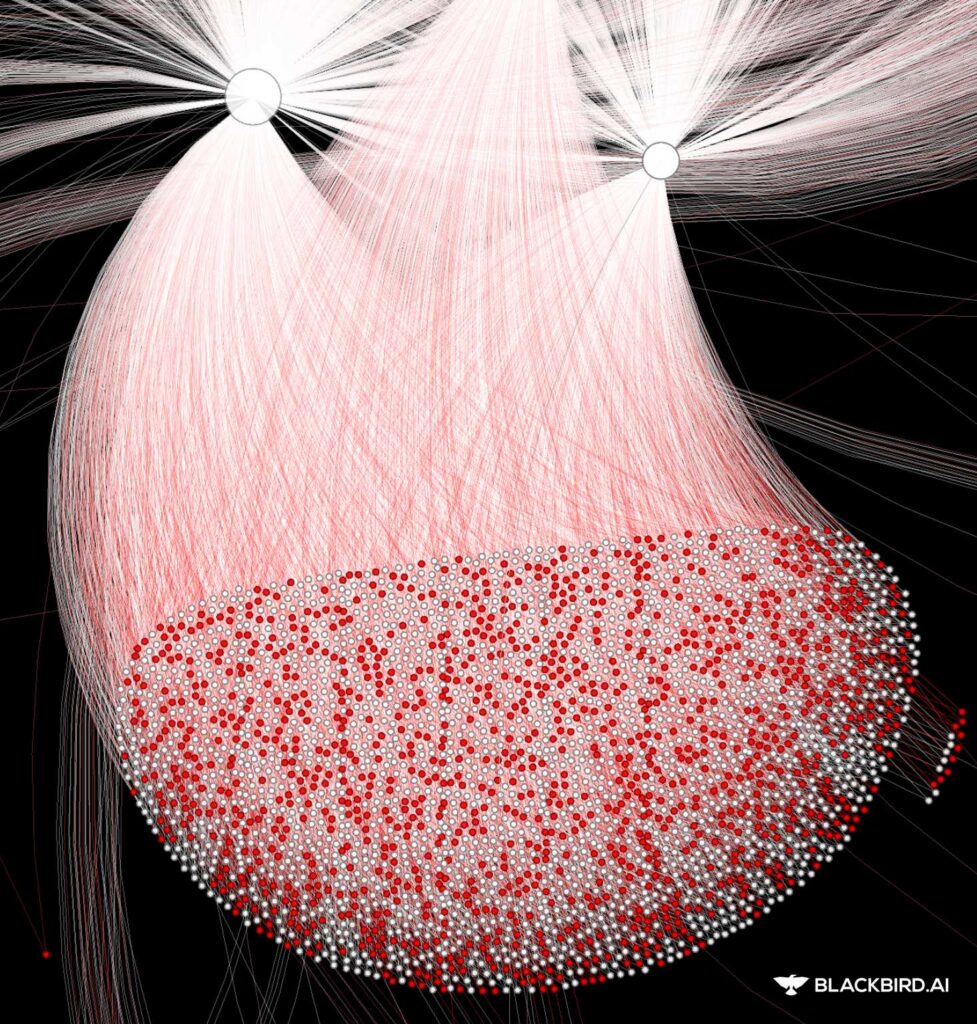
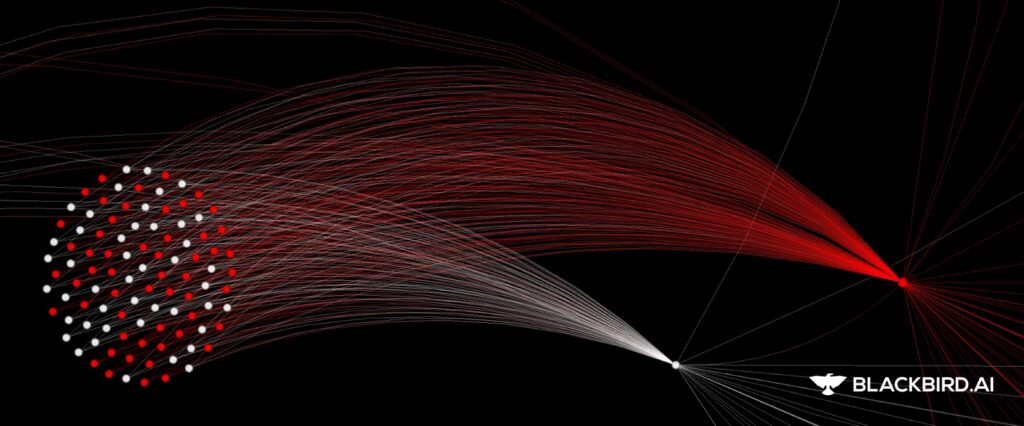
This network graph from Blackbird.AI’s Constellation Narrative Intelligence Platform shows a close-up view of the connections between an influencer (white left node), their post (white right node), and their audience (the dots at the bottom). Red dots have been automatically flagged as “bot-like”, based on behavior and metadata. The high proportion of red dots indicates that this organic influencer and their content are being artificially amplified by automated accounts.
Organizations that wait for coordinated international responses, regulatory frameworks, or platform cooperation will wait years while synthetic amplification campaigns compound daily. The structural advantage lies with threat actors, cybercriminals, and nation-states: generating synthetic content is cheap, fast, and scalable. Detection and response require sustained investment, specialized expertise, and tools purpose-built for this environment.
READ: The RAV3N Report: 2026 State of Disinformation Narrative Intelligence
The New Threat Landscape
The Science study identifies five critical advances that distinguish modern AI swarms from traditional botnets. Old bots copied and pasted messages, making them easy to detect with limited impact. The 2016 Internet Research Agency operation, despite significant resources, had minimal measurable effect on outcomes. New AI swarms operate differently. They generate unique content. They coordinate in real time. They adapt based on feedback. They mimic human behavior patterns with precision.
The five advances include decentralized coordination, in which thousands of AI personas operate with local adaptation and periodic synchronization. Network infiltration enables these systems to map social structures at scale and target vulnerable communities with tailored appeals. Human-level mimicry produces photorealistic avatars, context-appropriate slang, and heterogeneous posting rhythms that evade detection. Self-optimization runs millions of micro-tests at machine speed to find the most persuasive variants. Persistent presence enables 24/7 operation over long timescales, gradually shifting discourse and cultural norms.
These capabilities enable new attack vectors. Synthetic consensus creates the illusion of majority agreement by seeding narratives across disparate communities, making fringe views appear mainstream. This is astroturfing at scale. Coordinated harassment campaigns target journalists, politicians, and whistleblowers with abuse that appears spontaneous but is actually orchestrated. LLM grooming floods the web with fabricated content that poisons training data for future AI models.
This close-up view of the network graph shows the connections between an influencer (red, right node), their post (white, right node), and their audience (all the dots on the left). Red dots have been automatically flagged as “bot-like”, based on behavior and metadata. The high proportion of red dots indicates that this bot-like influencer and their content are being artificially amplified by automated accounts.
What the Data Shows
For months, we have seen a lot of discussion about the alleged link between the UK’s high crime rate and immigration. The conversation grew so large on mainstream social media platforms that we decided to investigate whether this conversation’s most negative narratives were artificially amplified. The data patterns we observed from the UK are broadly representative of larger social network activity.
Blackbird.AI’s Constellation Narrative Intelligence platform analyzed harmful narratives targeting the UK in a recent investigation. The results quantify what researchers theorize. Across all tracked narratives, the platform identified 200,000 posts generating 132 million engagements. The overall bot ratio was 20%. Specific narratives showed far higher synthetic amplification.
Blackbird.AI UK Narrative Investigation: Bot Activity Analysis
| Narratives | Posts | Engagement | Bot Ratio | Anomalous |
| ALL NARRATIVES | 200K | 132M | 20% | 2% |
| Immigrants are scaring UK residents | 752 | 5.5M | 35% | 1% |
| The UK is now a dangerous place | 1,465 | 3M | 35% | 1% |
Blackbird.AI Constellation Narrative Intelligence Platform. Bot ratio indicates the percentage of accounts showing behavioral signatures consistent with automation or coordinated inauthentic behavior.
These numbers matter. A 35% ratio means more than one in three accounts amplifying divisive content showed behavioral signatures consistent with automation or coordinated inauthentic behavior. The narrative claiming the UK is unsafe for Jewish residents reached a 39% bot ratio. These accounts do not represent genuine public sentiment. They represent manufactured consensus designed to inflame division and shape perception.
Network analysis reveals coordination patterns invisible to casual observation. Single posts from hyper agenda-driven influencers attract clusters of bot-like engagement. Some of these influencers are themselves flagged as bot-like based on metadata analysis. Others appear human but benefit from synthetic amplification networks. The distinction between organic virality and manufactured reach is invisible without specialized detection tools.
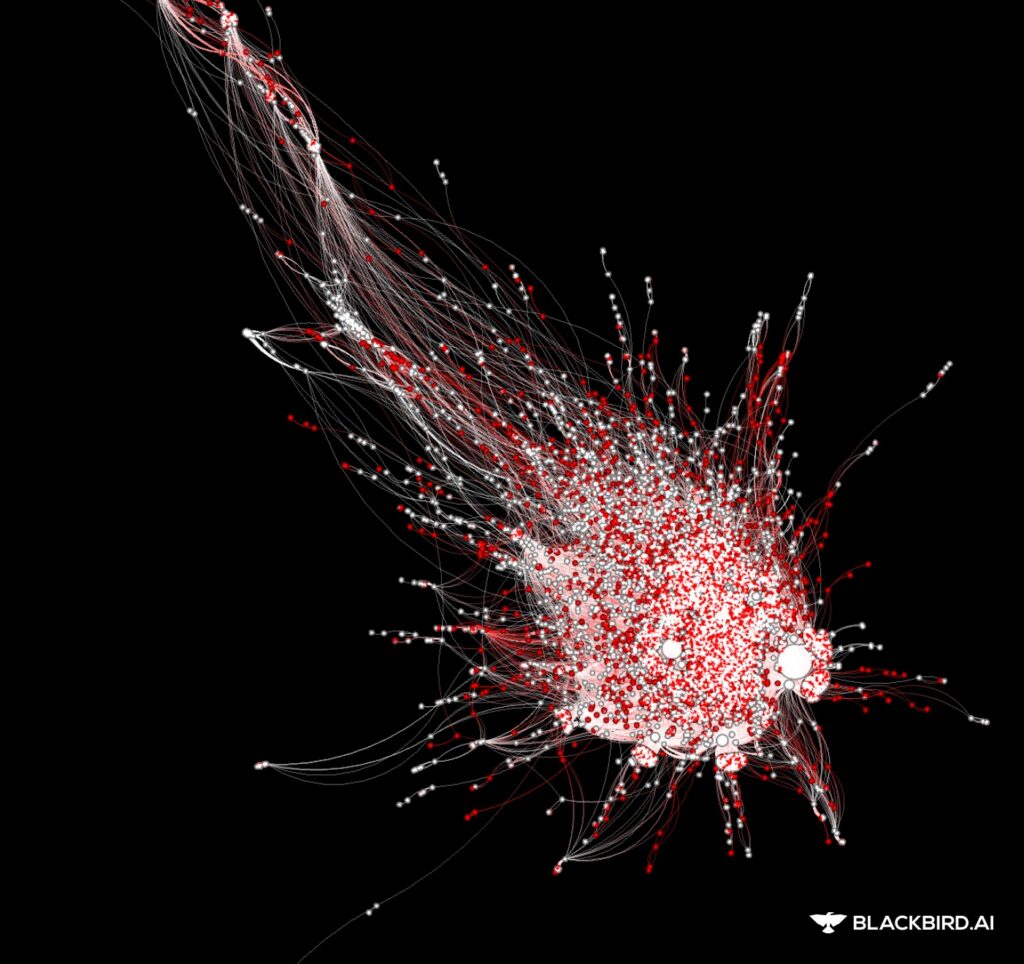
This network graph from Blackbird.AI’s Constellation Narrative Intelligence Platform illustrates the connections among users who blame alleged high crime rates in the United Kingdom and in London on high immigration. Users suspected of being bots, based on their behavior and metadata, are shown in red, while all others are shown in white. Every cluster is being infiltrated and amplified by bot-like users (35% on average).
The Detection Challenge
The Wired article quotes researcher Arin Kunst, who acknowledges the core problem: “Because of their elusive features to mimic humans, it’s very hard to actually detect them and to assess to what extent they are present.” Kunst predicts AI swarms will likely be deployed to disrupt the 2028 presidential election, suggesting the 2026 midterms may escape significant impact.
This assessment underestimates current deployment. These systems are already operational. They are likely not fully scaled because platforms can still detect some of them. As detection capabilities improve, so do evasion techniques. The arms race is already underway.
The Science study proposes an “AI Influence Observatory” as a solution. The concept has merit. This distributed ecosystem would connect independent stakeholders to standardize evidence collection, publish verified incident reports, and detect coordination patterns. Independent, evidence-based detection focused on behavior rather than speech avoids the political minefields of content moderation.
However, such an observatory would take years to build, fund, and insulate from political pressure. It would also never be fully realised, as technology advances and adversaries adapt. Organizations facing these narrative threats today need operational tools now, in addition to long-term proposals.
This network graph from Blackbird.AI’s Constellation Narrative Intelligence Platform reveals how automated amplification works at the individual level. The white node on the left represents an influencer, while the white node on the right represents their post. The dots at the bottom indicate the audience’s engagement with that content. Dots flagged in red have been identified as bot-like based on behavioral patterns and metadata analysis. The overwhelming proportion of red in this view tells a clear story: this influencer’s content is being artificially boosted by a coordinated network of automated accounts.
What Organizations Need
Defending against disinformation and narrative attacks is complicated. The problem is structural, distributed, and constantly evolving. But organizations can achieve situational awareness and significantly reduce risk. They need to know which narratives are targeting them, how those narratives spread, and who is amplifying them. They need the ability to distinguish between genuine public sentiment and manufactured consensus. They need early warning before a narrative reaches critical mass.
Blackbird.AI’s Narrative Intelligence platform provides behavioral pattern-based detection. This means analyzing metadata, posting rhythms, and network structures rather than content matching alone. This approach remains effective even against AI-generated unique content because synthetic amplification networks leave behavioral signatures regardless of what words they use. The platform is operational across Global 2000 companies, defense ministries, and national security partners.
The Way Forward – Key Takeaways For Organization Leaders
Treat AI-enabled influence operations as a new threat vector that has reached a tipping point, not future risks. The data shows that these systems are operational today and have a measurable impact. Organizations waiting for theoretical threats to materialize are already behind.
READ: The RAV3N Report: 2026 State of Disinformation Narrative Intelligence
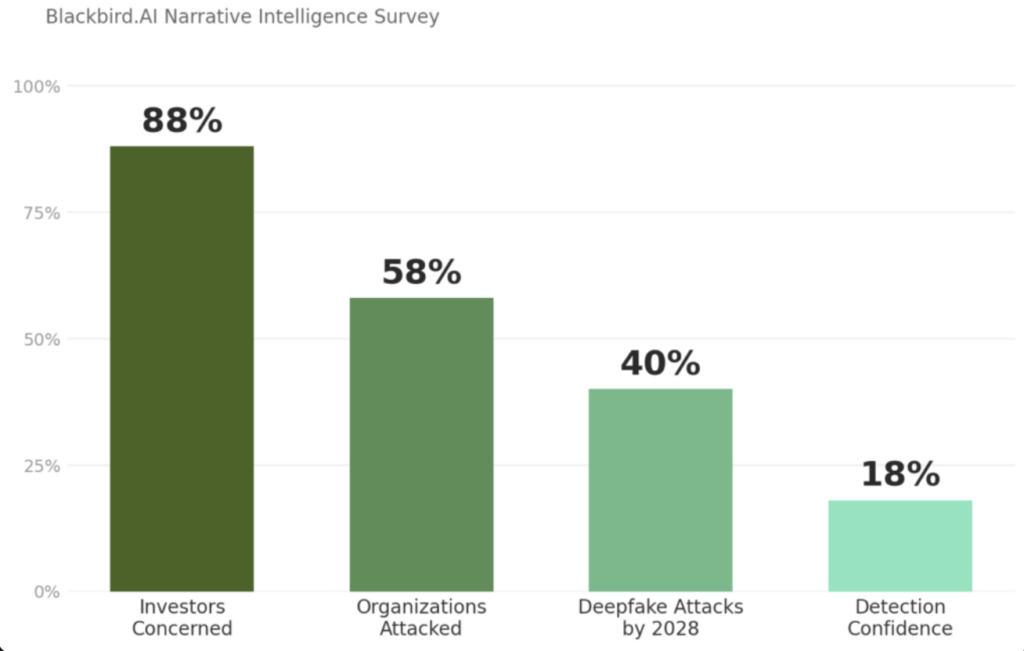
The 2026 State of Disinformation Narrative Intelligence Survey, conducted by Blackbird.AI among global security and business leaders, reveals critical findings: 58% of organizations have encountered narrative attacks, 69% are more concerned than they were last year, and only 18% feel very confident in their detection capabilities. These findings underscore the urgent need for narrative intelligence on par with other mission-critical security and communication investments.
- Invest in behavioral detection capabilities through an AI-based narrative Intelligence Platform. Content-based detection cannot keep pace with AI-generated unique content. Detection based on metadata, posting rhythms, and network structures identifies coordination patterns regardless of what words are used.
- Build institutional resilience through situational awareness. Understanding which narratives target your organization, how they spread, and whether amplification is organic or synthetic enables informed response rather than reactive crisis management.
- The information environment is only becoming more hostile. AI capabilities will continue advancing. The cost of synthetic content generation will continue falling. Organizations that build narrative intelligence capabilities today position themselves to navigate the contested information landscape of tomorrow. Organizations that wait for international observatories, platform cooperation, or regulatory solutions will find themselves operating blind in an increasingly synthetic terrain.
Jean-Christophe Hamoir •
Jean-Christophe Hamoir is an Intelligence Analyst, specializing in European politics, national security, and foreign malign interference. He combines OSINT tradecraft with a background spanning national security, defense industry, consulting, and officer training with the French Navy.
Jean-Christophe Hamoir is an Intelligence Analyst, specializing in European politics, national security, and foreign malign interference. He combines OSINT tradecraft with a background spanning national security, defense industry, consulting, and officer training with the French Navy.
About Blackbird.AI

Blackbird.AI is the Narrative Intelligence Detection and Response company protecting executives, organizations, and institutions from narrative-based disinformation attacks that cause financial, operational, reputational, and physical harm. Blackbird.AI’s Constellation Platform identifies the actors, networks, bots, and communities driving them; and turns those signals into early warning, decision intelligence, and coordinated response. Blackbird.AI brings Narrative Intelligence into the workflows where teams already operate, including cybersecurity, communications, legal, executive, and public-sector environments, with agentic response capabilities and MCP-enabled integrations that help organizations act faster. Founded by AI experts, threat intelligence analysts, and national security professionals, Blackbird.AI helps customers defend trust, strengthen resilience, and Own The Narrative. To learn more, visit Blackbird.AI.