


Ahead of Armenian Election, Russia Flooded Social Media with Manipulated Narratives
Blackbird.AI identified four key narratives targeting Armenia’s parliamentary vote. These narrative attacks demonstrated signs of inauthentic amplification and alignment with Russian state interests designed to influence the outcome of Armenian Elections.

Dall-E 3
Quick Answers
- What narratives are targeting Armenia’s 2026 election? Blackbird.AI’s Constellation Narrative Intelligence platform detected four narratives attacking Prime Minister Nikol Pashinyan and his government ahead of the June 7 parliamentary vote. The narratives question Pashinyan’s alleged repression of the opposition, his stance toward Azerbaijan, and his handling of public funds.
- Who is amplifying the narratives? All narratives selected for analysis carry signs of coordinated inauthentic activity and messaging that aligns with Russian state interests. The pattern points to attempts at external influence on Armenia’s democratic process.
- Why does Armenia’s election matter for narrative risk? The June 7 vote sits at the center of disputes over sovereignty, the Nagorno-Karabakh question, and Armenia’s pivot away from Russia. These tensions make the election a target for narrative manipulation.
- How can organizations track narrative threats like these? Blackbird.AI’s Constellation narrative intelligence detection and response platform scores narratives by risk and surfaces signs of manipulation as they emerge. Leaders use the analysis to anticipate reputational and geopolitical exposure.
READ: The RAV3N Report: 2026 State of Disinformation Narrative Intelligence
Ahead of Armenia’s parliamentary elections in early June, Russian state-aligned actors and covert accounts on social media have initiated coordinated influence efforts targeting Armenian officials and candidates, as well as calling into question the country’s gradual reorientation toward the EU and away from its traditional reliance on Russia.
A cluster of manipulated narratives painted Armenian Prime Minister Nikol Pashinyan unfavorably: allegations that he is skimming EAEU funds to pay for his campaign, repressing political opponents, supporting Azerbaijani President Ilham Aliyev’s political positions, and potentially surrendering Nagorno-Karabakh, and that more broadly the West seeks to institute another so-called “Color Revolution” in Armenia. Each narrative reframes a contested policy choice or an unproven allegation as proof that Pashinyan has betrayed the country, and several gain traction from accounts that are frequently and consistently aligned with Russian state interests. A Blackbird.AI RAV3N analysis surfaced the campaign using the Constellation Narrative Intelligence platform, which clusters social posts into narratives, scores each for risk, and checks the central claim against outside reporting. Four narratives demonstrated notable risk signals indicative of a coordinated campaign.
The Narratives
The Blackbird.AI RAV3N Intelligence Team identified four narrative attacks surrounding the upcoming Armenian elections that displayed one or more of the following characteristics: significant activity, such as narrative seeding or coordinated amplification, from Russia-aligned and/or covert accounts, moderate-to-high levels of bot-like user amplification, coordinated posting behavior, or circulation of questionable media (unverifiable images or videos) to support claims. The narratives are ordered from highest to lowest post volume.
Narrative Attack #1: Armenia’s Prime Minister, Nikol Pashinyan, illegally diverted EAEU funds to pay for his campaign while cutting people’s social benefits.
Allegations circulated that Armenian Prime Minister Nikol Pashinyan illegally diverted $11 million from the Eurasian Economic Union (EAEU) digitalization budget and funneled it into his election campaign. Users distributed a realistic-looking video, styled as a news investigation, alleging that Pashinyan was financing his campaign with stolen funds. Dozens of accounts circulated the video, which, although in the style of a media investigation, did not directly link itself to or cite any specific outlet or publication. BlackbirdAI’s Compass Context Checker found that there is no verified evidence supporting the stolen EAEU funds claim.
Bot-like amplification of this narrative was high at more than 35% of all authors. Additionally, Russia-aligned accounts constituted almost 39% of all posting activity. These users were also among the first to circulate the narrative, which emerged on 15 May but did not peak in engagement until 18 May. Low-engagement Russia-aligned users seeded the narrative early on 15 May. They continued to circulate it through 17 May, before a major, influential aligned account successfully garnered interest from outside audiences with a post featuring the video on 18 May. This individual’s post met with 2.6 million views.
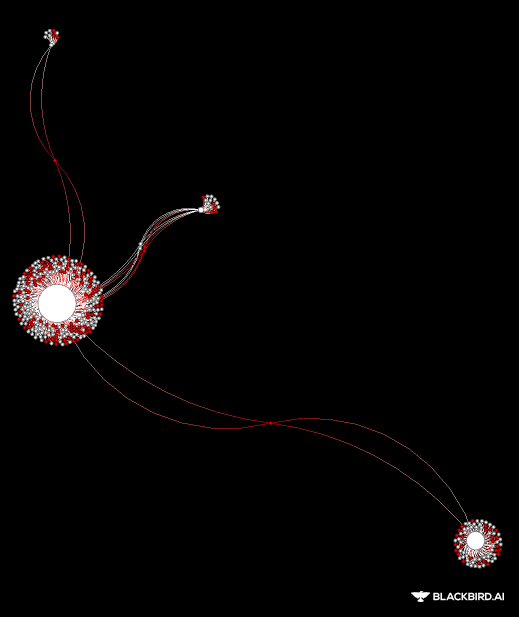
The network graph above shows users as nodes, connected by lines representing interactions (such as likes, comments, shares) with other users. Red nodes represent users identified as bots by Blackbird.AI’s Constellation platform.
In the network graph, a concentration of bot-like users was identified, primarily amplifying the two largest influencers. The largest node, which was also the most frequently amplified by bots, represents the Russia-aligned user who drew the most engagement for the narrative on 18 May. The moderate-sized node represents one of the two earliest circulators of the narrative on 15 May; this user is also labeled as a Russian covert account – that is, a user identified in broader third-party investigations as being associated with known Russian digital influence campaign networks, such as Storm-1516 or Doppelganger.
Narrative attack #2: Pashinyan is using political repression against opponents ahead of elections, undermining democracy.
Within this narrative, users alleged that Armenian Prime Minister Nikol Pashinyan has been attacking and suppressing the voices of political opposition in the lead-up to parliamentary elections. Specific allegations included that Pashinyan was preventing opponent Samvel Karapetyan from campaigning, restricting media, and suppressing free speech, among broad and generalized accusations of repression targeting political opponents.
The Blackbird.AI team identified a significant proportion of Russia-aligned users circulating content, with this contingent responsible for more than 21% of all posts. The team also identified bot amplification of content, with 27% of users identified as bots. Bot users primarily amplified posts from Russia-aligned users – more than 35% of whom were identified as bot-like accounts.
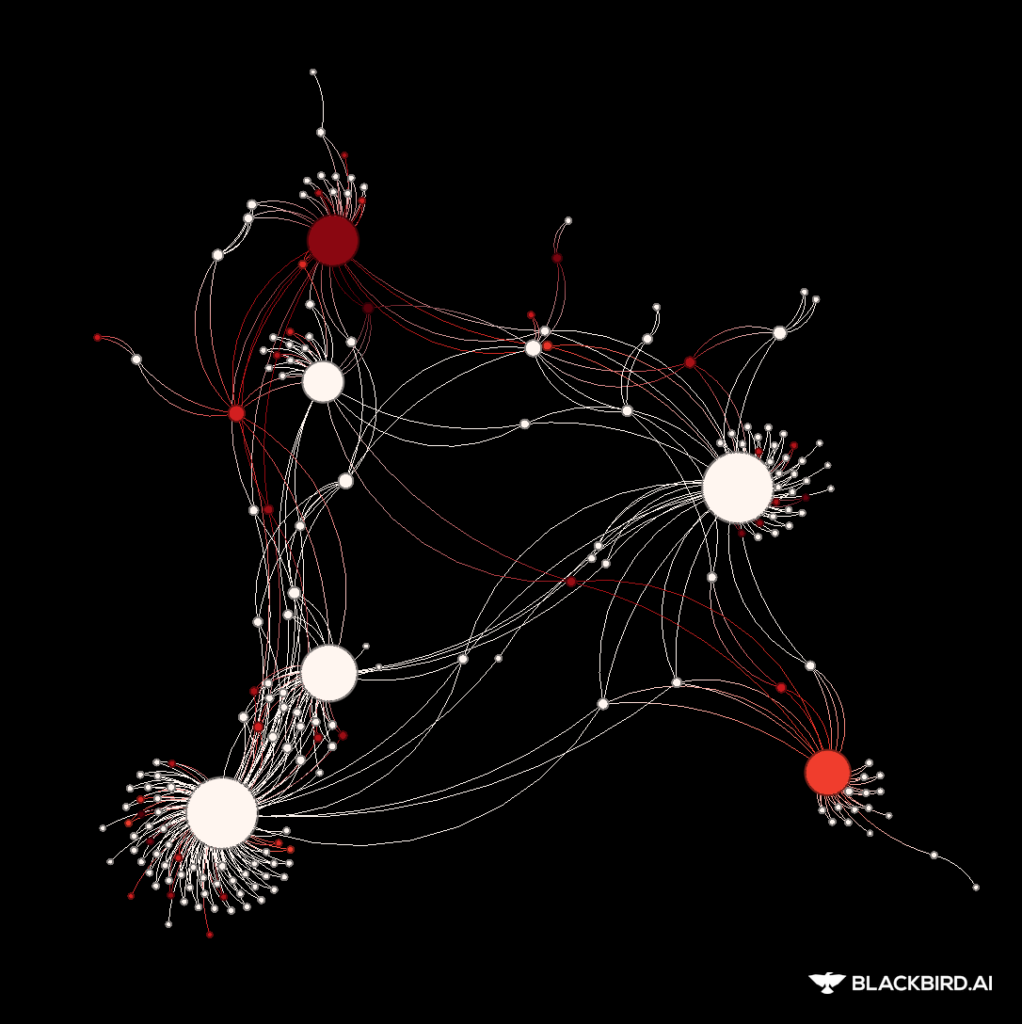
The network graph above shows users as nodes, connected by lines representing interactions (such as likes, comments, shares) with other users. Red nodes represent users identified as members of Blackbird’s Russia-aligned cohort.
Russia-aligned users in the network were among the most influential nodes, as well as small-to-moderately influential narrative circulators on the periphery of the network.
Narrative attack #3: Pashinyan’s government is increasingly echoing Azerbaijani President Ilham Aliyev’s rhetoric, raising concerns ahead of Armenia’s pivotal election.
Users alleged that Pashinyan and his government were increasingly echoing the rhetoric of Azerbaijani President Ilham Aliyev, particularly regarding purported concessions to Azerbaijan over the disputed region of Nagorno-Karabakh and the alleged adoption of repressive tactics and posturing toward the opposition.
Of all narratives analyzed, the Pashinyan-Aliyev narrative scored the highest for anomalous activity, indicating coordinated messaging patterns across posts. Approximately 24% of all accounts in the narrative were bot–like users, suggesting a moderate level of inauthentic amplification.
Narrative attack #4: The West is attempting another color revolution in Armenia and is interfering in the country’s elections.
A narrative attack claimed that Western powers were attempting a new color revolution in Armenia and interfering with the election process. The Blackbird team identified a high level of anomalous activity – a risk signal identifying coordination patterns in the circulation of content – that clustered around Russia-aligned and bot-like users.
Russia-aligned users were among the earliest circulators of this narrative, effectively seeding it within the information environment. Additionally, while bot-like activity for the narrative overall accounted for approximately 26% of users, 50% of Russia-aligned accounts were flagged as bot-like, indicating efforts to amplify these users’ content inauthentically.
The Way Forward: Key Takeaways For Organization Leaders
- Map the narrative terrain before a high-stakes event. Election cycles, mergers, and product launches all draw coordinated narratives, and early detection provides time to respond with confidence.
- Separate the factual hook from the manipulation. Most of these narratives are tied to a real policy or event, which makes risk scoring and source verification essential for a credible response.
- Watch for inauthentic amplification and external alignment. Signs of coordinated activity and state-aligned messaging signal a campaign rather than an organic debate, and they change the response a leader needs to provide.
The Armenia case shows how a single election can attract a coordinated set of narratives that mix verified information, partisan framing, and outright fabrication. Leaders who track these signals gain the context to protect their organizations, their reputations, and the publics they serve.

Jessica Terry • Director of Intelligence
Jessica Terry is the Director of Intelligence at Blackbird.AI, specializing in Russian geopolitical expertise, foreign malign influence, and risk monitoring and mitigation.
Jessica Terry is the Director of Intelligence at Blackbird.AI, specializing in Russian geopolitical expertise, foreign malign influence, and risk monitoring and mitigation.
About Blackbird.AI

Blackbird.AI is the Narrative Intelligence Detection and Response company protecting executives, organizations, and institutions from narrative-based disinformation attacks that cause financial, operational, reputational, and physical harm. Blackbird.AI’s Constellation Platform identifies the actors, networks, bots, and communities driving them; and turns those signals into early warning, decision intelligence, and coordinated response. Blackbird.AI brings Narrative Intelligence into the workflows where teams already operate, including cybersecurity, communications, legal, executive, and public-sector environments, with agentic response capabilities and MCP-enabled integrations that help organizations act faster. Founded by AI experts, threat intelligence analysts, and national security professionals, Blackbird.AI helps customers defend trust, strengthen resilience, and Own The Narrative. To learn more, visit Blackbird.AI.