



Data Center Opposition Is Local, But Foreign Nation-State Networks Are Turning Up the Volume
A new Blackbird.AI report finds that resistance to the U.S. data center buildout begins in local communities, while foreign nation-state-aligned networks add automation, bots, and scale, creating polarization.

Quick Answers
Why is public opposition a significant risk for data center developers? Concerns about electricity, water, construction, and public costs can delay permitting and threaten investments. Political actors and coordinated networks can use influencers, bots, and agentic AI to amplify local disputes and increase pressure on developers.
Are foreign nation-state actors creating opposition to U.S. data centers? Blackbird.AI’s RAV3N Research Team found that opposition was overwhelmingly domestic and organic. Foreign state-aligned networks primarily amplified existing narratives rather than creating new ones.
What should organizations connected to data center projects monitor? Developers, utilities, suppliers, infrastructure providers, executives, elected officials, and community organizations face interconnected risks. They need to identify which claims are spreading, who is promoting them, and whether disputes involving one organization are affecting others.
How can Narrative Intelligence help organizations manage data center risk? Narrative Intelligence examines the claims, actors, networks, and amplification patterns influencing public perception. It helps organizations detect emerging risks and respond with credible information before online disputes contribute to permitting delays, political pressure, reputational damage, or operational disruption.
DOWNLOAD: 2026 Data Center Narrative Intelligence Report
Data Centers Have a Perception Problem
The rapid expansion of artificial intelligence infrastructure is bringing data center developers into increasingly contentious local debates involving residents, elected officials, utilities, and zoning boards.
Public opposition is becoming a significant financial risk. Data Center Watch, which monitors U.S. data center development, estimates that opposition blocked or delayed $64 billion in projects between 2024 and 2025. In 2026, that figure is projected to exceed $130 billion across more than 75 projects. Opposition extends across the political spectrum.
Even well-financed projects with secured land, customers, and engineering resources can face delays when community concerns turn into organized resistance.
Water consumption, electricity demand, utility rates, tax incentives, and construction impacts are common points of contention. Local social media groups can spread claims about these issues before a public hearing takes place. National environmental and political organizations can provide research, legal templates, utility models, and organizing strategies that help local groups challenge proposed developments.
Developers bring their own evidence. They use economic impact studies, employment projections, and grid sustainability reports to demonstrate a project’s benefits. Residents and advocacy groups may challenge those projections with competing calculations.
Local officials must evaluate these claims alongside each proposal’s technical and financial merits, often without the resources to verify them independently. News coverage can further complicate decisions when it reports disputed statistics or unverified claims without sufficient context.
The result is an information environment where legitimate concerns, conflicting evidence, political advocacy, and coordinated manipulation become hard to distinguish.
The November 2026 midterm elections illustrated how opposition to data centers can influence public policy. According to Ballotpedia, voters favored restrictions or rejected pro-development proposals in 40 of 41 local ballot contests across ten states. In Texas, Governor-elect Gina Hinojosa pledged new protections for communities affected by data center development. CBS News exit polls found broad opposition to new facilities among Democratic and Republican voters. Concerns about electricity costs, water consumption, and local control are now shaping elections and adding regulatory and financial uncertainty for developers.
For developers and other stakeholders, the challenge is identifying which claims are accurate, which are misleading, and which are being amplified to influence public opinion and official decisions.
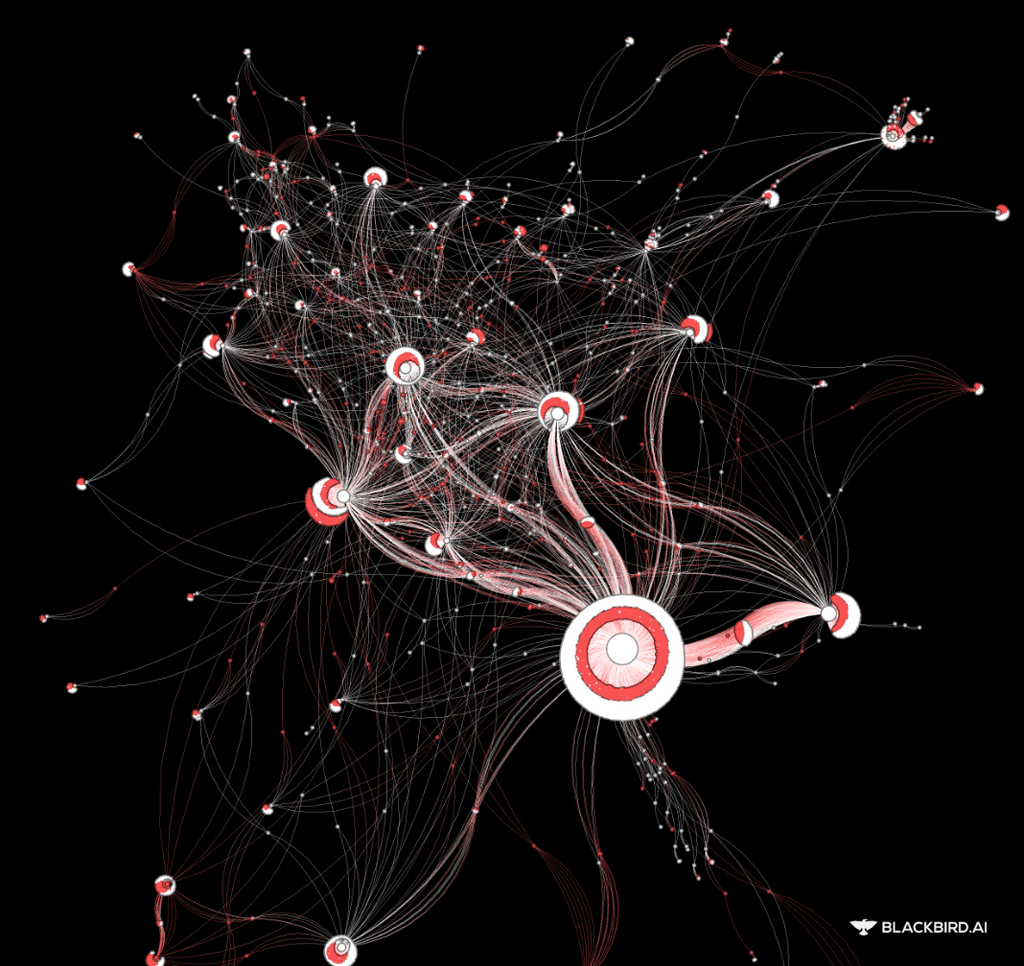
This is a Blackbird.AI Constellation Narrative Intelligence platform network graph of narratives surrounding a single data center. Bot-like behavior appeared in 28.4 percent of accounts, with coordinated chains operating primarily at the network’s edges. These accounts amplified existing narratives rather than initiating them, suggesting genuine public interest alongside coordinated inauthentic activity.
Opposition Is Local, But the Networks Aren’t
The Blackbird.AI 2026 Data Center Narrative Intelligence Report examines how narratives surrounding U.S. data center development originated, spread, converged, and escalated.
The report draws on five RAV3N Research investigations: a quarterly assessment of local opposition, a twelve-month study of foreign state-aligned activity, an analysis of a chipmaker’s expansion into data centers, an examination of consumer memory prices, and research into debates about AI and employment.
RAV3N analysts examined eight narratives containing more than 770,000 posts associated with five major American technology companies over twelve months. Additional research covered a water-related narrative generating about 1.5 million engagements, an energy narrative attracting about 1.6 million engagements, and a corporate assessment in which monthly mentions rose from 1.6 million in January to 6 million in May. The employment investigation analyzed millions of posts discussing layoffs and artificial intelligence.
The research covered social networks, news media, messaging applications, forums, and alternative online channels. Analysts used Blackbird.AI’s cohort database and bot classifier to compare behavior across domestic discussions and foreign state-aligned ecosystems. Analysts also examined eleven significant claims using Compass, Blackbird.AI’s context-checking engine.
The findings draw a key distinction: opposition to U.S. data centers is primarily domestic, but the networks amplifying it aren’t necessarily domestic or authentic.
Across the narratives examined in depth, local groups, activists, and partisan influencers generated and sustained the discussion. Foreign state-aligned networks largely redistributed material that already had an audience.
Shares accounted for 93 to 98 percent of posts within those networks. In one environmental narrative, original content represented just 2 percent of their activity and generated no measurable engagement.
The strongest evidence of manipulation appeared in account behavior.
Bot-like activity accounted for 32 to 37 percent of accounts across the full narratives analyzed. Within foreign state-aligned ecosystems, that proportion increased to 42 to 50 percent.
A separate quarterly assessment identified bot-like behavior in 28.4 percent of accounts surrounding one data center project. Coordinated accounts operated mostly at the network’s edges, extending established narratives rather than creating them.
The foreign ecosystems also differed considerably in size and activity.
The Russia-aligned ecosystem was the largest and most adversarial, with approximately 32,000 authors producing more than 82,000 posts. The China-aligned ecosystem contained roughly 4,200 authors and 14,000 posts. Its state media generally framed data center developments neutrally or positively while promoting domestic infrastructure investment. The Iran-aligned ecosystem contributed less than 0.5 percent of posts in each domestic narrative.
Despite those differences, all three ecosystems displayed their highest share of voice when a technology company became associated with an overseas conflict, rather than a domestic U.S. controversy.
This distinction matters. Foreign state-aligned networks did not need to invent opposition to American data centers. Existing disputes provided material they could redistribute, sometimes through coordinated or automated activity.
Organizations that dismiss opposition as manufactured risk overlooking legitimate grievances. Those that treat every apparently organic discussion as entirely authentic can miss deliberate efforts to increase its reach.
Both errors can distort assessments of public sentiment and lead to poor operational decisions.
Every Data Center Is a Local Issue
Data center companies operate globally, but each project has local consequences.
Every facility occupies land, draws electricity from a particular grid, and may rely on community water resources. Its construction costs, infrastructure requirements, tax incentives, and projected economic benefits are specific enough for residents and elected officials to scrutinize.
That gives each project a distinct set of political, financial, and reputational risks.
For developers and infrastructure operators, the questions are operational:
- Which sites face increasing public or political risk?
- Which concerns are gaining influence?
- Which claims are credible, misleading, or artificially amplified?
- Could these narratives affect permitting, construction, reputation, or capital deployment?
- Where should organizations engage with credible information before opposition becomes entrenched?
- How can leadership maintain a reliable assessment of risk across an entire portfolio?
The same arguments can emerge across multiple communities but lead to different outcomes. One project may face questions about electricity rates while another encounters a proposed moratorium, litigation, or an imminent zoning decision.
Analyzing each project independently can obscure those connections.
Blackbird.AI’s Constellation Narrative Intelligence Platform evaluates narrative risk, discussion speed, audience composition, and unusual amplification patterns. Its Context Graph maps relationships among narratives, actors, and communities to identify which claims are gaining influence, spreading between groups, or approaching decisions with real-world consequences.
Compass provides additional context about the accuracy and credibility of claims circulating within those discussions.
This approach differs from conventional media monitoring. Post and mention counts can show that attention has increased, but they don’t explain how a dispute is organized, which groups influence others, or whether coordinated accounts are extending its reach.
Those relationships also matter during periods of limited public activity. A small group can develop arguments and messaging long before a dispute attracts widespread attention. The RAV3N employment research showed how narratives can develop even when their immediate audience remains limited.
For organizations managing several projects, the goal is to spot these developments early, distinguish genuine community concerns from manipulated activity, and give leadership reliable information before decisions affecting construction or investment are made.
Narrative Risk Often Includes Facts
Narrative attacks don’t always start with false information. They often exploit real events, credible concerns, or accurate statistics, then remove context or attach conclusions the evidence doesn’t support.
A utility rate increase can become an accusation that residents are subsidizing corporate infrastructure. Layoffs can be presented as proof that AI investment is eliminating employment. A water study can suggest an imminent environmental crisis without establishing the actual risk.
The underlying event may be real. The interpretation may still be misleading.
Manipulated media, selective statistics, and coordinated amplification can reinforce those interpretations, making disputed claims appear more widely accepted than they are.
That creates a challenge for fact-checking. Verifying a single statement does not explain why it is spreading, who benefits from its interpretation, or how it connects to other disputes.
The risk also extends beyond the original controversy.
Consumer memory prices, export restrictions, international investments, employment decisions, and supply chain relationships can draw a technology company into debates unrelated to its initial data center proposal.
Smaller narratives can gain influence when they connect with established political or social movements. A previously limited discussion may reach new audiences by becoming part of a broader argument about corporate power, artificial intelligence, consumer costs, or international conflict.
Blackbird.AI’s research found that foreign state-aligned ecosystems were most active when American technology companies became connected to overseas conflicts. For organizations with international operations, investments, or suppliers, that creates an additional exposure that may emerge independently of local permitting disputes.
Companies initially peripheral to a controversy can become prominent targets when their activities connect to a larger political issue.
The operational challenge is therefore broader than correcting inaccurate statements. Organizations need to identify how facts are being interpreted, which actors are promoting those interpretations, and whether unrelated controversies are combining into more consequential narratives.
The Way Forward: Key Takeaways for Data Center Leaders
- Treat every project as a potential local narrative risk. Electricity, water, land use, public spending, and economic benefits can generate disputes that affect permitting, investment, and community trust.
- Monitor networks, not just mentions. Post counts and sentiment analysis can’t show whether an issue stems from legitimate community opposition, coordinated amplification, or networks that can influence public decisions.
- Assess risk across the entire ecosystem. Narratives can spread between projects, companies, suppliers, utilities, and political communities. Leaders need to understand how these connections create exposure across their operations and investments.
AI infrastructure is expanding amid growing public concern about electricity costs, employment, environmental impacts, and the concentration of corporate resources.
These concerns are legitimate subjects of public scrutiny. They also create opportunities for actors seeking to exploit existing disagreements.
For data center developers, the priority is not to win a national argument about artificial intelligence. It is to understand the specific concerns affecting each project, evaluate the evidence behind competing claims, and identify coordinated activity that could influence decisions.
Narrative Intelligence provides a way to monitor those developments across projects and connected organizations. The value comes from giving leadership enough information to distinguish credible concerns from manipulation and make informed decisions before opposition produces costly consequences.

Dan Patterson • Head of Corporate Communications
Dan Patterson is a strategic communications leader driving impact at the intersection of artificial intelligence, cybersecurity, and media. At Blackbird.AI, Dan leads communication and content strategy that breaks down complex AI and cybersecurity concepts for diverse business audiences. Prior, he was the national tech correspondent for CBS News.
Dan Patterson is a strategic communications leader driving impact at the intersection of artificial intelligence, cybersecurity, and media. At Blackbird.AI, Dan leads communication and content strategy that breaks down complex AI and cybersecurity concepts for diverse business audiences. Prior, he was the national tech correspondent for CBS News.

RAV3N Research •
The Blackbird.AI RAV3N Research Team is a cross-disciplinary unit of narrative intelligence analysts that publishes data-driven, evidence-based research on how narrative attacks created by misinformation and disinformation cause financial and reputational harm to public and private sector organizations, including global brands, Fortune 500 companies, government agencies, and executives. Using Blackbird.AI's Constellation Narrative Intelligence Platform, our analysts identify the influence behind narratives, the networks they touch, the anomalous bot behavior that scales them, and the cohorts and communities that connect them to surface the full picture of how narratives form and spread.
The Blackbird.AI RAV3N Research Team is a cross-disciplinary unit of narrative intelligence analysts that publishes data-driven, evidence-based research on how narrative attacks created by misinformation and disinformation cause financial and reputational harm to public and private sector organizations, including global brands, Fortune 500 companies, government agencies, and executives. Using Blackbird.AI's Constellation Narrative Intelligence Platform, our analysts identify the influence behind narratives, the networks they touch, the anomalous bot behavior that scales them, and the cohorts and communities that connect them to surface the full picture of how narratives form and spread.
About Blackbird.AI

Blackbird.AI is the Narrative Intelligence Detection and Response company protecting executives, organizations, and institutions from narrative-based disinformation attacks that cause financial, operational, reputational, and physical harm. Blackbird.AI’s Constellation Platform identifies the actors, networks, bots, and communities driving them; and turns those signals into early warning, decision intelligence, and coordinated response. Blackbird.AI brings Narrative Intelligence into the workflows where teams already operate, including cybersecurity, communications, legal, executive, and public-sector environments, with agentic response capabilities and MCP-enabled integrations that help organizations act faster. Founded by AI experts, threat intelligence analysts, and national security professionals, Blackbird.AI helps customers defend trust, strengthen resilience, and Own The Narrative. To learn more, visit Blackbird.AI.