
How Hantavirus Became a Vessel for Manipulated Narratives
Within days of the first hantavirus headlines, coordinated narratives recycled the COVID-era playbook, amplifying manipulated information campaigns about the severity of the virus, government lockdowns, pandemic claims, and more.

Dall-E 3
QUICK ANSWERS
What is driving hantavirus narratives on the social web? Coordinated clusters of agenda-driven and foreign-maligned actors are reshaping public perception of the outbreak through fear, conspiracy, and political grievance. The patterns match tactics seen across COVID-era narrative attacks.
Is hantavirus a bioweapon? Health authorities, including the WHO and CDC, confirm hantavirus spreads through contact with infected rodents, with no credible evidence of engineering or deliberate release.
Is hantavirus a side effect of COVID-19 vaccines? The narrative stems from a misreading of a vaccine document listing adverse events of interest monitored during trials.
Could hantavirus cause a pandemic? WHO and CDC assess the risk as low because hantavirus lacks the human-to-human transmission needed for pandemic spread. The Andes virus subtype involved in the cruise ship outbreak shows limited person-to-person transmission.
Who is amplifying these narratives? A mix of threat actors and foreign-malign affiliations drives high-engagement narratives.
READ: The RAV3N Report: 2026 State of Disinformation Narrative Intelligence
For a rodent-borne illness that the World Health Organization and the Centers for Disease Control and Prevention assess as posing a low risk of pandemic, hantavirus has captured an outsized share of attention on social media and the news. In the days after a small cluster of cases drew media coverage this spring based on an outbreak on a cruise ship traveling from South America to the Canary Islands, a familiar machinery clicked into place around the story: bioweapon claims, vaccine allegations, lockdown warnings, each one built from the architecture of manipulated narratives that echoed the early days of the Covid pandemic.
Blackbird.AI’s Narrative Intelligence platform identified seven distinct narratives shaping the hantavirus conversation across a sample window during the first week of May, 2026. The platform discovers narratives at scale from open and dark social sources, clusters them into coherent narratives using AI models, and scores each cluster across signals including toxicity, sentiment, bot-like behavior, anomalous coordination, and Compass context risk. The result is a structured view of how a narrative spreads, who carries it, and where it bends toward harm.
The post counts on individual narratives, which may read as modest. But each of these narratives targets a defined audience cohort, including vaccine communities, influencers, established networks, and accounts with foreign ties, and reaches those audiences through high-engagement amplifiers with established followings. A manipulated narrative inside a receptive community can shape the broader conversation, set the agenda for follow-on coverage, and lodge a frame in public memory before health experts can respond to them. Each narrative repurposes a familiar conspiracy frame: bioweapons, pandemics, vaccine harm, lockdown manipulation. These narratives form a coordinated effort to convert a public health story into a vehicle for political grievance and distrust of institutions.
A network graph from Blackbird.AI’s Constellation Narrative Intelligence Platform showing dominant narratives in lockdown-pretext narratives. Two primary narratives are driven by amplification of messaging around hantavirus and lockdown control measures.
The Narratives
Narrative 1. Misinformation and fear surrounding hantavirus outbreaks are being used to manipulate public perception and control behavior. Social network posts about hantavirus carry the fingerprints of coordinated influence. Groups with political, ideological, and foreign ties drive the conversation, emphasizing fear and conspiracy, while contrarian accounts label corrective claims as false. Engagement concentrates among a handful of prominent groups whose posts shape what reaches the broader audience. The result is a narrative environment built to steer perception toward distrust of public health institutions.
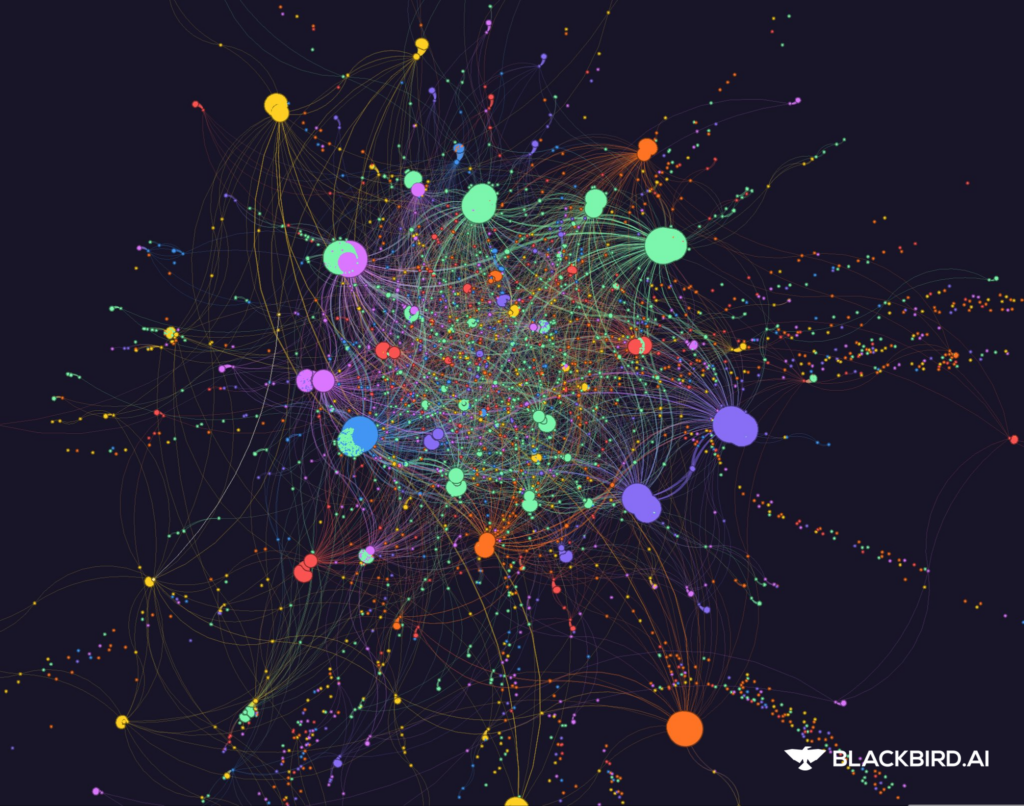
A network graph from Blackbird.AI’s Constellation Narrative Intelligence Platform showing narrative represented in a different color. The presence of overlapping colors indicates groups active across multiple narratives.
Narrative 2. Hantavirus may have been engineered or manipulated, similar to past viral outbreaks. Vaccine and communities depict hantavirus as a manufactured bioweapon, patented and released by global actors. The narrative links gain-of-function research to the outbreak and draws explicit parallels to early COVID-19 theories.
Narrative 3. Hantavirus could become a serious threat if it mutates. This narrative trades speculative risk, casting hantavirus as one mutation from catastrophic spread. The framing dismisses the virus’s rodent-borne origins while invoking pandemic potential to drive concern. CDC, NPR, and WHO assessments find that the human-to-human transmission capability needed for that scenario is absent, and that the Andes virus outbreak is contained through international cooperation.
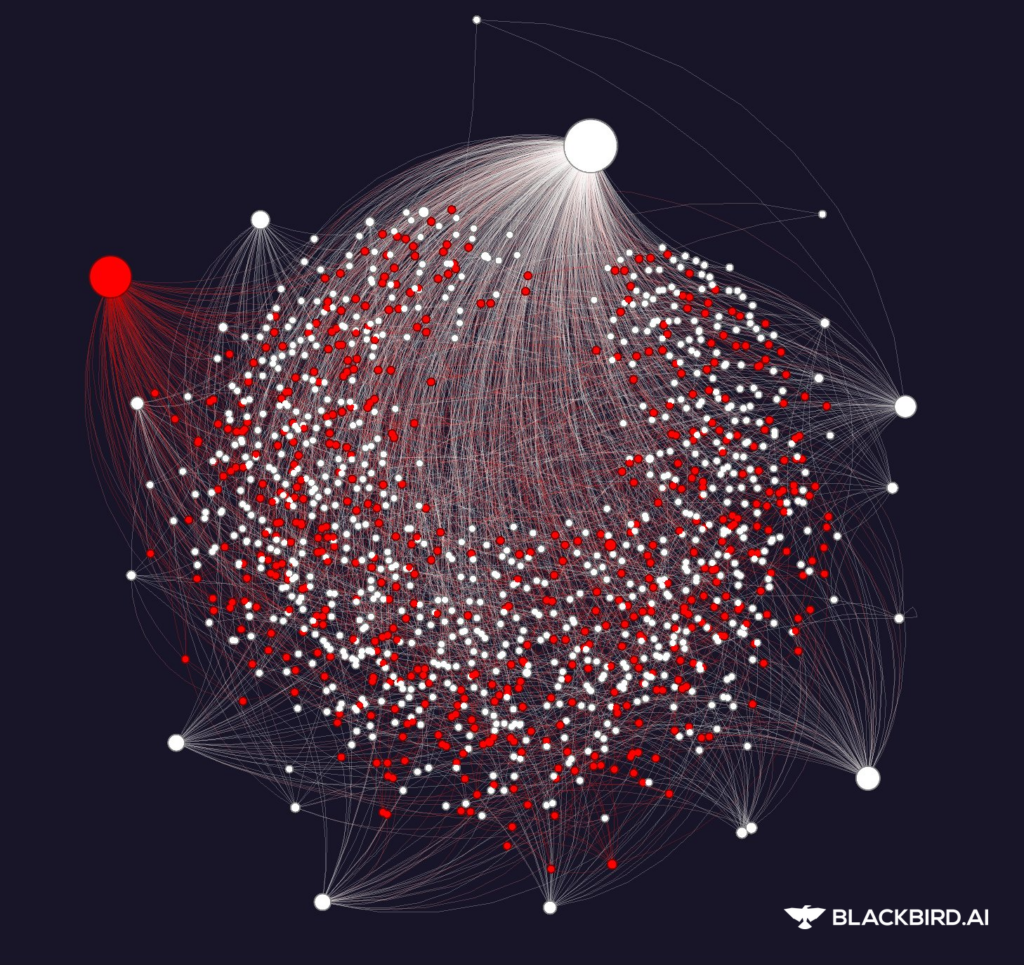
Narrative 4. Hantavirus poses a significant threat, potentially more severe than COVID, and requires widespread awareness. Narratives amplifying this frame compare hantavirus to COVID-19 in scale and severity, urging mass awareness and preemptive concern. The conversation blends factual reporting on transmissibility with predictions of economic disruption and pandemic spread. Harvard T.H. Chan School of Public Health, WHO, and CDC assessments place the global risk at low, citing the virus’s limited capacity for human-to-human spread. The narrative inflates a contained outbreak into a Covid-scale event without supporting evidence.
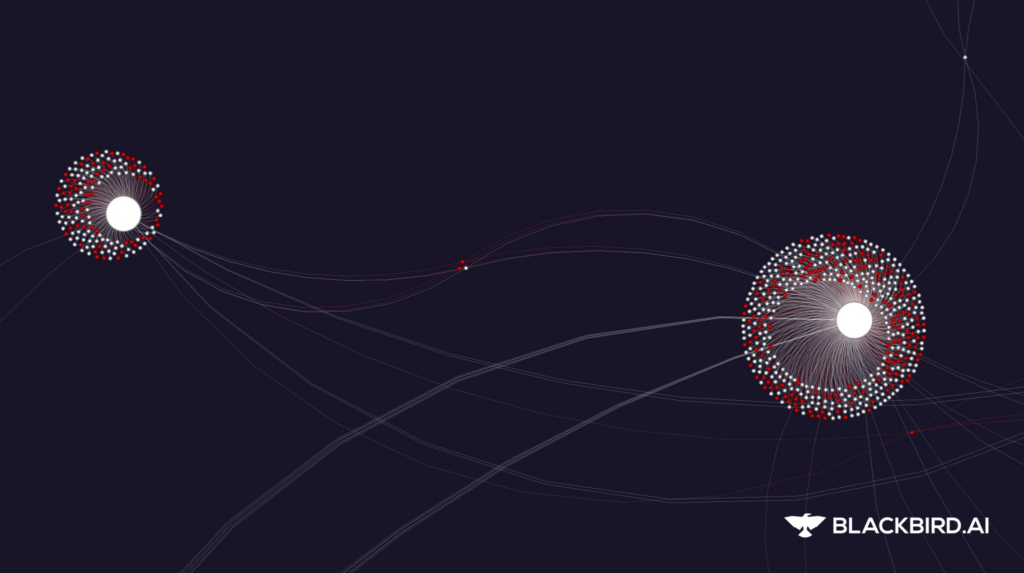
A network graph from Blackbird.AI’s Constellation Narrative Intelligence Platform of bot-like activity in hantavirus threat-severity narratives. Red nodes indicate bot-like behavior. Multiple social groups amplify messaging that hantavirus poses a significant threat, potentially more severe than COVID, and requires widespread awareness.
Narrative 5. The hantavirus outbreak is being compared to the early narrative information campaigns of COVID, suggesting it may be another planned pandemic. Theorists frame the outbreak as a planned operation, with anti-establishment and agenda-driven influencers drawing direct comparisons to the early days of COVID. The narrative centers on vaccine agendas and technology control, casting routine public health communication as evidence of orchestration. The pattern recycles the “plandemic” architecture that drove COVID-era distrust and applies it to a virus with no community spread.
Narrative 6. Hantavirus is listed as a side effect of COVID-19 vaccines. Agenda-driven actors, vaccine, and foreign-malignant communities spread the claim that COVID-19 vaccines cause hantavirus, citing a misreading of a pharmaceutical document that lists adverse events of interest monitored during trials. The vaccine has no documented role in hantavirus infections. The narrative exploits ambiguity in a technical document to manufacture a fresh vaccine-injury claim.
Narrative 7. Hantavirus may be used as a pretext for new lockdowns or control measures. Agenda-driven influencers and vaccine groups cast the outbreak as a setup for renewed lockdowns and state control. Narratives warn followers against trusting international health bodies and present routine public health guidance as manipulation by global entities. The narrative ties hantavirus to broader anti-mandate grievance, recycling lockdown-era distrust into the current news cycle. No public health authority has proposed lockdown measures in response to the outbreak.
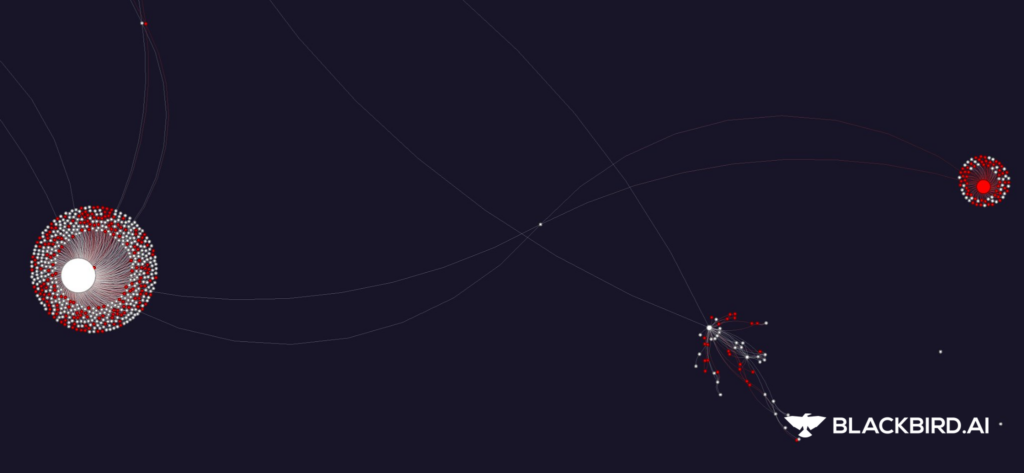
A network graph from Blackbird.AI’s Constellation Narrative Intelligence Platform of bot-like activity in lockdown-pretext narratives. Red nodes indicate bot-like activity designed to strategically amplify the narrative’s conversation drivers. The dominant narrative on the left shows a central pod with significant bot-like amplification, while a secondary user pod on the right amplifies related messaging. Connections between each indicate coordinated messaging around lockdown narratives.
The Way Forward: Key Takeaways For Organization Leaders
- Treat narrative risk as a category of operational risk. Health, brand, and policy stories can be hijacked within hours by narrative-manipulation networks that outpace corporate and public health communication cycles.
- Map the foreign-maligned threat actors, not the topic. The same clusters of vaccine, influencers, and foreign-affiliated accounts drive successive narrative attacks. Knowing who amplifies an emerging story is more valuable than tracking the story itself.
- Pre-position trusted voices. Subject-matter experts, public health authorities, and credentialed messengers carry weight during the opening hours of a narrative event. Waiting for a conspiracy to take hold cedes the field.
The hantavirus conversation is a stress test for the post-COVID information environment. The same narrative architecture that fueled pandemic-era distrust attaches itself to a contained, rodent-borne outbreak, with familiar amplifiers and frames. Organizations that prepare for the pattern, not the topic, will respond quickly and credibly when the next story breaks.
The analysis above captures one slice of a much larger narrative environment. Blackbird.AI’s RAV3N Research Team produces tailored narrative intelligence briefings for executives, communications leaders, and security teams that surface the cohorts, actors, bots, and state-aligned networks shaping conversations around your organization.
We welcome any team or company to reach out for more information on doing a more customized deep dive. Contact Blackbird.AI today to schedule a customized deep dive narrative analysis →

Dan Patterson • Head of Corporate Communications
Dan Patterson is a strategic communications leader driving impact at the intersection of artificial intelligence, cybersecurity, and media. At Blackbird.AI, Dan leads communication and content strategy that breaks down complex AI and cybersecurity concepts for diverse business audiences. Prior, he was the national tech correspondent for CBS News.
Dan Patterson is a strategic communications leader driving impact at the intersection of artificial intelligence, cybersecurity, and media. At Blackbird.AI, Dan leads communication and content strategy that breaks down complex AI and cybersecurity concepts for diverse business audiences. Prior, he was the national tech correspondent for CBS News.

RAV3N Research •
The Blackbird.AI RAV3N Research Team is a cross-disciplinary unit of narrative intelligence analysts that publishes data-driven, evidence-based research on how narrative attacks created by misinformation and disinformation cause financial and reputational harm to public and private sector organizations, including global brands, Fortune 500 companies, government agencies, and executives. Using Blackbird.AI's Constellation Narrative Intelligence Platform, our analysts identify the influence behind narratives, the networks they touch, the anomalous bot behavior that scales them, and the cohorts and communities that connect them to surface the full picture of how narratives form and spread.
The Blackbird.AI RAV3N Research Team is a cross-disciplinary unit of narrative intelligence analysts that publishes data-driven, evidence-based research on how narrative attacks created by misinformation and disinformation cause financial and reputational harm to public and private sector organizations, including global brands, Fortune 500 companies, government agencies, and executives. Using Blackbird.AI's Constellation Narrative Intelligence Platform, our analysts identify the influence behind narratives, the networks they touch, the anomalous bot behavior that scales them, and the cohorts and communities that connect them to surface the full picture of how narratives form and spread.
About Blackbird.AI

Blackbird.AI is the Narrative Intelligence Detection and Response company protecting executives, organizations, and institutions from narrative-based disinformation attacks that cause financial, operational, reputational, and physical harm. Blackbird.AI’s Constellation Platform identifies the actors, networks, bots, and communities driving them; and turns those signals into early warning, decision intelligence, and coordinated response. Blackbird.AI brings Narrative Intelligence into the workflows where teams already operate, including cybersecurity, communications, legal, executive, and public-sector environments, with agentic response capabilities and MCP-enabled integrations that help organizations act faster. Founded by AI experts, threat intelligence analysts, and national security professionals, Blackbird.AI helps customers defend trust, strengthen resilience, and Own The Narrative. To learn more, visit Blackbird.AI.