
Kohl’s Joins Meme-Stock Ranks Amid Social Media Frenzy

Kohl’s has become the latest target of meme-fueled trading campaigns, including false allegations of insider trading, executive mismanagement, and short manipulation. Narrative Intelligence reveals what’s driving the surge and who’s fueling it.

Dall-E 3
On July 22, 2025, Kohl’s ($KSS) surged more than 100% intraday, a stock surge that drew instant comparisons to GameStop’s historic rollercoaster in 2021. By the close of trading, Kohl’s stock settled at a 38% gain, still far above prior levels and one of its most significant single-day moves in years. The scale of the surge raised immediate questions: What triggered it, and why now? There were no earnings announcements, no product pivots, and no marketing campaigns. Instead, Kohl’s had a meme-ready brand vulnerable to coordinated attacks that manipulate narratives and capitalize on market dynamics to damage the brand and stock price.
Online discourse played a central role in the surge. Across social platforms and trading forums, Kohl’s was framed as the next GameStop: An undervalued stock heavily shorted by Wall Street and presented as an opportunity for individual investors to push back. Meme-stock narratives like these typically blend high short interest with anti-institutional sentiment, portraying coordinated trading as a form of financial activism.
Meme stocks are not moved by company performance. They are driven by narratives—emotional, viral, and often misleading. What unfolded with Kohl’s wasn’t market momentum; it was narrative manipulation. Coordinated narratives reshaped perceptions, driving collective trading behavior based on sentiment rather than valuation.
Our RAV3N research team utilized Blackbird.AI’s Narrative Feed and Compass Context checker to identify and validate the most impactful narratives. Below are five high-velocity narratives that surrounded the Kohl’s surge. Some contributed directly to the stock’s upward movement, while others emerged in parallel, amplifying sentiment, sustaining engagement, and reshaping public perception. Each illustrates how narrative manipulation and volatility now play a central role in market behavior.
LEARN: What Is Narrative Intelligence?
Why This Narrative Attack Matters
Kohl’s did not initiate this event, yet its brand and valuation were materially impacted. This illustrates a new operating environment where organizations may be swept into high-velocity narrative cycles without warning.
These cycles can drive significant market activity, reputational pressure, and stakeholder confusion, often before leadership has had a chance to respond. In this context, narrative attacks are no longer a communication issue; they are a strategic risk vector. Organizations need to be prepared not just to react, but to detect and strategically respond to these narratives early, before they affect and dictate outcomes.
Here are five narratives surrounding the stock surge event, sourced by Blackbird.AI’s Narrative Feed and verified by our Compass Context checker:
Narrative #1: Retail stock traders claim they triggered a short squeeze in Kohl’s to punish hedge funds manipulating the stock.
This narrative served as the primary catalyst for the surge, portraying meme-stock buying as a collective stand against institutional influence, echoing tactics first seen in the GameStop rally. It fueled early momentum and mobilized retail investors who viewed the trade as both an opportunity and a protest.
Insights from Narrative Feed Data:
- More than 15 unique influencers amplified “$KSS = next GME” content, many using recycled squeeze memes from the GameStop event.
- Narrative volume tagged as “meme stock,” “short squeeze,” or “WallStreetBets” increased 7x across key forums during the event window.
- Posts across multiple social media platforms claimed, “We made this squeeze happen” and used hashtags such as #KSSqueeze and #RetailRevenge.
- Narrative Feed recorded a 7x spike in posts referencing “make them cover,” “squeeze signal,” and “Wall Street losses.”
- Narrative Feed logged copy-pasted memes and squeezed language recycled from GameStop and AMC campaigns.
Narrative Risk Impact: Inflates valuation based on sentiment, rather than substance, exposing the brand to reputational and market volatility.
This claim was checked by Compass by Blackbird.AI.
Narrative #2: Retail investors say Wall Street is secretly shorting Kohl’s using hidden trades.
Posts accused hedge funds of hiding the true size of their short positions through complex trading tactics. This narrative convinced traders that the squeeze wasn’t over, fueling more buying to expose the manipulation.
Insights from Narrative Feed Data:
- Narrative Feed surfaced near-identical claims across five major social platforms in under two hours, suggesting coordination.
- Influencer content promoted Kohl’s as “the most hidden short on the market” and a “ticking time bomb.”
- Engagement spiked around terms like “dark pool,” “manipulated float,” and “short scam.”
- A social media platform hosted over 300 posts referencing “hidden float collapse” and “synthetic shorts.”
- Posts alleged that hedge funds were using swaps and derivatives to hide actual short exposure beyond the disclosed 49%
Narrative Risk Impact: Fuels distrust in markets and positions Kohl’s as a symbol of broader financial manipulation.
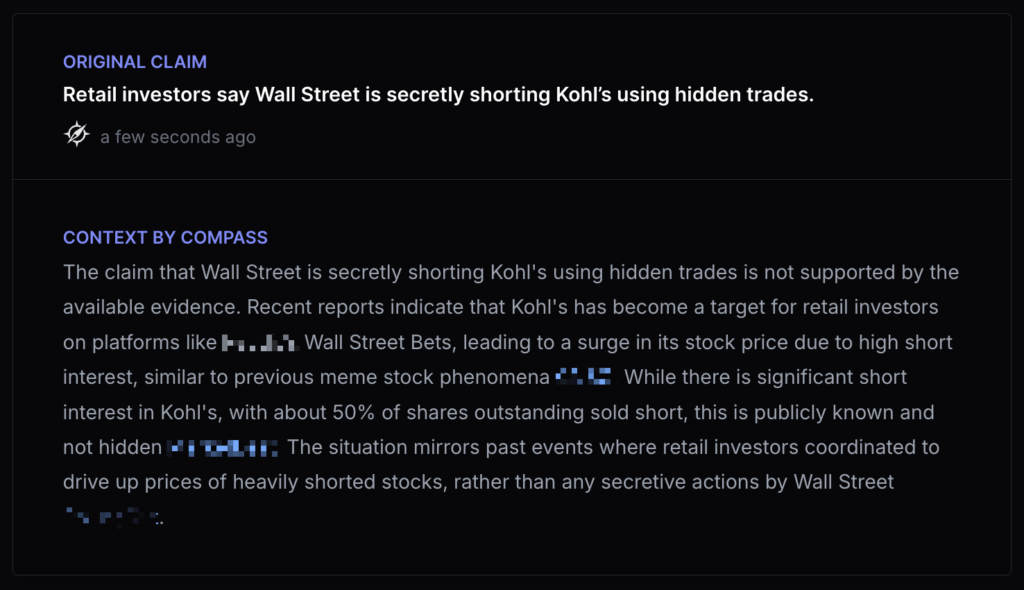
This claim was checked by Compass by Blackbird.AI.
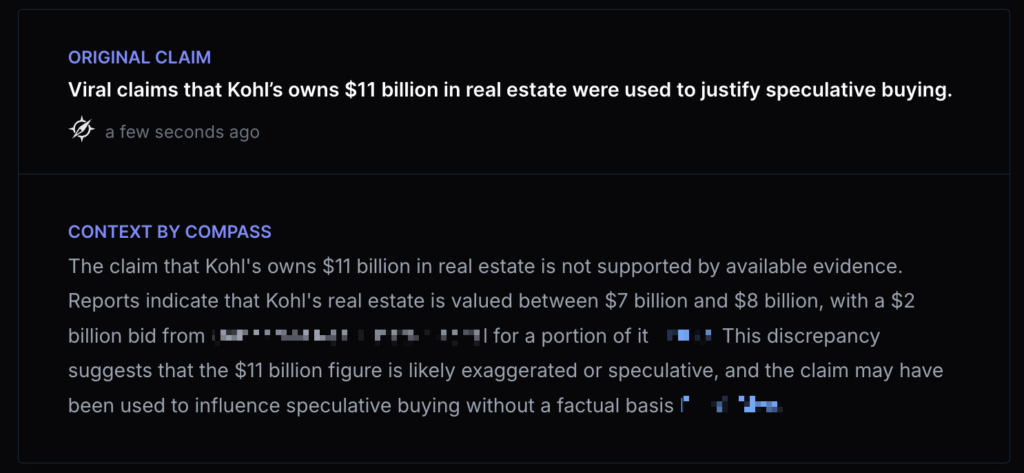
Narrative #3: Viral claims that Kohl’s owns $11 billion in real estate were used to justify speculative buying.
Retail traders circulated the idea that Kohl’s was worth far more than its stock price suggested, based solely on its real estate holdings. This narrative gave investors a simple, compelling reason to buy, even though the underlying claim lacked verified support.
Insights from Narrative Feed Data:
- Meme accounts promoted the claim that Kohl’s holds $11B in real estate assets, despite a ~$1.5B market cap
- A viral post with over 200K views claimed, “You’re not buying retail, you’re buying land.”
- Narrative Feed tracked over a dozen recycled, unsourced real estate graphics mimicking corporate balance sheets.
- Posts across multiple social media platforms framed the company as “a REIT in disguise,” driving retail FOMO buying.
- Analysts flagged that this claim ignores Kohl’s debt, lease liabilities, and declining operating margins.
Narrative Risk Impact: Distorts public understanding of value and risks, and long-term credibility if left unaddressed.
This claim was checked by Compass by Blackbird.AI.
Narrative #4: A Kohl’s executive sold stock at the exact moment of peak volatility, triggering insider trading accusations.
An executive stock sale at the height of the surge was framed as insider trading. This narrative stoked outrage and reinforced the belief that something bigger was happening, prompting traders to stay engaged.
Insights from Narrative Feed Data:
- A senior executive sold shares on July 22 at the intraday peak of $19.50 to $20.00, shortly before the stock dropped sharply.
- Over 50 posts on a social media platform accused the sale of being suspiciously timed, using terms like “rigged” and “leak.”
- A separate $2,000 options position that returned $500,000 was cited as further proof of insider knowledge spreading online.
- Threads on multiple social media platforms framed the event as “coordinated enrichment,” drawing parallels to prior meme-stock executive exits.
- Narrative Feed recorded a 4x spike in posts tagging terms like “dumping,” “fraud,” and “board corruption.”
Narrative Risk Impact: Raises suspicions of unethical behavior and erodes trust in leadership during periods of high volatility.
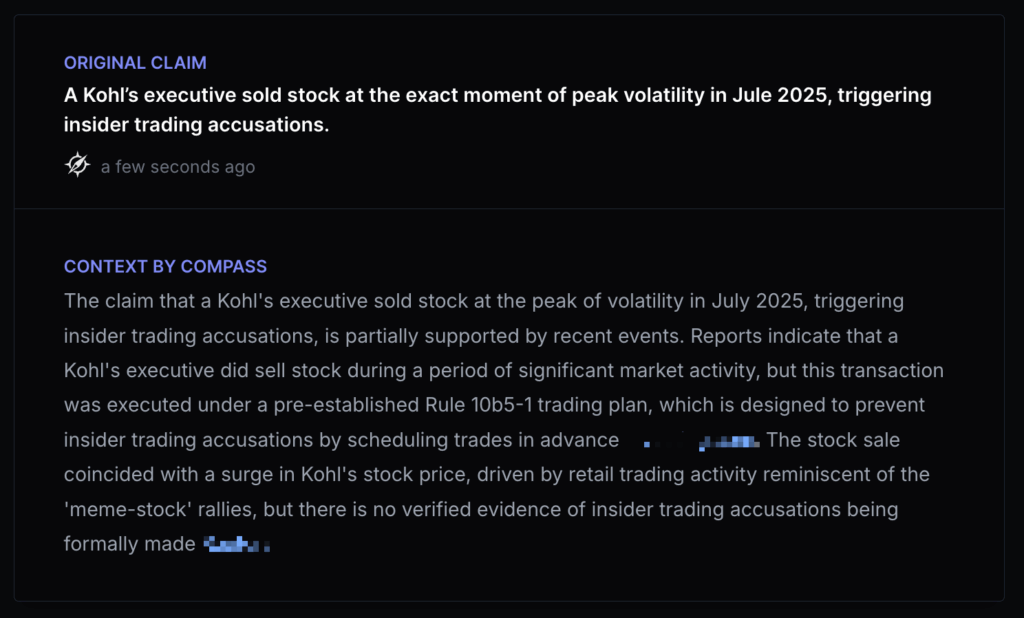
This claim was checked by Compass by Blackbird.AI.
Narrative #5: Meme traders say Kohl’s leadership is failing and must be replaced to save the brand.
In the absence of official communication during the surge, online narratives turned against Kohl’s executive team. Leadership was framed as ineffective and misaligned, prompting calls for board turnover and strategic overhaul. This narrative helped sustain retail engagement by casting traders as acting in the company’s best interest, stepping in where executives had failed.
Insights from Narrative Feed Data:
- Narrative Feed tracked a 3.5x rise in posts framing the company as “rudderless,” “legacy retail,” and “leadership dead weight.”
- A social media platform experienced a surge in posts calling for the complete replacement of the board due to a perceived lack of vision.
- Influencer posts claimed Kohl’s was “being saved by traders, not management,” gaining over 100,000 views.
- Executive silence during the stock rally was framed as “abandoning shareholders.”
- Dividend payouts were portrayed as misallocated capital, especially amid store closures and layoffs.
Narrative Risk Impact: Amplifies public pressure on executives and erodes confidence in the company’s strategy.
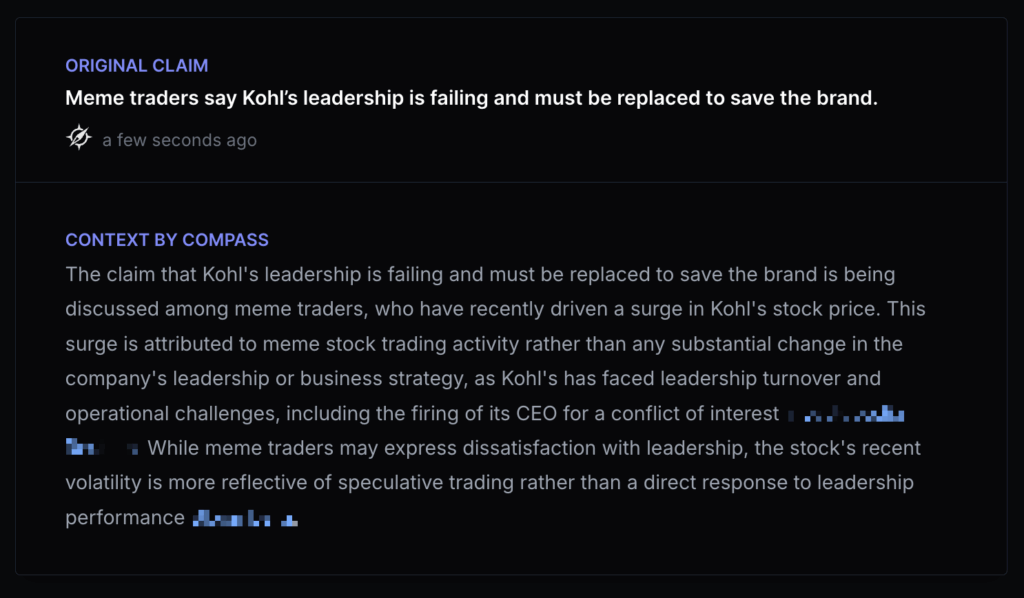
This claim was checked by Compass by Blackbird.AI.
The Way Forward: Three Key Takeaways for Organizational Leaders
The Kohl’s event reflects a broader shift in how companies are exposed to risk. Rapidly moving online narratives can now shape market behavior in ways that outpace traditional financial signals. Here’s what leaders should take away:
- Narrative momentum is independent of business performance: Surges like this show that perception, especially when amplified through social channels, can move faster than fundamentals.
- Narratives must be surfaced early and placed in context: Monitoring public discourse isn’t enough. Leaders must understand which narratives are gaining traction, whether they’re grounded in fact, and employ narrative intelligence to inform timely strategy before momentum takes hold.
- Narrative risk is now strategic risk: Communications, investor relations, and executive teams must coordinate around emerging narrative threats before they impact valuation, trust, or market position.
The Kohl’s episode demonstrates how narrative attacks now supersede traditional financial metrics in driving market behavior. Companies face a new operational reality where narrative attacks and online sentiment create immediate business consequences. Organizations that proactively monitor emerging storylines will outperform those that react once narrative attack momentum has built. Narrative intelligence has become an essential component of corporate infrastructure.

RAV3N Research •
The Blackbird.AI RAV3N Research Team is a cross-disciplinary unit of narrative intelligence analysts that publishes data-driven, evidence-based research on how narrative attacks created by misinformation and disinformation cause financial and reputational harm to public and private sector organizations, including global brands, Fortune 500 companies, government agencies, and executives. Using Blackbird.AI's Constellation Narrative Intelligence Platform, our analysts identify the influence behind narratives, the networks they touch, the anomalous bot behavior that scales them, and the cohorts and communities that connect them to surface the full picture of how narratives form and spread.
The Blackbird.AI RAV3N Research Team is a cross-disciplinary unit of narrative intelligence analysts that publishes data-driven, evidence-based research on how narrative attacks created by misinformation and disinformation cause financial and reputational harm to public and private sector organizations, including global brands, Fortune 500 companies, government agencies, and executives. Using Blackbird.AI's Constellation Narrative Intelligence Platform, our analysts identify the influence behind narratives, the networks they touch, the anomalous bot behavior that scales them, and the cohorts and communities that connect them to surface the full picture of how narratives form and spread.

Amanda Burkard • Marketing Manager
Amanda Burkard is a Marketing Manager at Blackbird.AI, where she supports content development, demand generation, event coordination, and marketing operations. Outside of work, Amanda is an accomplished Irish dancer. She holds a B.A. in Psychology from the University of Virginia.
Amanda Burkard is a Marketing Manager at Blackbird.AI, where she supports content development, demand generation, event coordination, and marketing operations. Outside of work, Amanda is an accomplished Irish dancer. She holds a B.A. in Psychology from the University of Virginia.
About Blackbird.AI

Blackbird.AI is the Narrative Intelligence Detection and Response company protecting executives, organizations, and institutions from narrative-based disinformation attacks that cause financial, operational, reputational, and physical harm. Blackbird.AI’s Constellation Platform identifies the actors, networks, bots, and communities driving them; and turns those signals into early warning, decision intelligence, and coordinated response. Blackbird.AI brings Narrative Intelligence into the workflows where teams already operate, including cybersecurity, communications, legal, executive, and public-sector environments, with agentic response capabilities and MCP-enabled integrations that help organizations act faster. Founded by AI experts, threat intelligence analysts, and national security professionals, Blackbird.AI helps customers defend trust, strengthen resilience, and Own The Narrative. To learn more, visit Blackbird.AI.