Meltwater Summit 2026: Enterprise Strategies for Detecting and Responding to Agentic Disinformation Narrative Attacks

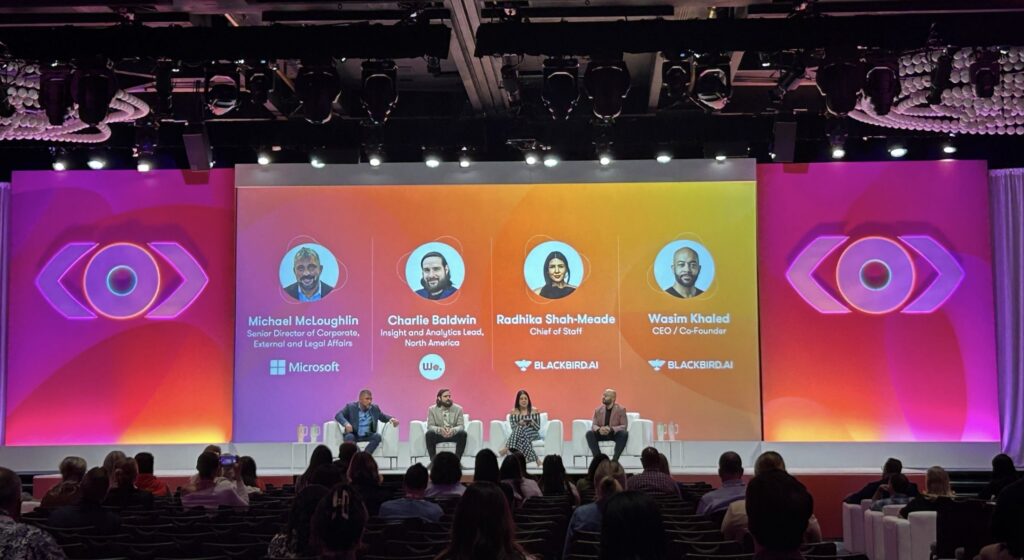
At the Meltwater Summit, Blackbird.AI CEO Wasim Khaled, Michael McLoughlin of Microsoft, and Charlie Baldwin of We. Communications held a session to discuss narrative attacks and how brand trust is now an active attack surface.
Quick Answers
- What was the Meltwater Summit 2026 panel about? Blackbird.AI CEO Wasim Khaled headlined a session titled Trust Under Pressure, joined by Michael McLoughlin of Microsoft and Charlie Baldwin of We Communications, with Chief of Staff Radhika Shah-Meade moderating. The panel examined how AI systems plan, generate, and adapt coordinated narrative attacks against executives and brands faster than legacy social listening tools can track.
- Why are narrative attacks now a board-level risk? A narrative attack is any assertion that can cause harm by shaping perceptions of a person, place, or thing in the information ecosystem, and it is the strategic category within which disinformation, deepfakes, and coordinated amplification all sit. The financial, operational, and reputational damage is measurable and increasing as AI scales, and the cost of launching an attack has dropped about 500 times.
- What is the liar’s dividend? The idea is that the spread of misinformation has made it easier for people to claim that an inconvenient truth is a false narrative. For brands, that means meeting fire with fire by protecting and defending with evidence and clarity, and getting ahead of a harmful narrative before it takes hold rather than responding in crisis after it spirals.
- How should brands respond in the first hour of a narrative attack? Responding without understanding which narratives are amplified, by whom, and through what channels can grow the narrative rather than contain it. Narrative intelligence indicates whether attention is organic or manufactured before leaders engage, and teams should be ready to assemble a clear, non-defensive, evidence-based account of the situation within 30 minutes.
At Meltwater Summit 2026, Blackbird.AI CEO Wasim Khaled headlined a panel titled Trust Under Pressure: Enterprise Strategies for Detecting and Responding to Agentic Disinformation Narrative Attacks. He was joined by Michael McLoughlin, Senior Director, Corporate, External & Legal Affairs at Microsoft, and Charlie Baldwin, Insights and Analytics Lead at We. Communications, with our very own Radhika Shah-Meade, Blackbird.AI Chief of Staff, as moderator. The session examined how AI systems can plan, generate, and adapt coordinated narrative attack campaigns against executives and brands at a speed that outpaces legacy social listening tools, and how communications, legal, and security teams can operate from a shared narrative detection and response layer when an attack lands.
As Wasim Khaled put it after the event, “trust was the real headline at Meltwater Summit 2026.” More than 1,300 leaders gathered in New York to talk about the future of media, communications, AI, and brand reputation. The same question continued to come up: how do communications, legal, and security teams protect brand trust when AI-generated content, synthetic media, and coordinated amplification can reshape brand perception within the first hour of a narrative attack?
Brand trust is now an active attack surface. Coordinated narrative attacks, synthetic media, and agentic amplification target trust directly, and the speed at which coordinated narrative attacks move has outpaced the traditional systems that most organizations rely on during a crisis. Our panel at Meltwater Summit 2026 focused on what communications leaders should do next to detect and respond to narrative attacks that aim to erode brand trust.
“The question is no longer what are people saying about us. The question is, what is real? What is being manufactured? What is moving? And what should we do before our response makes it worse?” — Radhika Shah-Meade, Blackbird.AI
READ: The RAV3N Report: 2026 State of Disinformation Narrative Intelligence
What is a narrative attack, and why are they now a board-level risk?
Blackbird.AI Chief of Staff Radhika Shah-Meade opened the panel by asking Wasim Khaled to define “narrative attack,” a term he coined with Blackbird.AI CMO Dan Lowden. A narrative attack is any assertion that can cause harm by shaping perceptions about a person, place, or thing in the information ecosystem. Narrative attacks cause massive financial and reputational harm. They are the strategic category within which disinformation, deepfakes, and coordinated amplification all sit.
“There are actually billions of dollars that have been spent building the infrastructure for narrative attacks, and today the cost of a narrative attack has gone down about 500x. So if you can’t see those signals, can’t see all of the new tools they’re using to drive that narrative, you certainly can’t understand how to predict which way to go with your playbooks and your responses.” — Wasim Khaled, Blackbird.AI
The panel turned to Michael McLoughlin for the legal and regulatory lens on why narrative attacks have moved into the enterprise risk register. As Michael McLoughlin said, “Trust has always been fragile. What’s changed is the speed at which it can be pressured and the sophistication of those applying it. In a world of agentic adversaries and overlapping geopolitical and enterprise risk, ‘monitoring’ isn’t enough. Organizations need to anticipate, interpret, and act.”
Narrative attacks have become a board-level risk because the financial, operational, and reputational damage caused by disinformation narrative attacks is measurable, real, and increasing as AI scales and the cost of launching a narrative attack campaign decreases. Boards want answers to the risks facing their organizations, and legal and communications teams are often pulled into the same room with very little time to coordinate a crisis response.
“Everything is an attack surface, even if it’s the news moment you’ve been working on for a long time, a product launch. When you ask me about the difference between a reputation-building moment and a crisis moment, I think the lines are blurring. As communicators, we need to be on the front foot all the time.” — Charlie Baldwin, We Communications
What is the “liar’s dividend,” and why does it matter for brands?
As Charlie Baldwin reflected on the panel, “Michael [McLoughlin] made a particularly salient point about the ‘liar’s dividend,’ the idea that the proliferation of misinformation has made it easier for people to simply claim that an inconvenient truth is actually a false narrative. Communicators have to meet fire with fire, protecting and defending with evidence and clarity.” For brands, that means getting ahead of a harmful narrative before it takes hold, rather than responding in crisis after it has already spiraled.
How should brands respond in the first hour of a narrative attack?
Radhika Shah-Meade walked the panel through a scenario in which a synthetic video of a company’s CEO saying something unhinged starts spreading, engagement climbs, and reporters circle. Every communications leader knows the tension between speed and certainty. Moving too slowly opens the door for a narrative to grow, and moving too loudly can grow it just as fast.
The temptation is to respond immediately. However, responding without understanding what narratives are being amplified, by whom, and through what channels can actually grow the narrative rather than contain it. Narrative intelligence changes the time pressure by giving communications leaders insights into whether attention is organic or manufactured before leaders decide to engage with the narrative.
“You should be prepared to put together, within 30 minutes, a very clear, comprehensive, and really importantly, non-defensive, evidence-based accounting of a situation. So that you can bring the facts, you can anchor on the evidence and on what’s real, and make decisions from that. Every organization, whether you’re a one-person shop or a large organization, should have a plan in place to very quickly be able to put that report together.” — Charlie Baldwin, We Communications
Why does cross-functional team alignment and detection-response to narrative attacks matter?
The panel ended with a focus on the operational shift for teams that Wasim Khaled identified: narrative incidents now pull communications, legal, cybersecurity, executives, and the board into the same crisis response moment. When those teams work from separate interpretations of the crisis, the response fragments. When they work from the same intelligence layer, decisions are made faster and with greater precision. A response built on the full picture of who is driving a narrative and how it is spreading is what enables organizations to act strategically rather than reactively.
“This concept of fusion centers, where people are trading cyber intelligence, comms intelligence, it’s making everything much more powerful. You’re able to make decisions on a common operating plane. It gives you that single pane of glass to operate from, instead of being at odds with these responses, and lets you be very precise and surgical.” — Wasim Khaled, Blackbird.AI
“Trust today is continuously computed, happening in almost real time. So it becomes a bit of a risk-management dynamic. We look to partners like We and Blackbird to help us better understand our landscape. And then look to your partners again, like Blackbird, to help you understand what the dissemination dynamic is. How is this information flowing? Where is it coming from?” — Michael McLoughlin, Microsoft
Beyond the Main Stage with the Blackbird.AI Team
In true Blackbird.AI fashion, we worked hard and enjoyed each other’s company at the summit. The team came to NYC ready to talk about narrative intelligence with anyone willing to walk over and pick up one of our swag candles that read “This smells like disinformation.” Attendees stopped by the booth across both days to see the platform in action, meet the team, and grab some swag.

A huge thank you to the team at Meltwater for hosting another exceptional summit, and to Michael McLoughlin of Microsoft, and Charlie Baldwin of We. Communications for joining us on stage and sharing how narrative intelligence is helping their teams navigate some of the most complex perception challenges facing brands today.
The Blackbird.AI and Meltwater Partnership
The Way Forward: Key Takeaways for Communications Leaders
As Radhika Shah-Meade closed the panel, “the clear takeaway is that trust is now something organizations have to actively detect, protect, and defend against narrative attacks. The teams that do this best will be the ones that understand fastest, align earliest, and respond with confidence.”
Here are three takeaways for Communications Leaders:
- Build cross-functional alignment on a shared intelligence layer. Narrative attacks pull communications, legal, security, executives, and the board into the same crisis response moment. Establish a fusion model that gives every function the same read on what is happening, who is driving the narratives, and how they are spreading, so the response moves as one coordinated effort instead of fragmenting across teams.
- Treat narrative attacks as a risk category. Disinformation, deepfakes, and coordinated amplification are tactics inside a larger campaign. Narrative intelligence reveals the coordinated actors behind narratives and how they spread. Treating these as risks for your organization enables teams to stay ahead of narrative attacks before they spiral.
- Operationalize narrative intelligence in the first hour of crisis response. Build narrative intelligence into the response workflow so communications leaders can see whether attention is organic or manufactured, who is amplifying the narrative, and how it is moving across the information ecosystem before deciding the type of crisis response.
Protecting brand trust now requires narrative intelligence, cross-functional team alignment, and shared visibility into who is driving the narratives against your organization and how they are spreading.

Amanda Burkard • Marketing Manager
Amanda Burkard is a Marketing Manager at Blackbird.AI, where she supports content development, demand generation, event coordination, and marketing operations. Outside of work, Amanda is an accomplished Irish dancer. She holds a B.A. in Psychology from the University of Virginia.
Amanda Burkard is a Marketing Manager at Blackbird.AI, where she supports content development, demand generation, event coordination, and marketing operations. Outside of work, Amanda is an accomplished Irish dancer. She holds a B.A. in Psychology from the University of Virginia.
About Blackbird.AI

Blackbird.AI is the Narrative Intelligence Detection and Response company protecting executives, organizations, and institutions from narrative-based disinformation attacks that cause financial, operational, reputational, and physical harm. Blackbird.AI’s Constellation Platform identifies the actors, networks, bots, and communities driving them; and turns those signals into early warning, decision intelligence, and coordinated response. Blackbird.AI brings Narrative Intelligence into the workflows where teams already operate, including cybersecurity, communications, legal, executive, and public-sector environments, with agentic response capabilities and MCP-enabled integrations that help organizations act faster. Founded by AI experts, threat intelligence analysts, and national security professionals, Blackbird.AI helps customers defend trust, strengthen resilience, and Own The Narrative. To learn more, visit Blackbird.AI.