



Narratives Against Data Centers Are Growing in Volume and Frequency
A Blackbird.AI RAV3N narrative intelligence analysis reveals how environmental, economic, geopolitical, and legal influences are converging into coordinated opposition campaigns against data center development.

Gemini
Quick Answers
What narratives are driving opposition to data centers? Environmental concerns — water usage, thermal pollution, and ecosystem harm — legal challenges and transparency demands — and local Issues dominate the narratives.
How can narrative intelligence help resolve these issues? Narrative intelligence can help organizations better understand the real issues being discussed and respond by addressing them with factual data.
READ: The RAV3N Report: 2026 State of Disinformation Narrative Intelligence
UPDATE: Recent developments show that opposition to data center development is increasingly influencing state environmental regulations and public disclosure requirements. An October 8 analysis by the National Conference of State Legislatures identified approximately 100 bills and resolutions across 39 states addressing data center water use and related planning during 2025 and 2026. California enacted requirements for operators to disclose water consumption and assess future demand before construction. Meanwhile, an October 6 Texas Tribune investigation reported that the state’s Public Utility Commission sued to prevent the release of certain geographic information about data centers, citing national security concerns. The dispute illustrates how demands for transparency can conflict with claims about protecting critical infrastructure, creating additional legal and reputational risks for developers.
Local opposition is also influencing elections and development decisions. According to Ballotpedia’s November 2 analysis, voters in 10 states will decide 41 data center-related ballot measures on November 3. Of those, 28 would restrict development if approved, while 13 would facilitate it. All six measures decided earlier in 2026 favored greater restrictions. Ohio leads with 21 measures, reflecting growing concerns about electricity costs, water consumption, zoning, and local infrastructure. A Reuters investigation on October 29 found that proposed restrictions could threaten major investments, including a large tech firm’s planned $2 billion facility in Sunbury, Ohio. These developments show how environmental and economic grievances are translating into political action. They also reinforce the need to distinguish legitimate community opposition from coordinated manipulation, rather than treating organized public criticism as evidence of inauthentic activity.
Opposition to data center development is no longer a series of isolated local disputes. A Blackbird.AI narrative intelligence risk analysis covering Q4 2025 through Q1 2026 identified key narratives centered on environmental grievances, economic issues, legal challenges, and geopolitical risk.
The RAV3N risk analysis assessed narratives across three main categories. Environmental concerns — centered on water use, groundwater contamination, and strain on the power grid. Legal challenges, transparency demands, and local issues dominate the key narratives.
NARRATIVES
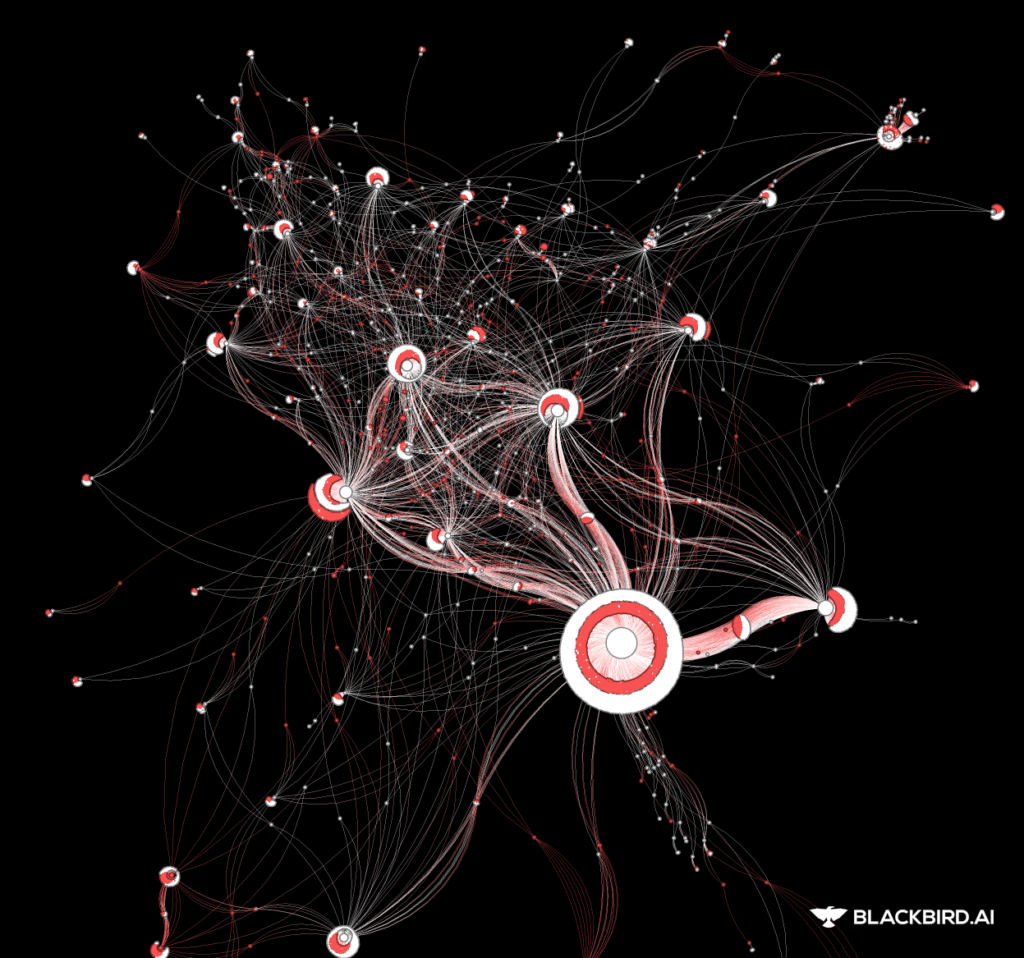
This Blackbird.AI Constellation Narrative Intelligence Platform network graph visualizes narratives around a data center, with 28.4% exhibiting bot-like behavior. Bot accounts operated at the network’s edges in coordinated chains, amplifying existing influence rather than driving it. The overall pattern suggested genuine public interest in the topic, artificially boosted by coordinated inauthentic activity.
Narrative 1. Environmental and Health Narratives Anchor the Opposition
Narratives linked legislation to data center water discharge into community groundwater and surface water. Narratives focused on environmental impacts and water-use concerns, ecosystem harm, thermal pollution, and strain on the power grid
Narrative 2. Legal Challenges and Transparency Demands Are Escalating
Narratives in the legal and transparency category included attempts to keep data center water-use records secret after a judge ordered their release. Narratives also spread about how to support the legal challenge. This pattern — legal proceedings generating narratives — creates a feedback loop in which court actions further reinforce echo chambers and bot influence.
Narrative 3. Data Centers Are a Local Issue
Data centers have surfaced as a local issue in multiple states. In one example, a state legislator held a public Q&A session on social media and proposed using data center tax revenue to fund college education. In another, narratives spread that data centers consumed substantial power and raised energy bills for state residents.
The Way Forward – Key Takeaways About Narratives Against Data Centers
- Narrative intelligence can help better understand and address public concerns. Knowing the real issues and addressing them can reduce confusion and resolve conflicts.
- Treat transparency as a strategic asset. Proactive disclosure of water usage data, environmental impact assessments, and community benefit agreements can reduce the narrative surface area
- Understand the intersection of narratives and local concerns. Data center development is a local and regional issue. Organizations should understand legislative proposals, candidate platforms, and polling that references data centers, energy costs, or tax abatements to anticipate important issues when they materialize.
Opposition to data center development has matured from scattered local pushback into a networked narrative ecosystem in which environmental grievances, legal maneuvering, and geopolitical anxieties reinforce one another across platforms. Organizations that invest in narrative intelligence will be positioned to separate authentic voices from manufactured manipulations before public consensus hardens.

RAV3N Research •
The Blackbird.AI RAV3N Research Team is a cross-disciplinary unit of narrative intelligence analysts that publishes data-driven, evidence-based research on how narrative attacks created by misinformation and disinformation cause financial and reputational harm to public and private sector organizations, including global brands, Fortune 500 companies, government agencies, and executives. Using Blackbird.AI's Constellation Narrative Intelligence Platform, our analysts identify the influence behind narratives, the networks they touch, the anomalous bot behavior that scales them, and the cohorts and communities that connect them to surface the full picture of how narratives form and spread.
The Blackbird.AI RAV3N Research Team is a cross-disciplinary unit of narrative intelligence analysts that publishes data-driven, evidence-based research on how narrative attacks created by misinformation and disinformation cause financial and reputational harm to public and private sector organizations, including global brands, Fortune 500 companies, government agencies, and executives. Using Blackbird.AI's Constellation Narrative Intelligence Platform, our analysts identify the influence behind narratives, the networks they touch, the anomalous bot behavior that scales them, and the cohorts and communities that connect them to surface the full picture of how narratives form and spread.

Dan Patterson • Head of Corporate Communications
Dan Patterson is a strategic communications leader driving impact at the intersection of artificial intelligence, cybersecurity, and media. At Blackbird.AI, Dan leads communication and content strategy that breaks down complex AI and cybersecurity concepts for diverse business audiences. Prior, he was the national tech correspondent for CBS News.
Dan Patterson is a strategic communications leader driving impact at the intersection of artificial intelligence, cybersecurity, and media. At Blackbird.AI, Dan leads communication and content strategy that breaks down complex AI and cybersecurity concepts for diverse business audiences. Prior, he was the national tech correspondent for CBS News.
About Blackbird.AI

Blackbird.AI is the Narrative Intelligence Detection and Response company protecting executives, organizations, and institutions from narrative-based disinformation attacks that cause financial, operational, reputational, and physical harm. Blackbird.AI’s Constellation Platform identifies the actors, networks, bots, and communities driving them; and turns those signals into early warning, decision intelligence, and coordinated response. Blackbird.AI brings Narrative Intelligence into the workflows where teams already operate, including cybersecurity, communications, legal, executive, and public-sector environments, with agentic response capabilities and MCP-enabled integrations that help organizations act faster. Founded by AI experts, threat intelligence analysts, and national security professionals, Blackbird.AI helps customers defend trust, strengthen resilience, and Own The Narrative. To learn more, visit Blackbird.AI.