
Fight AI Disinformation: A CISO & CCO Playbook for Enterprise Defense

Disinformation attacks targeting executives and organizations are also a cybersecurity problem. Recent reports from Gartner and TAG Infosphere agree: the CISO is the right leader to own narrative attack defense.

Quick Answers
- Why should the CISO and CCO own narrative attack defense? The CCO, CISO, and SOC team are the only group that looks outward for threats to executives and the company. Reports from Gartner, TAG Infosphere CEO Dr. Edward Amoroso, and Blackbird.AI CEO Wasim Khaled reach the same conclusion: narrative attacks fall within the CISO’s mandate because many disinformation incidents directly impact cybersecurity.
- Why are narrative attacks a communications and cybersecurity problem? Narrative attacks use disinformation, misinformation, and deepfakes to target reputation, finances, executives, and employees, often running in parallel with cyberattacks and escalating them. Gartner found that 36% of organizations experienced social engineering using a deepfake in a video call with an employee, resulting in significant financial losses.
- What do CISOs need to do across attack surfaces? On internal surfaces, partner with the CIO to require multifactor authentication for meeting platforms, adopt real-time deepfake detection, and upgrade security awareness training. On external surfaces, work with the CCO to deploy narrative intelligence tools, adopt content-provenance standards such as C2PA, and enhance executive protection.
- Why does this matter for governance and liability? The SEC may require disclosures about incidents that affect brand reputation, which means CISOs could face accountability and personal liability for narrative threats they fail to address. Gartner recommends joint task forces among the CISO, CIO, and CCO, with KPIs including time-to-detection, response time, incident recurrence, and brand trust.
Disinformation narrative attacks are now a top threat to executives and organizations. Nation-states and agenda-driven threat actors now create and execute coordinated narrative attack campaigns that damage reputations, escalate cyberattacks, increase geopolitical exposure, influence insider threats, manipulate stock prices, and erode stakeholder trust. For Chief Information Security Officers, Disinformation Narrative Intelligence has quickly become their responsibility, as they and their SOC team are the only group that looks outward for threats to their executives and company
The advisory report from TAG Infosphere CEO Dr. Edward Amoroso and Blackbird.AI CEO Wasim Khaled argues that narrative attacks belong within the CISO’s mandate. And a report by the analyst firm Gartner reinforced this position, calling disinformation security an emerging discipline requiring cross-functional leadership from security teams.
“Disinformation, particularly when amplified by generative AI (GenAI), poses a significant and largely unmanaged risk for organizations, spanning internal and external attack surfaces. Many disinformation incidents have a direct impact on cybersecurity. CISOs must collaborate with CIOs, Chief Communications Officers (CCOs), and CMOs to effectively counter this threat and establish a unified disinformation security strategy.
Some forms of disinformation pose a clear cybersecurity threat, so CISOs need to be involved. However, collaboration with other C-suite stakeholders like the CIO and CMO is crucial—each will be focused on different aspects of disinformation, but they’ll need to work together.”
– Gartner, Fight AI Disinformation — A CISO Playbook for Working with Your CIO, CCO and CMO
Both reports arrive at the same conclusion: CISOs are the right leaders to own this fight alongside the CIO, CCO and CMO.
The Disinformation Narrative Attack Threat Is Real and Accelerating
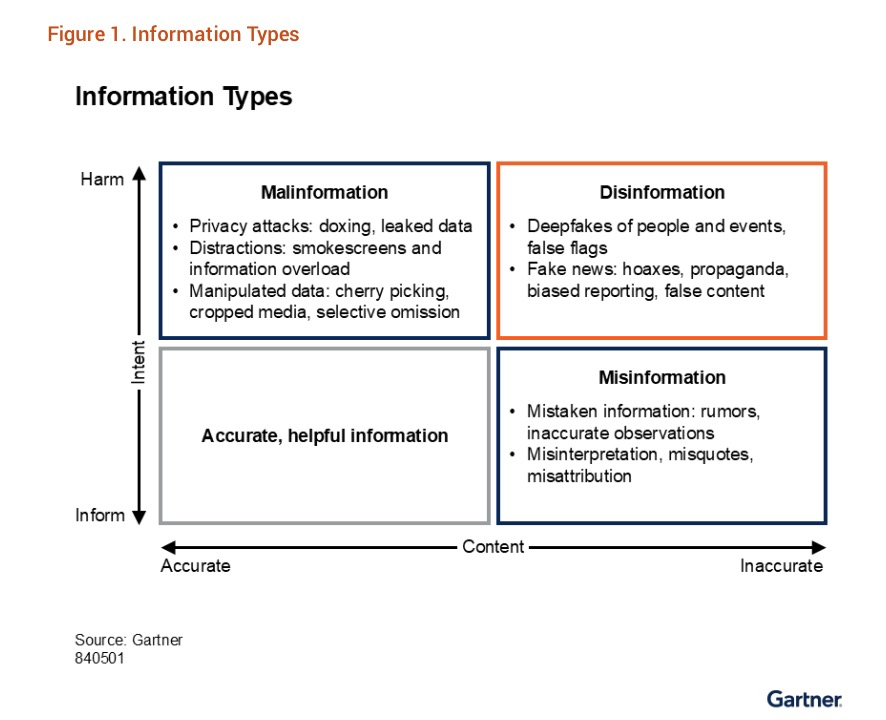
Narrative attacks use disinformation, misinformation, and deepfakes to target an organization’s reputation and financial position, as well as its executives and employees. These campaigns blend truth with fabrication, exploit emotional triggers, and use AI-generated content to create the illusion of credibility. Bots and fake accounts amplify false narratives across social media, news platforms, and online forums. The result: viral disinformation campaigns that can move markets and destroy trust within hours.
The financial and operational consequences are measurable. Unchecked narrative attacks can reduce consumer confidence, depress stock prices, and create internal destabilization as employees question the integrity of their workplace. Executives face personal and professional narrative attacks that can lead to morale problems, job dissatisfaction, departures and even physical attacks.
“CISOs will increasingly need to focus on managing digital personas and online reputational and financial risks as these become inseparable from their responsibilities in cyber risk,” said Dr. Edward Amoroso, CEO of TAG Infosphere. “With online perception influencing customer trust, these reputational and financial concerns are no longer just PR issues. Cyber incidents such as data leaks, real or fake breaches, nation-state attacks, misinformation campaigns, stock manipulation, or executive targeting or impersonation can inflict immediate and long-lasting damage to a brand’s image and financial position.”
Gartner’s 2025 survey data underscores the urgency. The firm found that 36% of organizations had experienced social engineering with a deepfake in a video call with an employee. Attackers combine deepfake audio and video with social engineering tactics on corporate meeting platforms, resulting in significant financial losses for victim organizations.
Why the CISO Is the Right Leader
The CISO’s mandate has expanded over the past decade. The technology stack for threat detection and incident response has matured. Yet disinformation narrative attacks are a new blind spot, delegated to public relations teams and legal departments.
That division no longer holds. The TAG Infosphere report makes clear that the evolving digital landscape has blurred the lines between cybersecurity and reputation management. Cyber incidents now pose reputational and financial risks, and stakeholders will expect CISOs to help mitigate these threats.
“The most effective means for dealing with narrative attacks, which experts agree are increasingly being launched by AI-based automated offensive platforms – is to mitigate the threat using automated defensive platforms,” said Dr. Amoroso. “CISOs are best positioned in any organization to work with information technology and other relevant organizations to manage a platform designed to prevent attacks.”
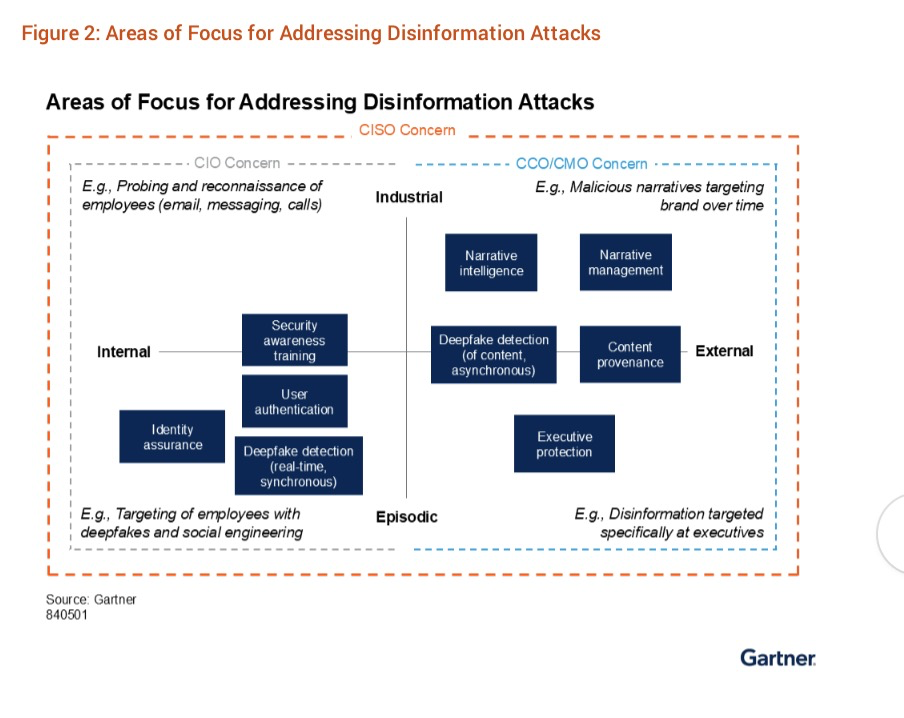
Gartner’s framework reinforces this by mapping disinformation attacks across internal and external attack surfaces. On internal surfaces, CISOs should partner with CIOs to deploy multifactor authentication for meeting platforms, adopt real-time deepfake detection tools, upgrade security awareness training to dynamic nudging models, and implement identity assurance solutions for help desk interactions. On external surfaces, CISOs should work with Chief Communications Officers to deploy narrative intelligence tools, adopt content-provenance standards such as C2PA, and enhance executive-protection services.
The Gartner report names Blackbird.AI as an example vendor for narrative intelligence, alongside other firms in adjacent categories. Narrative intelligence goes beyond monitoring brand sentiment. It examines the evolution of a given narrative, the information flows that drive it, whether deepfake content is involved, and the anomalous connections among accounts that spread it.
High Stakes and Rising Pressure
For U.S. public companies, the stakes extend beyond operational risk. The TAG Infosphere report highlights a growing likelihood that the Securities and Exchange Commission will require disclosures about incidents that affect brand reputation. If a narrative attack hints at material loss, CISOs may find themselves accountable for managing and reporting on these threats with the same rigor applied to other cyber risks.
“In our view, this heightened scrutiny and threat from regulators means that CISOs will need to treat online narrative threats with the same due diligence that they apply to technical and operational cybersecurity vulnerabilities and incidents,” said Dr. Amoroso. “Failing to address these misinformation- and disinformation-related issues could expose CISOs to personal liability and even potential litigation. We recognize that this is an intense claim – but we believe it to be justified.”
Gartner echoes this governance imperative. The firm recommends that CISOs, CIOs, and CCOs establish joint task forces on disinformation with clear policies across content provenance, deepfake detection, and narrative management. The firm also proposes specific KPIs for disinformation security, including time-to-detection of campaigns, response time for coordinated countermeasures, incident recurrence rate, and brand trust metrics.
Closing the Blind Spot
The challenge is clear: current threat intelligence and social listening tools do not cover disinformation narrative attacks. This leaves a significant gap for organizations and their security teams. Platforms built for disinformation narrative intelligence fill that gap by providing visibility into the attacks targeting an organization, the actors behind them, the networks amplifying them, and the bot activity that scales them.
Blackbird.AI’s Narrative Intelligence Platform leverages AI and machine learning to detect and counter online narrative threats, giving CISOs the tools and automation needed to monitor, analyze, and respond to digital narrative risks alongside traditional cybersecurity threats. The platform enables security leaders to help their organizations make better strategic decisions during crises. Gartner recently named Blackbird.AI the Company to Beat for Disinformation Narrative Intelligence in its latest AI Vendor Race report.
The Way Forward – Key Takeaways For Cybersecurity Leaders
Disinformation is an organizational challenge that requires cross-functional coordination, clear governance, and technology purpose-built for the threat. CISOs have the operational expertise, the platform management experience, and the mandate to lead this effort. Three priorities should guide the path forward:
- Deploy narrative intelligence alongside existing threat intelligence. Brand sentiment monitoring is insufficient. Invest in platforms that analyze narrative evolution, detect coordinated inauthentic behavior, identify deepfake content, and map the networks amplifying harmful campaigns against your organization and executives.
- Harden internal and external attack surfaces against disinformation. On internal surfaces, require MFA for meeting platforms, adopt real-time deepfake detection, and upgrade security training to experiential models. On external surfaces, implement narrative intelligence tools, adopt C2PA content-provenance standards, and expand executive-protection services to address digital threats.
- Establish shared governance for disinformation security. Define clear responsibilities between the CISO, CIO, and CCO. Create joint task forces, set policies on content provenance and deepfake detection, and build reporting dashboards to keep the board informed about narrative risks.
The convergence of cybersecurity and reputation risk is complete. CISOs who treat narrative attacks with the same discipline they apply to ransomware, phishing, and data breaches will position their organizations to withstand the next generation of threats.
Gartner, Fight AI Disinformation — A CISO Playbook for Working with Your CIO, CCO, and CMO, by Akif Khan, 23 October 2025. Gartner is a trademark of Gartner, Inc. and/or its affiliates.

Dan Patterson • Head of Corporate Communications
Dan Patterson is a strategic communications leader driving impact at the intersection of artificial intelligence, cybersecurity, and media. At Blackbird.AI, Dan leads communication and content strategy that breaks down complex AI and cybersecurity concepts for diverse business audiences. Prior, he was the national tech correspondent for CBS News.
Dan Patterson is a strategic communications leader driving impact at the intersection of artificial intelligence, cybersecurity, and media. At Blackbird.AI, Dan leads communication and content strategy that breaks down complex AI and cybersecurity concepts for diverse business audiences. Prior, he was the national tech correspondent for CBS News.
About Blackbird.AI

Blackbird.AI is the Narrative Intelligence Detection and Response company protecting executives, organizations, and institutions from narrative-based disinformation attacks that cause financial, operational, reputational, and physical harm. Blackbird.AI’s Constellation Platform identifies the actors, networks, bots, and communities driving them; and turns those signals into early warning, decision intelligence, and coordinated response. Blackbird.AI brings Narrative Intelligence into the workflows where teams already operate, including cybersecurity, communications, legal, executive, and public-sector environments, with agentic response capabilities and MCP-enabled integrations that help organizations act faster. Founded by AI experts, threat intelligence analysts, and national security professionals, Blackbird.AI helps customers defend trust, strengthen resilience, and Own The Narrative. To learn more, visit Blackbird.AI.