

Webinar: When Narratives Become Threats – Understanding Coordinated Attacks on Brands
 Amanda Burkard
Emily Kohlman, Senior Intelligence Analyst at Blackbird.AI, and Sarah McGrew, Solutions Consultant at Cision, discuss how one influencer used a repeatable playbook to launch coordinated narrative attacks against multiple global brands.

Quick Answers
What did Blackbird.AI uncover about influencer-led narrative attacks? Blackbird.AI’s research identified a repeatable five-stage strategy that combines crowdsourced targeting, public exposés, audience mobilization, and coordinated amplification to pressure global brands to change corporate policies.
How can organizations identify potential narrative attacks before they escalate? Early indicators include repeated calls to target specific companies, coordinated messaging, and bot-like amplification. By analyzing these signals and the networks behind them, Blackbird.AI identified potential targets of future influencer-led narrative attack campaigns.
How are influencer-led narrative attacks evolving? Blackbird.AI’s research found that tactics initially used to target corporate DEI policies are now being adopted by other influencers and applied to new issues, including H-1B visa hiring. These campaigns are also becoming more fragmented, with smaller accounts introducing narratives that larger influencers and bot-like networks help amplify.
In a recent webinar hosted in partnership with Brandwatch (Cision), When Narratives Become Threats: Understanding Coordinated Attacks on Brands, Emily Kohlman, Senior Intelligence Analyst at Blackbird.AI, joined Sarah McGrew, Solutions Consultant at Cision, to examine how one influencer used a repeatable strategy to pressure global brands into changing their DEI policies.
Drawing on Blackbird.AI’s RAV3N research, Kohlman broke down the influencer’s five-stage playbook, which combined crowdsourced targeting, public exposés, and sustained audience pressure to influence corporate decisions. She also explored the role of bot-like amplification and how early online signals helped researchers identify potential targets before attacks were publicly launched, highlighting the reputational risks these coordinated campaigns pose to global brands.
READ: Blackbird.AI’s overview of the Gartner Emerging Market Quadrant for Narrative Intelligence
Inside the Influencer’s Five-Stage Narrative Attack Playbook
Blackbird.AI’s research identified a consistent five-stage strategy the influencer used to target companies, mobilize supporters, and maintain pressure until corporate policies changed. The campaigns initially targeted consumer-facing brands with publicly stated DEI commitments. Rather than relying exclusively on automated accounts, the influencer leveraged an established audience, politically leaning communities, and bot-like amplification to spread the narratives.
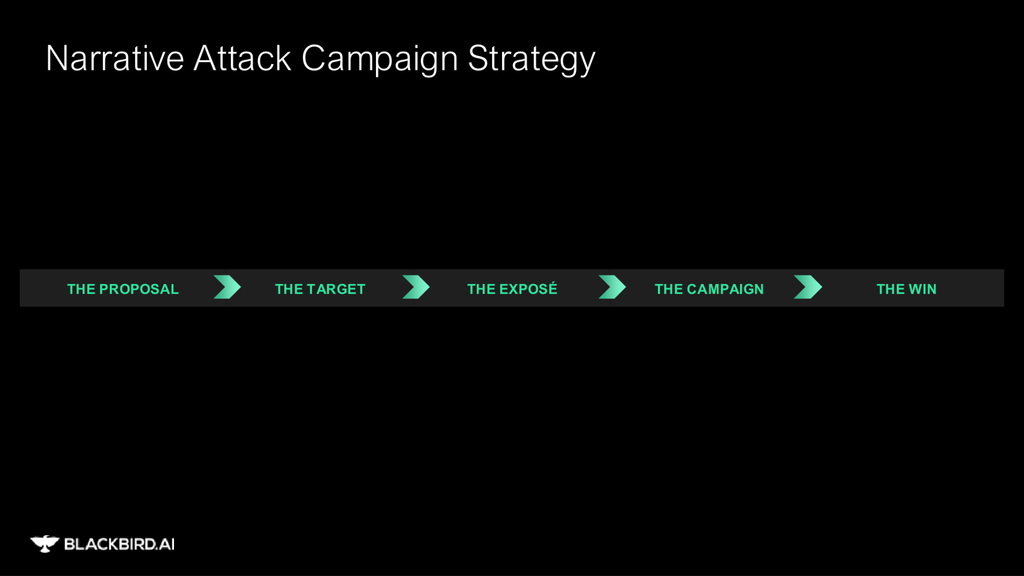
The strategy followed five stages:
- The Proposal: Followers recommend potential targets to the influencer through social media replies, emails, and dedicated submission forms.
- The Target: The influencer selects a company, typically based on its publicly stated DEI commitments.
- The Exposé: A detailed post or video identifies the company and calls on followers to demand specific policy changes.
- The Campaign: Additional posts, alleged insider information, and direct calls to action sustain pressure on the organization.
- The Win: The influencer publicizes corporate policy changes as victories, reinforcing the strategy for future campaigns.
Blackbird.AI also examined the tactics, techniques, and procedures (TTPs) behind these campaigns using an eight-phase framework developed in partnership with NATO. The analysis identified several recurring tactics, including influencer amplification, highly similar messaging, bot-like activity, and direct calls for audience mobilization.
One particularly important finding was that these campaigns originated with an authentic influencer rather than a covert network of fake accounts. As Kohlman explained, “It’s an open operation run by one single authentic influencer using every single win as proof for the next campaign.” Real users played a significant role in circulating the content, while bot-like accounts helped amplify its reach. In several instances, companies announced policy changes after private outreach, without the influencer publishing a public exposé.
When Online Pressure Becomes Corporate Risk
The research examined multiple campaigns targeting retailers, manufacturers, financial institutions, and technology companies, revealing how the same strategy produced different patterns of online engagement. One of the earliest examples involved a major hardware retailer targeted in June 2024.
Following an initial exposé criticizing the company’s DEI policies, the influencer encouraged followers to share the content and contact the organization. Additional posts shared alleged insider information about internal policy discussions, sustaining engagement over several weeks. The campaign subsequently expanded to include screenshots targeting senior leadership. Approximately three weeks after the initial exposé, the retailer publicly announced policy changes.
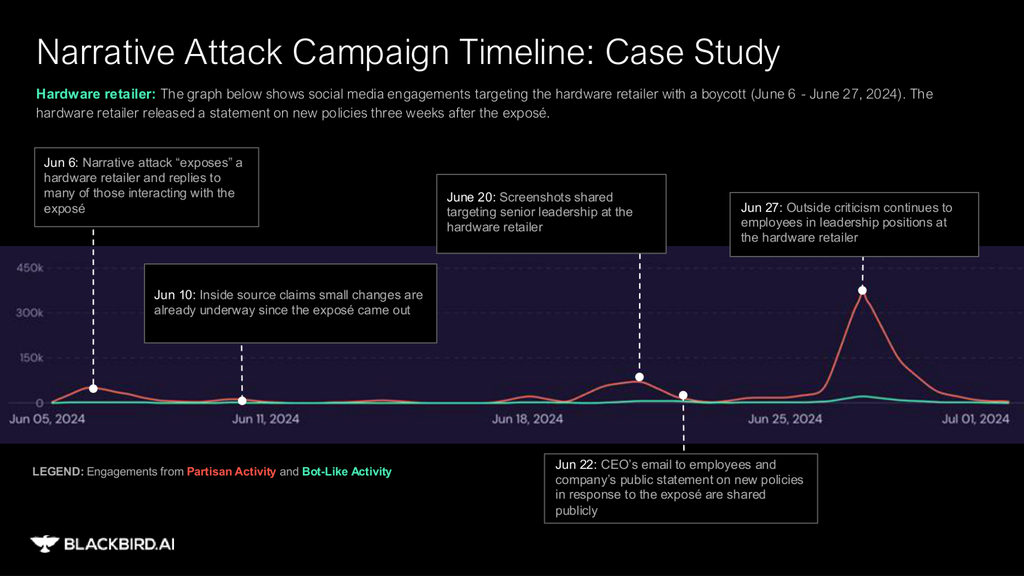
Kohlman pointed out an interesting finding in the hardware retailer’s engagement data: “The largest spike on the screen here comes after that reversal of the policies.” Online criticism continued to target leaders, showing how a campaign that began with corporate policy can broaden into a wider reputational and executive-protection concern.
The research also examined a major auto manufacturer that had previously faced online boycott campaigns without making policy changes. In September 2024, the influencer launched a more targeted campaign with specific demands around its DEI policies. “The specificity is what made this campaign effective,” Kohlman explained. Within one week, the company publicly reversed its position.
Identifying Future Targets Before an Attack Begins
One of the most significant findings was Blackbird.AI’s ability to identify potential future targets by analyzing replies to the influencer’s posts. “The early signals are public,” Kohlman explained. Blackbird.AI’s RAV3N Research team identified companies the influencer’s followers repeatedly suggested, several of which later appeared in campaigns or announced corporate policy changes.
For example, Blackbird.AI identified a national big-box retailer as a potential target months before the influencer announced that the company had agreed to modify its DEI commitments following private discussions. No public exposé was necessary. However, high engagement did not always translate into policy changes. A warehouse club retailer accounted for 96% of sampled posts suggesting a future target, yet it launched no public exposé, and its policies remained unchanged.
How One Influencer’s Strategy Inspired Copycat Narrative Attack Campaigns
Blackbird.AI’s RAV3N research also found that other accounts adopted the original influencer’s methods and applied them to new issues. While the earliest campaigns focused on corporate DEI policies, later activity expanded into public institutions and campaigns targeting H-1B visa hiring practices, particularly in the technology and healthcare industries.
The networks behind these campaigns also began to change. Kohlman described “copycat influencers popping up that are industry specific,” including accounts targeting smaller companies that may not be household names. Some newer campaigns also began with smaller accounts presenting themselves as current or former employees. Larger influencers then circulated the content to their established audiences, sometimes using nearly identical language.
In one campaign targeting a healthcare company over H-1B visa hiring, Blackbird.AI identified a fragmented network in which smaller accounts seeded the narrative while larger influencers and bot-like accounts helped drive its circulation. Looking at the network graph, Kohlman explained that “a lot of this amplification is inauthentic,” demonstrating how online activity can appear more widespread than genuine participation would suggest.
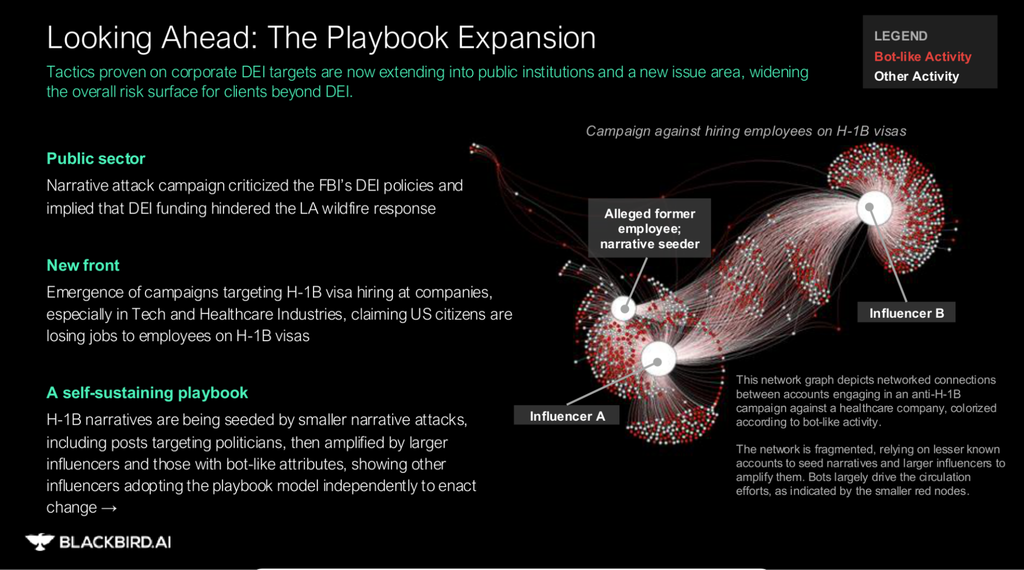
This evolution shows how other actors across industries and issues can replicate one influencer’s strategy. It also complicates detection, as organizations that monitor only prominent influencers or individual conversations may miss smaller accounts and coordinated networks where campaigns first emerge.
The Way Forward – Key Takeaways For Organizational Leaders
The webinar illustrated how coordinated narrative attacks can influence corporate decisions, create sustained reputational pressure, and introduce risks extending beyond communications teams. As Kohlman explained, “Once you know the sequence, you can recognize the campaign while it’s forming instead of after it peaks.”
For organizational leaders, three priorities emerge:
- Identify early targeting signals. Monitor repeated calls to action, emerging narratives, and activity in influential communities to spot potential campaigns before they gain momentum.
- Look beyond engagement and sentiment. Analyze the actors, networks, and amplification patterns behind online conversations to distinguish genuine public criticism from coordinated narrative manipulation.
- Integrate narrative intelligence into risk management. Equip communications, security, and risk teams with the intelligence needed to assess coordinated activity, anticipate escalation, and make informed response decisions.
As these tactics spread across more industries and issues, organizations need visibility into the networks and behaviors that shape online narratives. Understanding how coordinated campaigns develop, who drives them, and how they gain influence can help leaders spot emerging narrative threats before they cause financial, reputational, operational, or physical harm.
Amanda Burkard • Marketing Manager
Amanda Burkard is a Marketing Manager at Blackbird.AI, where she supports content development, demand generation, event coordination, and marketing operations. Outside of work, Amanda is an accomplished Irish dancer. She holds a B.A. in Psychology from the University of Virginia.
Amanda Burkard is a Marketing Manager at Blackbird.AI, where she supports content development, demand generation, event coordination, and marketing operations. Outside of work, Amanda is an accomplished Irish dancer. She holds a B.A. in Psychology from the University of Virginia.
About Blackbird.AI

Blackbird.AI is the Narrative Intelligence Detection and Response company protecting executives, organizations, and institutions from narrative-based disinformation attacks that cause financial, operational, reputational, and physical harm. Blackbird.AI’s Constellation Platform identifies the actors, networks, bots, and communities driving them; and turns those signals into early warning, decision intelligence, and coordinated response. Blackbird.AI brings Narrative Intelligence into the workflows where teams already operate, including cybersecurity, communications, legal, executive, and public-sector environments, with agentic response capabilities and MCP-enabled integrations that help organizations act faster. Founded by AI experts, threat intelligence analysts, and national security professionals, Blackbird.AI helps customers defend trust, strengthen resilience, and Own The Narrative. To learn more, visit Blackbird.AI.