
Boomerang Narratives Behind The FAA Ground Stop, The NSA, Banking, and Internet Service Outages
The recent FAA ground stop, along with NSA, banking, and internet outages, fueled narratives about artificial intelligence, cyberattacks, and fragile infrastructure. Blackbird.AI’s RAV3N Research Team observed the top key narratives.
Gemini
Quick Answers
- What caused the FAA ground stop, the bank outages, and the NSA network outage? The Transportation Department traced the ground stop to a router replaced during maintenance; JPMorgan Chase said third parties that provide services to the banking giant were the target of a cyberattack; and the NSA said internal communications temporarily degraded during scheduled routine maintenance. Testimony before a House committee on Nov. 18 turned up no sign of malicious cyber activity.
- Did AI or a cyberattack cause the U.S. outages? Federal aviation and transportation leaders discounted AI and cyber theories for the ground stop, and the intelligence community’s assessment attributed each outage to its own maintenance or technical change. The speculation returns with every outage, which is why Blackbird.AI calls it a boomerang narrative.
- Did a foreign state cause the outages? No official attribution links the outages to a foreign state, but Russian state-aligned accounts and accounts that are part of Russian covert networks made up about 5% to 6% of accounts in the conversation and amplified narratives already circulating.
- How does an outage become a narrative attack? An outage leaves hours or days of uncertainty before a verifiable and plausible cause is reported. And narrative speculation forms, evolves, and grows in a short window of time. Narrative attacks occur when harmful claims about an event—often manipulated by bad actors—cause financial, organizational, or reputational harm.
READ: Narrative Risk Intelligence for Financial Services Report
In recent weeks, a series of internet outages has disrupted the National Security Agency, banks and financial institutions, and the Federal Aviation Administration, taking critical services offline. The disruptions have raised questions among organizational leaders and consumers about whether the incidents are connected and have fueled a surge of speculative narratives about artificial intelligence, cyberattacks, and the reliability of critical infrastructure.
Blackbird.AI’s RAV3N Research Team analysis of the online information environment around the recent internet outages found that most of the narratives were organic, driven by users across the political spectrum trying to make sense of grounded flights, bank outages, and a malfunctioning NSA network, all happening continuously. Each new service disruption revived suspicion that AI or a cyberattack was to blame—a “Boomerang Narrative” that this week jumped from social feeds to cable news and policymakers in Washington.
Users also fused the separate outages into a single narrative of failing infrastructure or official concealment; one narrative exclaimed that “no one is telling us the truth!” Narratives quickly shifted from speculation about technical causes to broader discussions of distrust in institutions and government. Additionally, influential Russia state-aligned and covert accounts generated about 5% of the activity—a small number with outsized potential to amplify misleading narratives. Many of these accounts command large followings that can push narratives to new audiences, keeping them alive longer than they would last on their own.
Banking Outages: Separate Incidents Become Evidence of a Wider Failure
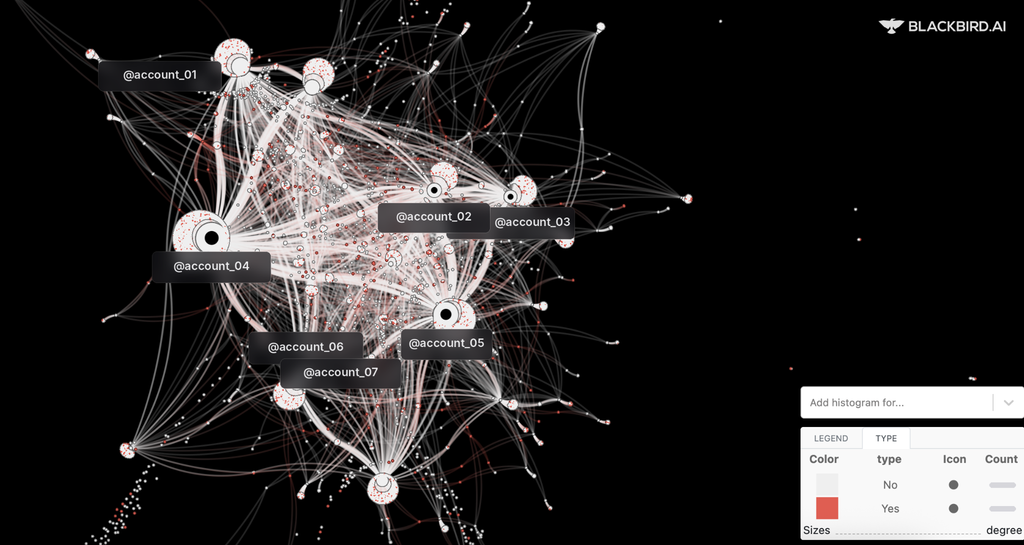
The above authors-only network graph visualizes connections between social network users, with bot-like users colored red and organic users colored white (see legend).
On November 16, customers reported problems accessing online banking services and completing transactions at several major financial institutions.
The disruption originated at JPMorgan Chase and was initially reported as a software bug affecting internal systems and delaying transactions. Customers at other banks also experienced problems with payments involving Chase. The adjacent Zelle network remained operational, although some transfers involving Chase customers were delayed.
But on November 19, Reuters reported that JPMorgan Chase, Visa, and Mastercard had disclosed cyberattacks involving third-party service providers. Chase said attackers may have accessed customer names and email addresses held by its vendors. Mastercard confirmed limited exposure of customer email addresses, while Visa said its systems and payment data were unaffected. A hacking group called n0n claimed responsibility, although Reuters could not independently verify the leaked data.
Chase said the incident was unrelated to its November 16 banking outage. It remains unclear whether the three companies were affected by the same attack, but online narrative attacks quickly drew connections between the outages and incidents, and social posts increasingly treated the timing as evidence of a coordinated disruption campaign.
Blackbird.AI identified three primary narrative attacks (reporting period, 11/16/26 – figures are approximate):
- Narrative attack #1: Major U.S. banks experienced widespread outages:
- 2.5 million engagements
- 300 thousand authors
- 12% bot-like density
- The discussion attracted bipartisan audiences and showed predominantly organic activity. Some posts also linked the disruptions to concerns over leaked customer data, consumer privacy, and the liquidity of financial institutions.
- Narrative attack #2: The outages suggested a deliberate pattern of disruption:
- 1.2 million engagements
- 125 thousand authors
- 15% bot-like density
- Posts connected banking problems with recent airline and technology outages. Claims that “no one is telling us the truth” turned uncertainty about technical failures into suspicion of institutional cover-ups.
- Narrative attack #3: Multiple outages exposed weaknesses in U.S. infrastructure:
- 1 million engagements
- 125 thousand authors
- 17% bot-like density
- This narrative linked outages across banking, aviation, and technology. Engagement developed over a longer period as additional users referenced other disruptions.
NSA Network Outage: Cyberattack and Sabotage Theories Spread
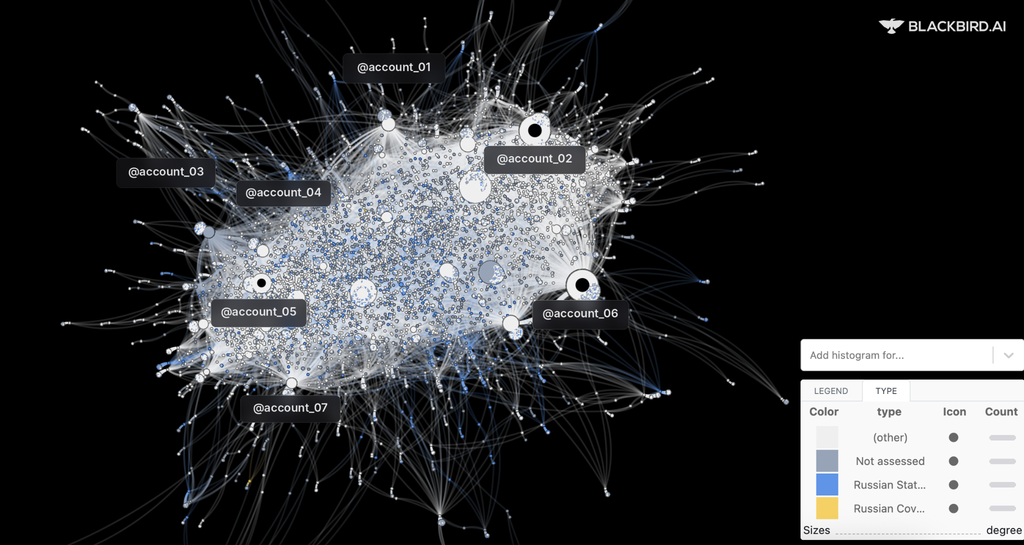
The above authors-only network graph visualizes connections between social network users, with Russian state-aligned accounts colored blue, Russian covert accounts colored yellow, and other users colored white.
On November 17, the National Security Agency experienced disruptions to NSA Net, its classified internal communications network. The agency staggered employee arrival times at Fort Meade, Maryland, while technical teams worked to restore stable operations.
The NSA described the incident as a temporary degradation during scheduled maintenance and said mission-critical capabilities remained operational.
Subsequent reporting provided additional context. The Wall Street Journal reported that the outage was connected to software patches intended to address critical PHP vulnerabilities. Allegedly, AI-assisted research had helped identify the vulnerabilities, prompting organizations to update affected systems. They did not establish that AI systems caused the outage or that attackers had exploited the network.
Blackbird.AI identified three primary narrative attacks (reporting period, 11/17/26 – figures are approximate):
- Narrative attack #1: AI-powered tools contributed to a wider wave of technological disruptions:
- 1.7 million engagements
- 140 thousand authors
- 13% bot-like density
- Posts associated AI-driven vulnerability exploitation with recent outages, despite little evidence establishing the connection.
- Narrative attack #2: The NSA’s classified network was disabled by a cyberattack or internal sabotage:
- 1.4 million engagements
- 120 thousand authors
- 19% bot-like density
- High anomalous and bot-like activity indicates (though does not prove) coordination. This narrative also speculated about a link between the NSA outage and hostile cyber activity, although officials reported no evidence of a cyberattack.
- Narrative attack #3: The outage was intended to pressure Congress into approving emergency funding:
- 1 million engagements
- 110 thousand authors
- 15% bot-like density
- This unsupported narrative portrayed the disruption as a deliberate attempt to influence government spending.
The NSA outage gave existing cyberattack theories another opportunity to spread. Its national security role also made the organization particularly susceptible to narrative speculation about intrusion by hostile foreign actors and other concealed threats.
On November 18, U.S. intelligence officials told Congress that the recent technology disruptions appeared to be separate incidents associated with maintenance and technical changes, not a coordinated or state-sponsored attack.
The official explanation did, however, not stop online discussions linking the NSA outage to earlier failures in aviation, banking, and technology services.
FAA Ground Stop: AI and Cyberattacks Become the Default Suspect
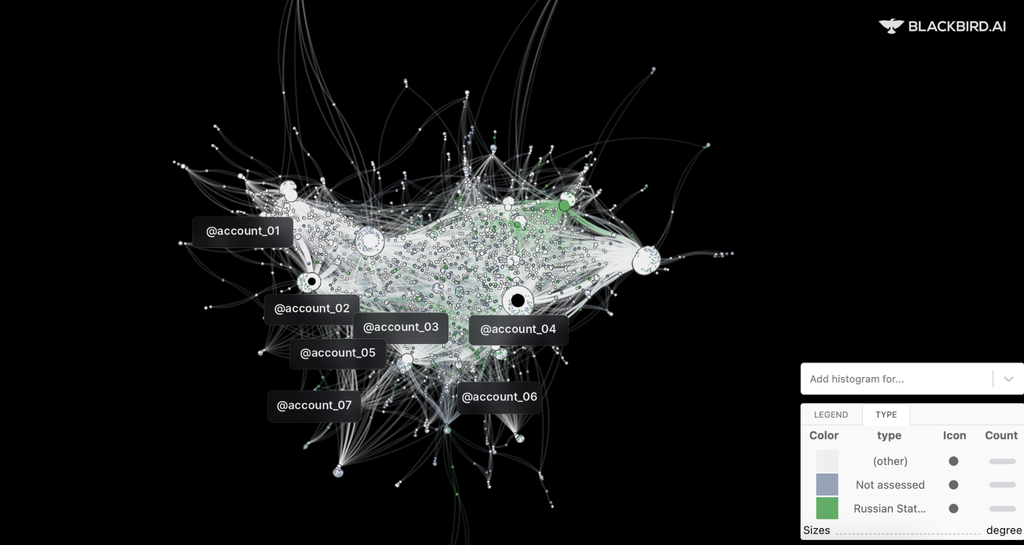
The above authors-only network graph visualizes connections between social network users, with Russian state-aligned accounts colored green and other users colored white.
On November 13, the FAA ordered a nationwide ground stop after communications and radar systems became unstable. The disruption lasted more than four hours, delaying and canceling thousands of flights.
According to the FAA’s investigation, excessive data traffic overwhelmed legacy telecommunications equipment. Investigators identified two possible sources of the network instability, including a site in Arkansas where a contractor had installed a new router. Officials found no evidence of a cyberattack.
Blackbird.AI identified three primary narrative attacks (reporting period, 11/13/26 – figures are approximate):
- Narrative attack #1: The FAA issued an unprecedented nationwide ground stop with little explanation:
- 4 million engagements
- 750 thousand authors
- 11% bot-like density
- This was the dominant narrative, attracting broad, bipartisan participation with low levels of bot-like activity. And it continues to evolve.
- Narrative attack #2: AI or a cyberattack caused the disruption:
- I million engagements
- 150 thousand authors
- 13% bot-like density
- Much of the narrative speculation spread organically, reflecting recurring concerns about the security and reliability of critical infrastructure, artificial intelligence, and cybersecurity.
- Narrative attack #3: The ground stop was intended to distract from the Epstein files:
- 316 thousand engagements
- 26 thousand authors
- 21% bot-like density
- This narrative had fewer authors than most narratives and showed higher levels of anomalous, bot-like activity than the dominant outage discussion.
The AI narrative developed partly because the FAA had recently expanded its use of SMART, an AI-powered airspace planning system. The timing prompted questions about whether the new technology contributed to the failure.
The speculation moved beyond social media. News coverage examined the potential connection, while members of Congress demanded explanations about the agency’s technology and oversight. The FAA and the system’s developer said SMART was not responsible for the outage.
Blackbird.AI identified the AI and cyberattack explanation as a boomerang narrative, a recurring claim that resurfaces whenever another technical outage occurs. Each disruption gives the theory renewed attention, even when subsequent investigations identify unrelated causes.
The unsupported allegation that the ground stop was a deliberate distraction followed a different pattern. It connected a real disruption to an unrelated political controversy. Unlike the largely organic speculation about AI and cybersecurity, this narrative displayed stronger signals of anomalous amplification.
Russian State-Aligned Accounts Amplified Existing Narratives
Across all three datasets, Russian state-aligned and affiliated accounts were one source of identified foreign-aligned activity. They represented approximately 5% to 6% of accounts in each discussion.
Their presence was limited relative to the broader conversation, but their reach was not necessarily proportional to their numbers.
Blackbird.AI’s network analysis found that these foreign-aligned nation-state accounts largely amplified claims already circulating among prominent U.S. influencers. Some had substantial followings, increasing the potential visibility of the narratives they shared.
The activity included accounts associated with known malicious foreign influence operations and others with a history of amplifying Russian state-aligned messaging.
Three patterns emerged:
Amplification was focused on sharing rather than origination. Russian-aligned accounts primarily shared existing claims about cyberattacks, institutional failures, and government concealment. In the banking discussion, some also helped drive narratives rather than simply redistributing them.
Domestic political communities extended the reach of these claims. U.S. political influencers and accounts that regularly shared Russian state-aligned content participated in overlapping discussions. These connections increased the circulation of polarizing messages, although shared content alone does not establish coordination or direction by a foreign government.
The narratives reinforced distrust of American institutions. The incidents occurred within days of one another, allowing accounts to present separate failures as evidence of a wider breakdown. This messaging was consistent with longstanding Russian-aligned efforts to undermine confidence in Western institutions.
The Way Forward: Key Takeaways For Organization Leaders
- Monitor narratives alongside technical incidents. Monitor emerging narratives, assertions, and public reactions throughout the cyber or technical incident. Watch for small, influential groups that might have an outsized influence on narratives. Identify how claims spread, the accounts that amplify them, and whether activity is organic or coordinated.
- Connect cybersecurity, threat intelligence, and communications teams. Technical teams should establish the fact pattern, while communications teams should investigate emerging narratives and amplification networks. This coordinated reporting approach gives leaders a clear assessment of both operational disruption and information risk.
- Communicate what is known, unknown, and under investigation. Share timely, specific updates about the incident and the next steps. Address unsupported allegations with verified information without repeating claims unnecessarily.
The FAA, banking, NSA, and internet service outages appeared to be separate technical incidents. But on social media, they echoed common themes— the “Boomerang Narratives” of mistrust about AI, cyberattacks, and digital infrastructure. The resulting narratives illustrate how uncertainty surrounding a real incident can become an opportunity for manipulation and escalation, increasing the risk of breaking consumer trust in institutions and government.

Sarah Boutboul • Lead Intelligence Analyst
Sarah is a Lead Intelligence Analyst specialising in risk monitoring and foreign malign interference techniques. She draws on an interdisciplinary background with previous career experiences in national security and corporate risk intelligence.
Sarah is a Lead Intelligence Analyst specialising in risk monitoring and foreign malign interference techniques. She draws on an interdisciplinary background with previous career experiences in national security and corporate risk intelligence.

Emily Zhang • Intelligence Analyst
<p>Emily Zhang is an intelligence analyst at Blackbird.AI.</p>
<p>Emily Zhang is an intelligence analyst at Blackbird.AI.</p>

Dan Patterson • Head of Corporate Communications
Dan Patterson is a strategic communications leader driving impact at the intersection of artificial intelligence, cybersecurity, and media. At Blackbird.AI, Dan leads communication and content strategy that breaks down complex AI and cybersecurity concepts for diverse business audiences. Prior, he was the national tech correspondent for CBS News.
Dan Patterson is a strategic communications leader driving impact at the intersection of artificial intelligence, cybersecurity, and media. At Blackbird.AI, Dan leads communication and content strategy that breaks down complex AI and cybersecurity concepts for diverse business audiences. Prior, he was the national tech correspondent for CBS News.
About Blackbird.AI

Blackbird.AI is the Narrative Intelligence Detection and Response company protecting executives, organizations, and institutions from narrative-based disinformation attacks that cause financial, operational, reputational, and physical harm. Blackbird.AI’s Constellation Platform identifies the actors, networks, bots, and communities driving them; and turns those signals into early warning, decision intelligence, and coordinated response. Blackbird.AI brings Narrative Intelligence into the workflows where teams already operate, including cybersecurity, communications, legal, executive, and public-sector environments, with agentic response capabilities and MCP-enabled integrations that help organizations act faster. Founded by AI experts, threat intelligence analysts, and national security professionals, Blackbird.AI helps customers defend trust, strengthen resilience, and Own The Narrative. To learn more, visit Blackbird.AI.