


Gartner® Outlines a Framework for Managing Misinformation and Disinformation
 Amanda Burkard
This Gartner® report outlines a framework for helping communications leaders manage misinformation, disinformation, and malinformation (MDMI) through proactive defense, monitoring, assessment, and response.

Dall-E 3
Quick Answers
How can communications teams prepare for misinformation and disinformation threats? Communications teams can prepare by investing in narrative intelligence capabilities, establishing clear response criteria, and coordinating responsibilities across communications, cybersecurity, legal, and risk management teams before an incident occurs.
How prepared are organizations to manage misinformation? Many organizations lack established response mechanisms. Gartner® research found that 79% of organizations surveyed had experienced at least one MDMI-related issue, but only 37% already had mechanisms in place to manage these threats.
How does narrative intelligence support communications teams? Narrative intelligence supports communications teams by identifying where harmful narratives originate, who is amplifying them, and whether activity is coordinated. These insights help teams assess reputational risk and prioritize emerging threats before they escalate.
Narrative attacks and AI-generated disinformation can undermine stakeholder trust and damage brand reputation, with consequences extending to customer relationships, investor confidence, and business operations. For chief communications officers, these threats present significant reputational, operational, and financial risks.
According to Gartner® research, 79% of organizations have experienced at least one issue involving misinformation, disinformation, or malinformation (MDMI). Yet only 37% already have mechanisms in place to manage these threats. In its September 2026 report, Communications Framework for Managing Misinformation, Gartner® outlines how communications leaders can address this preparedness gap through proactive defense, monitoring, threat assessment, and established response processes.
READ: Gartner®: Communications Framework for Managing Misinformation
Gartner®’s Framework for Managing Misinformation and Disinformation
Gartner® outlines five core practices for communications leaders managing misinformation, disinformation, and malinformation.
Core Practice 1. Proactively Defend Against Misinformation Threats
Organizations can reduce their exposure to misinformation and disinformation by strengthening internal information practices before an incident occurs. The report identifies several practices that help protect organizational information integrity, including compliance with generative AI policies, retaining records of content origin and development, fact-checking, and attaching metadata or watermarking to content.
Cross-functional governance is also an important part of proactive defense. Gartner® states that “Cross-functional trust councils help govern and establish the necessary mechanisms to protect against disinformation” and describes their responsibilities for establishing policies, monitoring disinformation security, and educating employees. These councils help organizations establish clear ownership and coordinate efforts across communications, cybersecurity, risk management, and other functions.
READ: What is a TrustOps Council and Why Does it Matter to Your Team?
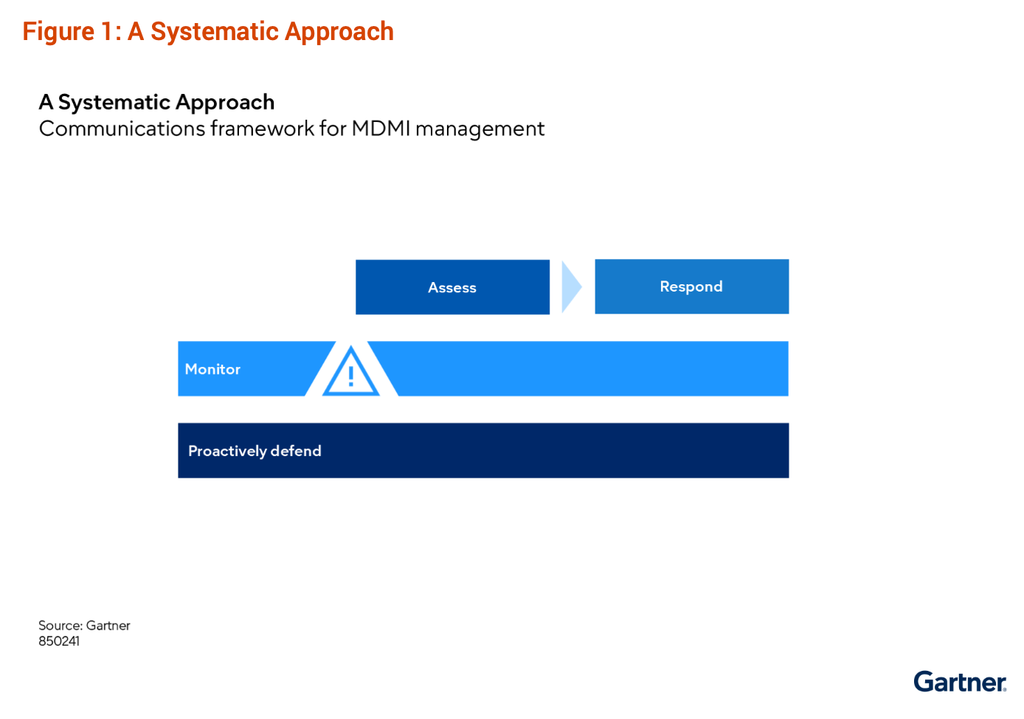
Source: Gartner®, Communications Framework for Managing Misinformation, 22 September 2026, Figure 1.
Core Practice 2. Monitor Emerging and Evolving Narratives
Gartner® recommends that communications leaders evaluate their existing social and media monitoring capabilities and consider investing in narrative intelligence capabilities to better investigate emerging misinformation and disinformation.
“Communications should also consider investing in narrative intelligence (NI) capabilities. NI tools can help investigate narratives online, identifying the origin and propagators of narratives, classifying disinformation attacks and analyzing adversarial intent.”
—Gartner®, Communications Framework for Managing Misinformation, September 2026
The report also highlights the importance of organization-wide monitoring practices, including employee reporting and information sharing across communications, cybersecurity, and risk management teams.
Core Practice 3. Assess Misinformation, Disinformation, and Malinformation (MDMI) Threats
Once a potential threat is identified, communications teams need to establish its credibility and potential impact. Gartner® recommends checking the source and facts, then applying clear response criteria. These assessments help teams determine whether to continue monitoring the activity, engage specific audiences, or respond more broadly.
Core Practice 4. Respond to Incidents of MDMI
When responding to misinformation or disinformation, communications teams need to consider which audiences are affected and whether information should come from company executives, independent experts, or other credible sources.
Research cited by Gartner® highlights the importance of credibility when responding to misinformation. In the 2025 Gartner® Misinformation and Reputation Management Survey, 59% of respondents considered hearing from an independent expert very or extremely important, while 57% said they would look to independent sources to determine whether to trust a company’s response.
These findings highlight the importance of determining when to involve company executives, independent experts, or other trusted sources in responding to misinformation, disinformation, and narrative attacks. However, intervention isn’t always necessary. As the report notes, “That said, strategic silence can be the right decision for certain misinformation incidents.”
“To ensure quick, consistent decision-making and effective management of MDMI, heads of communications need a framework for the proactive defense, monitoring, assessment, and — when necessary — response.”
—Gartner®, Communications Framework for Managing Misinformation, September 2026
Core Practice 5. Enable Iterative Learning
The final component addresses how communications teams can improve their misinformation management practices over time. Gartner® recommends that teams “Learn as they go, adapting practices and evolving functional management to MDMI in a rapidly changing reputation risk landscape.”
How Narrative Intelligence Supports Misinformation and Disinformation Management
Understanding how online narratives originate, spread, and gain traction is an important part of assessing misinformation and disinformation risk. The Gartner® report specifically addresses narrative intelligence in its recommendations for monitoring emerging and evolving narratives. “Communications should also consider investing in narrative intelligence (NI) capabilities. NI tools can help investigate narratives online, identifying the origin and propagators of narratives, classifying disinformation attacks and analyzing adversarial intent.”
Blackbird.AI’s Constellation Narrative Intelligence Platform helps organizations detect emerging narrative attacks, identify the actors and networks driving their spread, and uncover patterns of coordinated amplification and bot-like behavior. By distinguishing genuine public concerns from manipulated activity, communications teams can better assess narrative risk and prioritize emerging threats.
READ: What Communications Leaders Need to Know About Narrative Intelligence
The Way Forward: Key Takeaways for Communications Leaders
The Gartner® framework outlines several practices communications teams can establish to manage misinformation and disinformation more consistently. Here are three key takeaways for communications leaders and teams:
- Invest in narrative intelligence capabilities before a reputational crisis occurs: Integrating a narrative intelligence platform into existing risk management processes enables communications teams to monitor emerging threats, establish escalation criteria, and develop informed response plans to protect organizational reputation and business operations.
- Develop clear assessment and response criteria. Establish evidence-based processes to verify information, evaluate potential reputational and operational impacts, and determine when intervention is warranted without unnecessarily amplifying narrative attacks.
- Establish cross-functional governance through Trust Councils: Define responsibilities across communications, cybersecurity, legal, and risk management to improve information sharing, strengthen organizational preparedness, and coordinate responses to disinformation threats.
By establishing these practices, communications leaders and teams can make more informed decisions about emerging misinformation, disinformation, and narrative threats. Narrative intelligence supports this process by providing visibility into the actors, networks, and behaviors driving online narratives.
Amanda Burkard • Marketing Manager
Amanda Burkard is a Marketing Manager at Blackbird.AI, where she supports content development, demand generation, event coordination, and marketing operations. Outside of work, Amanda is an accomplished Irish dancer. She holds a B.A. in Psychology from the University of Virginia.
Amanda Burkard is a Marketing Manager at Blackbird.AI, where she supports content development, demand generation, event coordination, and marketing operations. Outside of work, Amanda is an accomplished Irish dancer. She holds a B.A. in Psychology from the University of Virginia.
About Blackbird.AI

Blackbird.AI is the Narrative Intelligence Detection and Response company protecting executives, organizations, and institutions from narrative-based disinformation attacks that cause financial, operational, reputational, and physical harm. Blackbird.AI’s Constellation Platform identifies the actors, networks, bots, and communities driving them; and turns those signals into early warning, decision intelligence, and coordinated response. Blackbird.AI brings Narrative Intelligence into the workflows where teams already operate, including cybersecurity, communications, legal, executive, and public-sector environments, with agentic response capabilities and MCP-enabled integrations that help organizations act faster. Founded by AI experts, threat intelligence analysts, and national security professionals, Blackbird.AI helps customers defend trust, strengthen resilience, and Own The Narrative. To learn more, visit Blackbird.AI.