



AI Infrastructure Could Face $3.5 Trillion in Data Center Write-Downs
Gartner’s AI spending forecast and Blackbird.AI’s data center research show why developers need to assess financial exposure, local concerns, and coordinated narrative attacks that can delay or derail projects.

Dall-E 3
Quick Answers
- Did foreign governments start the backlash against data centers? American activists, polarized influencers, and local groups started every data center narrative RAV3N examined in depth. Foreign state-aligned accounts mostly reshared that content, and shares made up 93% to 98% of their posts.
- What does Gartner’s impairment forecast mean for data center narratives? Gartner projects that AI revenue will fall short of planned capital spending, leaving more than $3.5 trillion exposed to impairment by 2030. That figure gives existing bubble and layoff narratives a credible source, and the risk comes from claims that stretch it to conclusions Gartner did not reach.
- Why do data center narratives spread so quickly? Each project has a name, an address, a water allocation, and a tax abatement, so residents have specific numbers to cite. The posts that traveled farthest were local and tied to real numbers, with named projects and video testimony attributed to residents.
- Does falling post volume mean falling risk? Data center mentions fell from about 6 million to about 3.3 million in one month as criticism moved from local hearings into federal policy debate. The exposure shifted to new audiences on a new calendar of legislative sessions, court dates, and filings.
- How can a company get pulled into a narrative it didn’t start? Adjacent issues such as export controls, consumer prices, and federal legislation attach to companies that were never the original target. A chipmaker’s investor day fell on the same day as a federal construction moratorium bill, and the company ended up in a policy fight it had not entered
UPDATE: Since Gartner published its October 14 forecast, new financial results have highlighted differences in how companies manage AI infrastructure spending. Technology companies face greater pressure as infrastructure costs increase and borrowing expands. A Reuters investigation on October 29 found that major investment firms increasingly favor data centers with long-term leases and financially stable tenants. A real estate management firm estimated more than $5 trillion in AI-related capital spending through 2030, including approximately $2 trillion for physical data centers and power infrastructure. Moody’s has also warned of growing risks in construction, financing, and asset valuation. These developments suggest investors are becoming more selective about which AI infrastructure projects they finance, even as spending accelerates.
Meanwhile, new research shows how local opposition and electricity constraints could further complicate the financial outlook for data center developers. An October 20 Goldman Sachs report projected that global data center electricity demand would increase 170% between 2025 and 2030, with the United States accounting for more than 60% of that growth. Goldman also identified 86 projects canceled or significantly delayed since January, including 76 linked directly to local opposition. Political resistance is becoming another obstacle. According to Ballotpedia, voters will decide 41 data center-related ballot measures across 10 states on November 3. These developments reinforce the financial importance of community engagement, infrastructure planning, and early identification of emerging disputes. Delayed approvals and construction can increase project costs and postpone revenue, although the available evidence does not establish that coordinated narrative manipulation caused these delays.
Gartner warned in a recent report that more than $3.5 trillion in AI infrastructure spending could face write-downs by the end of 2030. The estimate assumes providers maintain their current spending pace. For data center developers, the forecast sharpens pressure to build projects and start earning revenue.
Local approvals help determine when that revenue begins. Disputes over water use or electricity bills can delay permits and construction. Financing costs may continue to accrue while projects wait to open.
DOWNLOAD: Complimentary Gartner Emerging Market Quadrant for Narrative Intelligence
AI Infrastructure Returns Face A Revenue Gap
Gartner expects providers to spend nearly $1 trillion on AI infrastructure in 2026. It forecasts another $6 trillion from 2027 through 2030. To cover announced capital spending, financing costs, and a 12% return on invested capital, AI data center owners would need $8.5 trillion in cumulative revenue through 2030. Gartner forecasts no more than $3.6 trillion in attributable enterprise and consumer AI revenue.
The pressure is especially acute for neoclouds, which specialize in AI cloud infrastructure. Gartner predicts that more than 80% will stop operating independently by 2030. The forecast addresses industry economics and does not measure losses from narrative attacks.
Local Water And Power Concerns Drive Data Center Opposition
Blackbird.AI’s twelve-month review examined about 770,000 posts across eight selected narratives tied to five American hyperscale companies. Water concerns accounted for about 276,000 posts. Energy demand and power bills accounted for about 264,000 posts. Those figures describe the selected research sample.
Local groups, activists, and partisan influencers drove the domestic conversations examined. In three account-level narratives, 93% to 98% of posts from foreign state-aligned ecosystems reshared existing content. These networks extended the reach of material that domestic voices had already made influential. The finding makes accurate site data and credible community engagement central to the response.
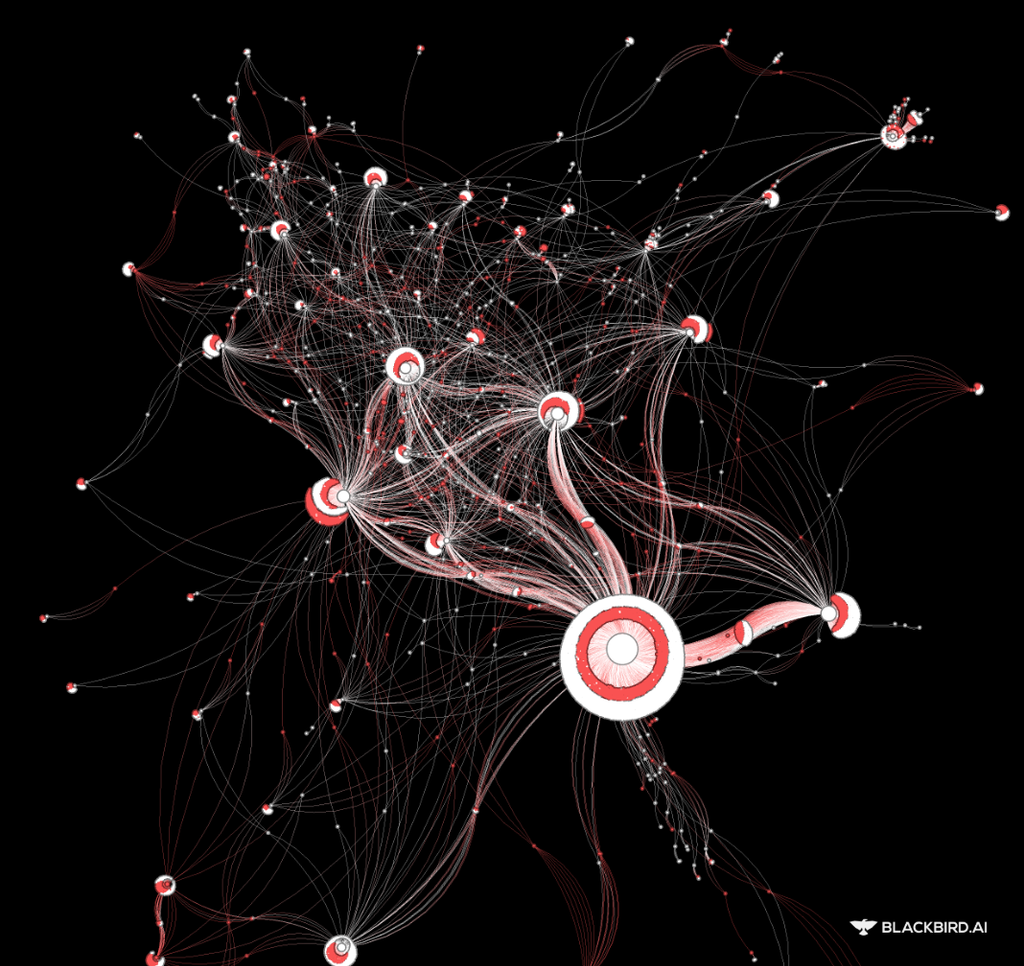
Constellation network graph of narratives around a single data center, with 28.4 percent of accounts exhibiting bot-like behavior. Bot accounts operated at the network’s edges in coordinated chains, amplifying existing influence rather than driving it. The pattern indicates genuine public interest in the topic, boosted by coordinated inauthentic activity.
Lower Post Volume Can Conceal Data Center Policy Risk
Blackbird.AI’s 2026 Data Center Narrative Intelligence Report traced how those disputes spread across the United States. It found that genuine concerns about water, power, and transparency attracted misleading claims and amplification by foreign state-aligned networks. Developers need to address residents’ concerns and understand who is extending their reach.
In a separate RBlackbird.AI RAV3N Research Team assessment of one chipmaker, data center mentions fell from about 6 million to 3.3 million between consecutive review months. The audience behind the criticism shifted from grassroots opposition toward federal policy debate. Teams needed to understand which officials and policy communities were engaging and which decisions they could influence. A hearing date or legislative proposal can matter more to a project than a large but disconnected audience.
Earlier warning gives teams time to examine a claim before a hearing, filing, or policy decision. Blackbird.AI’s Constellation platform maps narratives, actors, and networks. RAV3N Radar delivers briefs and alerts in Slack or email. Teams can use those findings to identify who should verify an issue and whether a response is needed.
The Way Forward: Key Takeaways for Organization Leaders
- Take local opposition seriously. Publish verifiable information about water use, power demand, tax incentives, and expected jobs. Address residents’ concerns directly and explain what remains uncertain.
- Examine who is spreading consequential claims. Use narrative intelligence to trace their origins, identify amplification networks, and assess evidence of manipulation. Post volume and shared language alone do not establish a coordinated attack.
- Monitor risk across the full portfolio. Prioritize sites where emerging disputes could affect permits, litigation, or construction schedules. Assign responsibility for verification and response, and brief leaders before critical decisions.
Narrative intelligence should inform site selection, permitting, and community relations. Teams need to see which claims are gaining influence and which decisions they could affect. That gives leaders a clearer basis for engagement before a dispute escalates.
Gartner’s research puts AI infrastructure returns under closer examination. Blackbird.AI’s research shows why developers must also understand the disputes surrounding each site. For a project awaiting approval, an unanswered water question can become a delivery problem.

Dan Patterson • Head of Corporate Communications
Dan Patterson is a strategic communications leader driving impact at the intersection of artificial intelligence, cybersecurity, and media. At Blackbird.AI, Dan leads communication and content strategy that breaks down complex AI and cybersecurity concepts for diverse business audiences. Prior, he was the national tech correspondent for CBS News.
Dan Patterson is a strategic communications leader driving impact at the intersection of artificial intelligence, cybersecurity, and media. At Blackbird.AI, Dan leads communication and content strategy that breaks down complex AI and cybersecurity concepts for diverse business audiences. Prior, he was the national tech correspondent for CBS News.

RAV3N Research •
The Blackbird.AI RAV3N Research Team is a cross-disciplinary unit of narrative intelligence analysts that publishes data-driven, evidence-based research on how narrative attacks created by misinformation and disinformation cause financial and reputational harm to public and private sector organizations, including global brands, Fortune 500 companies, government agencies, and executives. Using Blackbird.AI's Constellation Narrative Intelligence Platform, our analysts identify the influence behind narratives, the networks they touch, the anomalous bot behavior that scales them, and the cohorts and communities that connect them to surface the full picture of how narratives form and spread.
The Blackbird.AI RAV3N Research Team is a cross-disciplinary unit of narrative intelligence analysts that publishes data-driven, evidence-based research on how narrative attacks created by misinformation and disinformation cause financial and reputational harm to public and private sector organizations, including global brands, Fortune 500 companies, government agencies, and executives. Using Blackbird.AI's Constellation Narrative Intelligence Platform, our analysts identify the influence behind narratives, the networks they touch, the anomalous bot behavior that scales them, and the cohorts and communities that connect them to surface the full picture of how narratives form and spread.
About Blackbird.AI

Blackbird.AI is the Narrative Intelligence Detection and Response company protecting executives, organizations, and institutions from narrative-based disinformation attacks that cause financial, operational, reputational, and physical harm. Blackbird.AI’s Constellation Platform identifies the actors, networks, bots, and communities driving them; and turns those signals into early warning, decision intelligence, and coordinated response. Blackbird.AI brings Narrative Intelligence into the workflows where teams already operate, including cybersecurity, communications, legal, executive, and public-sector environments, with agentic response capabilities and MCP-enabled integrations that help organizations act faster. Founded by AI experts, threat intelligence analysts, and national security professionals, Blackbird.AI helps customers defend trust, strengthen resilience, and Own The Narrative. To learn more, visit Blackbird.AI.