


How Extreme Weather Events Fuel Climate Disinformation and Narrative Attacks
Extreme weather events such as heatwaves, wildfire smoke, hurricanes, and power-grid disruptions impact communities around the world. These events also fuel narrative attacks targeting government agencies and utility companies, portraying their responses as negligent, manipulative, or driven by hidden political and ideological motives.

Gemini
Quick Answers
Why does extreme weather fuel climate disinformation? Extreme weather creates fear, disruption, and an urgent public demand for answers. Threat actors use that uncertainty to seed narrative attacks, coordinated efforts to spread harmful narratives that damage an organization’s reputation and operational structure. These harmful narrative attacks are used to assign blame, deepen distrust in the organizations responding, and advance broader political or ideological goals.
How do narrative attacks about extreme weather put organizations at risk? Government agencies, utility companies, and emergency responders make the most visible decisions during an extreme weather event. This can include evacuation orders, requests to reduce electricity use, and public health advisories. Those decisions are often circulated by threat actors and bots in social posts as narrative attacks alleging incompetence or hidden motives, seeking to erode trust in the organizations coordinating the response. This usually happens while teams are still actively working the emergency, leaving communications teams to answer for the decisions mid-response. Erosion of public trust due to disinformation and narrative attacks can cost an organization the public cooperation it depends on to manage the emergency effectively.
How do threat actors amplify narrative attacks about extreme weather? Threat actors seed disinformation and narrative attacks during extreme weather events, using coordinated influence campaigns and bot amplification to spread them across online networks. That amplification can make a narrative held by a small number of accounts appear to be widely shared organic public opinion, drawing in people who would not have encountered it on their own.
Extreme weather events have hit hard this summer. Several heatwaves broke records across the East Coast and much of Europe. Canadian wildfires sent smoke as far south as Florida and the Gulf Coast, and power grids were strained due to increased demand, leaving thousands of customers without electricity. Along the Gulf Coast and Eastern Seaboard, communities are also preparing for an active hurricane season.
The scale and intensity of this summer’s heat show how quickly extreme weather can strain public health systems and critical infrastructure. Europe recorded its hottest June ever this year, with the heat arriving unusually early and causing thousands of deaths across western Europe. A separate heat dome settled over the eastern United States and eastern Canada through early July. Washington, D.C. had its hottest July 4 on record at 103°F, and Atlantic City, New Jersey reached 106°F, an all-time high for the city. The high temperatures prompted the Department of Energy to issue emergency orders to increase electricity generation across the Mid-Atlantic grid to reduce the risk of outages.
DOWNLOAD: Complimentary Gartner Emerging Market Quadrant for Narrative Intelligence
Extreme weather events like the ones experienced this summer often create openings for climate disinformation and narrative attacks to spread. As conditions worsen, the organizations responsible for public guidance and emergency response can become targets while their work is still underway. This summer, government agencies faced scrutiny over heat advisories and emergency preparedness, while utility companies were blamed for outages and grid strain as crews worked to restore service. Similar dynamics emerge during hurricanes, when evacuation orders, disaster aid decisions, and power-restoration timelines can be reframed as evidence of negligence, incompetence, or favoritism.
Narrative attacks can escalate as extreme weather events create fast-moving emergencies, placing additional pressure on the organizations leading the response and creating narrative risks that extend beyond public criticism. Narrative intelligence gives organizations early visibility into which narratives are spreading and who is driving them while response efforts are still underway.
How does narrative risk show up for organizations during a climate event?
Narrative attacks during an extreme weather event pose risks across multiple functions simultaneously, often while emergency responses are still underway. Narrative risk commonly shows up in four key ways:
- Communications risk: Teams must counter narrative attacks and disinformation while continuing to deliver emergency updates
- Operational risk: Eroding public trust can reduce cooperation with evacuation orders, conservation requests, and safety guidance.
- Reputational and regulatory risk: Organizations and agencies can be portrayed as negligent or profit-driven, increasing political pressure and regulatory scrutiny.
- Security risk: Employees and officials can become personal targets when a narrative attack shifts from criticizing an organization to targeting its leaders.
We identified five narratives shaping the online conversation around the barrage of extreme weather events this summer. Each narrative was checked using Blackbird.AI’s Compass Context.
Narrative #1: The media is exaggerating ordinary summer heat to push a climate agenda
This narrative claims that journalists, climate scientists, and government agencies are overstating normal summer temperatures to create fear and build support for climate policies. Many posts cited historical heat events as evidence that current temperatures were unremarkable, while others alleged that temperature records were distorted by urban heat or manipulated data. We found that multiple accounts posted near-identical messaging within short windows, a signal of coordinated amplification rather than organic spread.
One high-reach post that was promoting broader climate-skeptic messaging received more than 141,000 views, while a separate post falsely alleging that a UN climate committee had admitted its projections were wrong received 24,000 views. Blackbird.AI had previously flagged both accounts for inauthentic amplification behavior.
When a narrative like this gains traction, public agencies issuing heat warnings can be forced to defend their data while trying to deliver urgent safety guidance. That added pressure can weaken public trust and reduce compliance with the precautionary guidelines that could save lives.
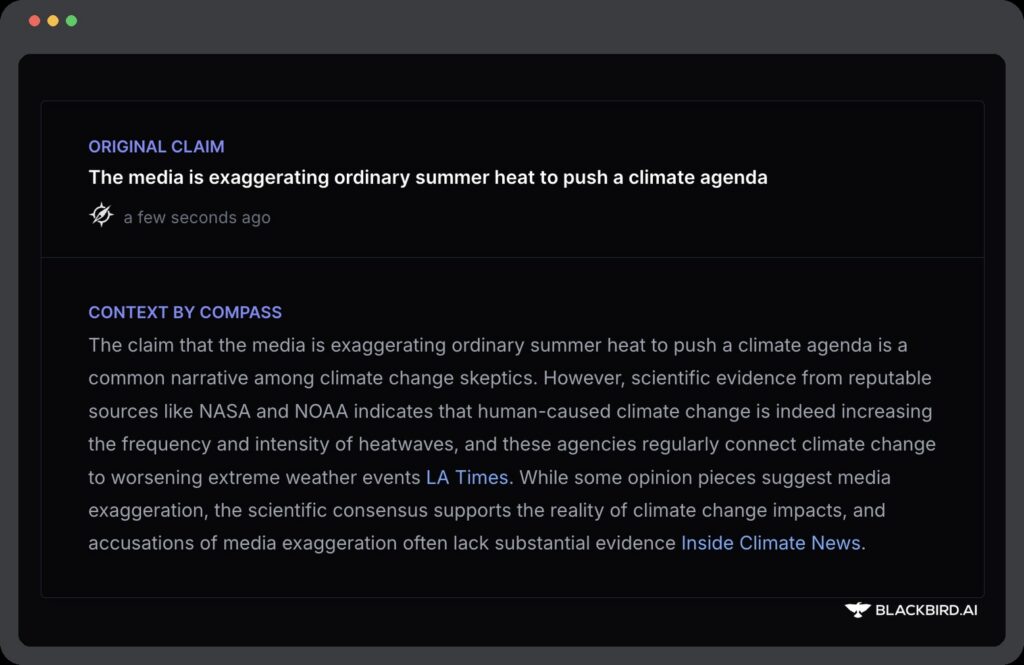
This claim was checked by Compass by Blackbird.AI.
Narrative #2: Canada intentionally allowed wildfire smoke to harm Americans
This narrative attack suggests that Canadian officials failed to prevent or contain the fires, and deliberately allowed smoke to spread into the United States. Posts portrayed forest management decisions and the speed of response to the fires as evidence of government negligence. Others argued that officials prioritized climate policies over wildfire prevention and emergency preparedness.
The narrative expanded beyond criticism of Canada’s response into demands that the country be held responsible for the health and economic effects of the smoke in American communities. Several high-reach posts promoting deliberate-arson narratives generated between 118,000 and 148,000 engagements, even though Canadian government data showed that lightning-caused fires accounted for more than 90% of the total area burned.
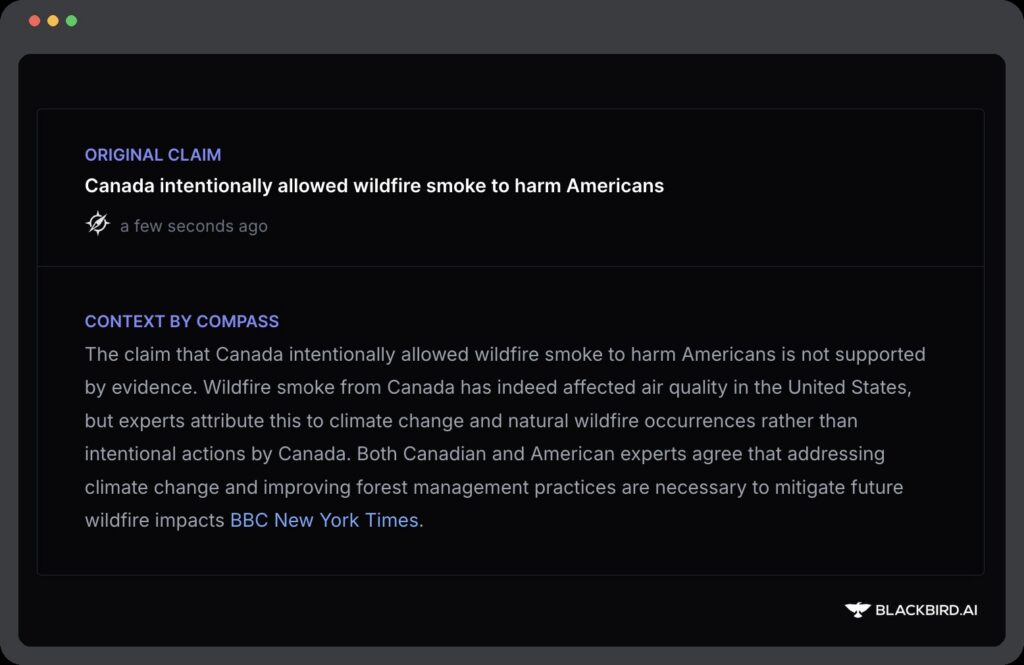
This claim was checked by Compass by Blackbird.AI.
Need help protecting your organization?
Book a demo today to learn more about Blackbird.AI.
Narrative #3: Renewable Energy and AI Infrastructure Caused the Power-Grid Crisis
This narrative attack frames grid instability and conservation requests as direct consequences of climate policy, arguing that prioritizing renewable energy left the grid unable to handle summer demand. As the Department of Energy (DOE) issued emergency orders placing 17 states under a power emergency, two competing blame narratives emerged simultaneously.
The higher-engagement narrative focused on AI infrastructure and data centers. Posts urged the public to ask “where all that electricity is going” and called for “tougher questions” about the amount of power data centers consume, generating more than 527,000 engagements. The DOE orders required large data centers to switch to backup generators, which online social media users cited as definitive proof that AI infrastructure was straining the grid.
A parallel narrative blamed clean energy investment for the grid’s inability to handle summer demand. Government advertisements asking residents to limit electricity use during peak evening hours were reframed as proof that renewable energy could not meet demand when it was needed most. One widely circulated post called it “what happens when ideology replaces engineering,” drawing 184,000 engagements.
For energy companies and grid operators, emergency measures can quickly be recast as evidence of failed planning, misplaced investment, or preferential treatment for certain industries. These narratives often begin shaping public opinion while operators are still working to stabilize the grid, leaving organizations to manage an operational emergency alongside growing public scrutiny and reputational pressure.
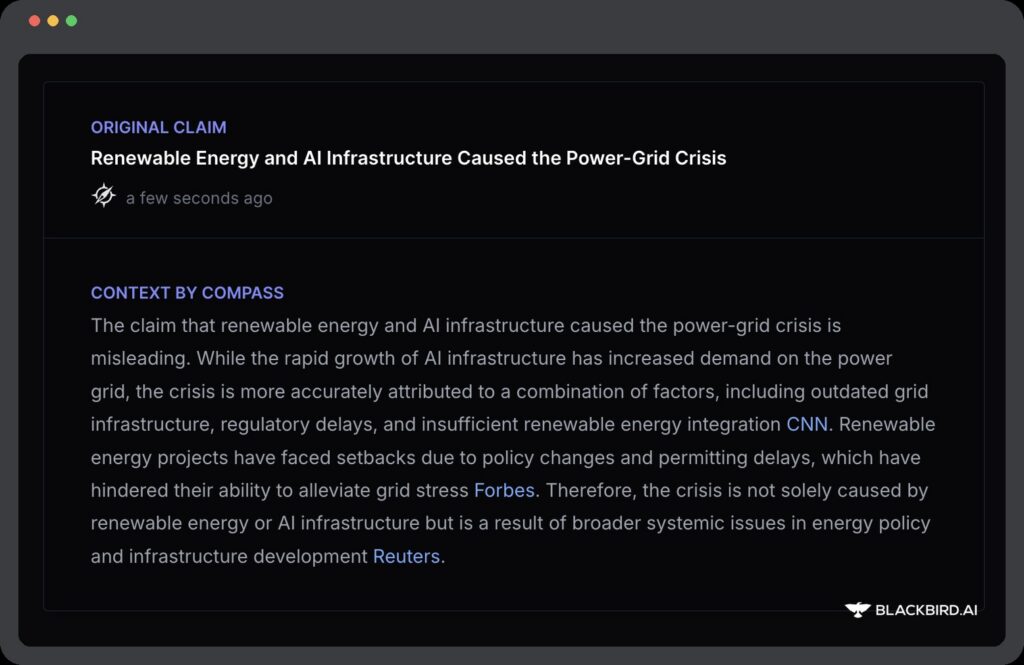
This claim was checked by Compass by Blackbird.AI.
Narrative #4: Governments are manufacturing extreme weather
This narrative attack alleges that governments and private companies are manufacturing extreme weather using methods such as cloud seeding, geoengineering, and directed-energy technology to create or intensify it.
The most widely circulated post in this narrative declared, “This is NOT climate change. This is WEATHER MANIPULATION,” generating nearly 292,000 engagements. A separate thread targeted an executive at a cloud-seeding company, citing $2.6 million in federal cloud-seeding funding as evidence that the government was “launching weather control from the ground.” The two posts received more than 60,000 views combined. Real policy events also added fuel to this narrative. Last year, Florida’s governor signed legislation making unauthorized cloud seeding a felony, giving the narrative a credible hook and making it easier to spread across right-leaning channels.
One pattern that stood out was that 27% of the accounts amplifying the narrative were associated with an anti-vaccine cohort. This overlap suggests that weather-manipulation narratives are moving through audiences already engaged with other conspiracy-focused content, rather than remaining confined solely to climate discussions.
For government agencies, meteorological organizations, and companies involved in cloud seeding or weather-monitoring programs, the targeting can become personal. Executives and officials are named alongside the institutions they represent, creating reputational and security concerns that extend beyond the broader climate debate.
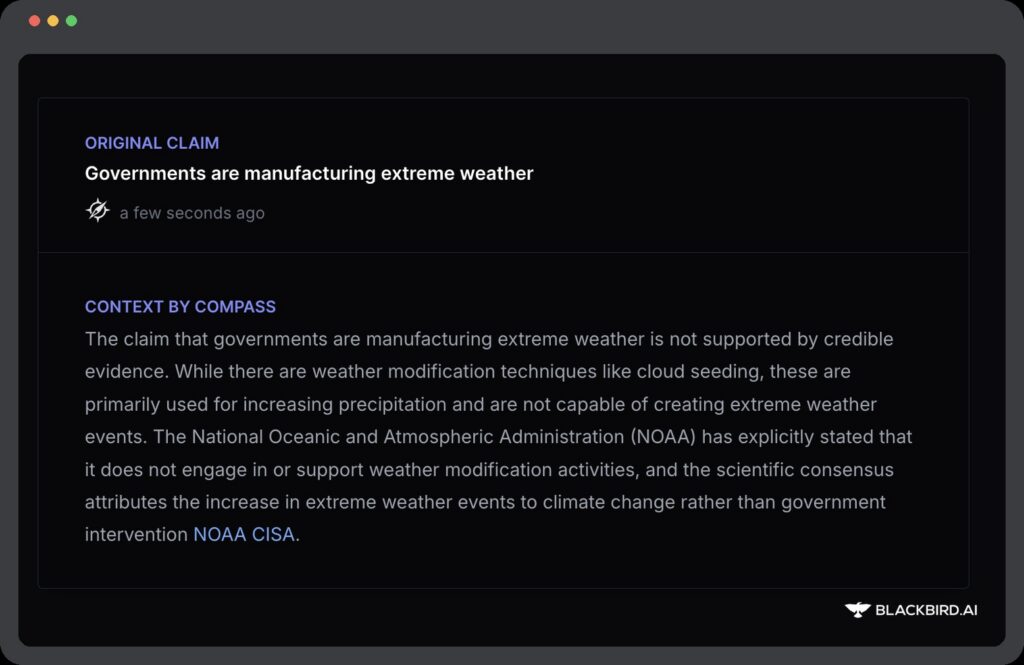
This claim was checked by Compass by Blackbird.AI.
“Unlike deepfake detection, it monitors narratives, identifies adversaries’ intent and pinpoints audience vulnerabilities before AI disinformation attacks can cause significant damage.“
Narrative #5: Climate Emergencies Are Being Used to Expand Government Control and Justify “Climate Lockdowns”
This narrative attack portrays climate policies and emergency measures as tools for expanding government control. It suggests that extreme weather is being manufactured or exaggerated to justify restrictions on daily life, including evacuation orders and limits on electricity use.
The framing is not new. Similar narratives circulated during the COVID-19 pandemic, when public health measures were recast as tools of surveillance and behavioral control. The same amplifier networks that drove health conspiracy content are now applying that framework to climate policy and extreme weather response.
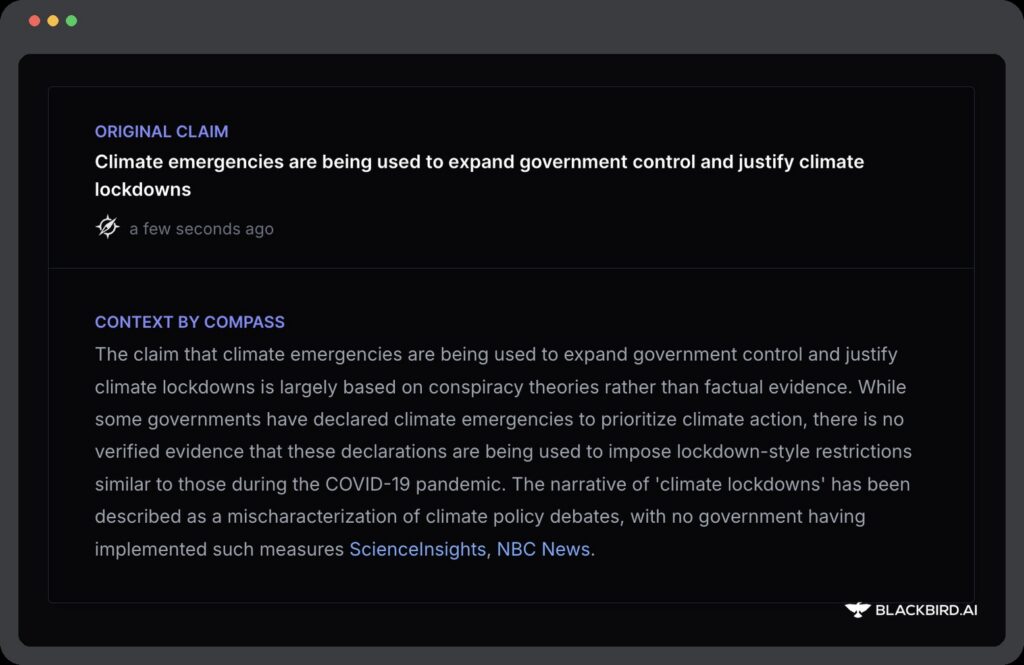
This claim was checked by Compass by Blackbird.AI.
The Way Forward: Key Takeaways for Organization Leaders
Extreme weather creates uncertainty and intense public scrutiny during a time of urgency. Most government agencies and critical infrastructure organizations already have emergency response plans in place. Those plans should also account for narrative attacks that emerge during a physical emergency response. Here are three key takeaways for leaders:
- Integrate narrative intelligence into existing emergency response plans: Identify the narratives most likely to target the organization during an extreme weather event. Define who will monitor them and when to escalate them.
- Detect narratives before they shape public response: Narrative attacks can erode trust in evacuation orders, conservation requests, and other critical guidance. Early visibility using narrative intelligence helps teams identify harmful narratives before they reduce public cooperation.
- Align teams around narrative risk: Communications, operations, and security teams need a shared view of the narratives affecting the response. This helps teams coordinate decisions and deliver consistent information while the emergency remains active.
Organizations and agencies responding to extreme weather must manage public perception alongside the physical emergency. As heatwaves, wildfires, and grid emergencies unfold, narrative attacks can portray urgent safety guidance as evidence of negligence or hidden political motives, turning online distrust into operational risk. Narrative intelligence helps response teams identify which narratives are gaining traction, who is driving them, and how they are spreading. Blackbird.AI’s Constellation Narrative Intelligence Platform provides organizations with real-time visibility, helping maintain public cooperation as extreme weather unfolds.

Amanda Burkard • Marketing Manager
Amanda Burkard is a Marketing Manager at Blackbird.AI, where she supports content development, demand generation, event coordination, and marketing operations. Outside of work, Amanda is an accomplished Irish dancer. She holds a B.A. in Psychology from the University of Virginia.
Amanda Burkard is a Marketing Manager at Blackbird.AI, where she supports content development, demand generation, event coordination, and marketing operations. Outside of work, Amanda is an accomplished Irish dancer. She holds a B.A. in Psychology from the University of Virginia.
About Blackbird.AI

Blackbird.AI is the Narrative Intelligence Detection and Response company protecting executives, organizations, and institutions from narrative-based disinformation attacks that cause financial, operational, reputational, and physical harm. Blackbird.AI’s Constellation Platform identifies the actors, networks, bots, and communities driving them; and turns those signals into early warning, decision intelligence, and coordinated response. Blackbird.AI brings Narrative Intelligence into the workflows where teams already operate, including cybersecurity, communications, legal, executive, and public-sector environments, with agentic response capabilities and MCP-enabled integrations that help organizations act faster. Founded by AI experts, threat intelligence analysts, and national security professionals, Blackbird.AI helps customers defend trust, strengthen resilience, and Own The Narrative. To learn more, visit Blackbird.AI.