How Generosity Became one of the Biggest Stories of the World Cup’s Final Weeks
A humanitarian gesture from one nation's football team flew under the radar for months, then it blew up as one of the World Cup's biggest narratives as fans united during the tournament's final weeks. Blackbird.AI's RAV3N Research team details what the surge reveals about organic audience energy.

Gemini
This blog is part of a series of Blackbird.AI RAV3N Research posts about manipulated narratives impacting the 2026 World Cup. Read more:
- Millions of World Cup viewers fooled by fireworks: Argentina and Messi victims of 5 distinct narrative attacks, all from different actors
- How a Narrative Attack Reshaped Mexico’s 2026 World Cup
- As the FIFA World Cup Comes to North America, Narrative Attacks Target Sponsors
- The World Cup Continues, FIFA Targeted By Narrative Attacks
- The Verdict Came Before the Games: How Bad Actors Tried to Buy World Cup Narratives.
Quick Answers
- What happened? A months-old charity donation by Country D’s football federation resurfaced around a marquee knockout match and became the window’s largest narrative cluster, with close to 34,000 posts and more than 775,000 engagements.
- Why did it spread? Fans used the story as a statement of values, associating their support with humanitarian action and framing the team as something worth standing for.
- Who carried it? Fan communities. Constellation classified the cluster as an organic surge, spread by individual users posting on their own rather than by coordinated amplification.
- Why does it matter? Positive narratives store energy the same way risk narratives do, and the instrumentation that flags threats can spot goodwill in motion while there is still time to act on it.
DOWNLOAD: Complimentary Gartner Emerging Market Quadrant for Narrative Intelligence
Months before the tournament began, one nation’s football team gave the net ticket revenue from a qualifying match to humanitarian relief. The gesture drew wide attention online, became a talking point among fans, and then went quiet. On the day Country D met a tournament favorite in the knockout rounds, the story returned at scale, passing 16,000 posts in a single day, driven by supporters who wanted the world to know what their team had done with its money. The donation was old news. The pride in it was current.
During the latest reporting window, Blackbird.AI’s RAV3N team used the Constellation platform to monitor the tournament’s narrative landscape, and the largest cluster in it was a story about generosity. The donation narrative generated nearly 34,000 posts and more than 775,000 engagements, peaking at about 8,000 posts per day, with a single-day spike exceeding 16,000 posts on match day. Constellation classified the surge as organic, carried by fan communities posting as individuals. A smaller thread from the prior window showed the same instinct: supporters of the nation, Country A, defending the legitimacy of their team’s run. Together, the clusters make a case that tournament conversation is driven as much by what fans want to stand for as by what they want to argue about. Five positive narratives stood out across the two windows.
Positive Narrative 1: An act of charity became the window’s largest narrative
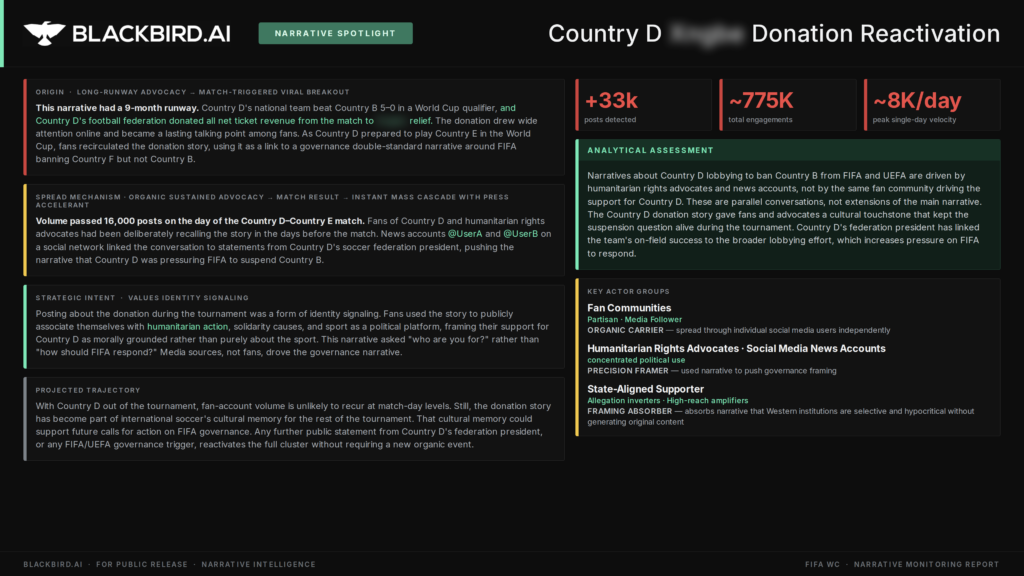
The donation cluster outdrew every other narrative Constellation tracked in the window. Close to 34,000 posts and more than 775,000 engagements accumulated around a single fact: Country D’s federation gave the net proceeds of a match to humanitarian relief. Volume peaked at about 8,000 posts per day and passed 16,000 on the day of Country D’s knockout match, when fans revived the story as their team took the tournament’s biggest stage. No other narrative in the window came close. The next largest cluster ran at less than a tenth of the volume. A federation’s decision about ticket revenue outperformed every manufactured storyline on the board.
Positive Narrative 2: Fans made a statement of support for values
The post about the donation served as identity signaling. Supporters used the story to associate themselves with humanitarian action and with the idea of sport as a platform for good, framing their support for Country D as grounded in values rather than results alone. The question the narrative asked was “Who are you for?” and fans answered with the story of what their federation had given away. For brands and federations, the mechanics matter: audiences did the storytelling themselves, unprompted by any campaign, because the underlying act gave them something they were proud to attach their names to.
Positive Narrative 3: Goodwill held its value for nine months
The narrative had a nine-month runway. The donation drew attention when it happened, faded from feeds, and sat dormant until the fixture gave fans a reason to bring it back, at which point it returned larger than its first wave. The story has now entered international soccer’s cultural memory for the remainder of the tournament. The lesson runs counter to the assumption that online attention is disposable: an authentic gesture kept its full charge for nine quiet months, and the audience, rather than the institution, decided when to spend it.
Positive Narrative 4: The surge was organic and fan-carried
Constellation classified the cluster as an organic surge. Fan communities functioned as the carrier, spreading the story as individual users posted on their own, without coordinated amplification. The cluster showed the signature of a genuine narrative throughout: distributed origins, individual voices, and volume that tracked a real-world moment, the fixture itself, rather than a posting schedule. In a tournament information environment where authenticity is often the open question, this was the rare cluster where the answer was clear.
Positive Narrative 5: Supporters stood by their country
A smaller thread from the prior window showed the same fan instinct pointed at a different target. Supporters of Country A pushed back on attempts to label the team’s World Cup success a “robbery,” insisting the run was earned on the field. The cluster was modest, about 340 posts and more than 2,500 engagements, and Constellation rated it low risk, which is itself worth noting: fan loyalty expressed as defense of a team’s legitimacy registered as one of the calmest corners of the tournament’s information environment. The volume was small. The instinct behind it, pride in a team’s achievement, is the same energy that powered the donation story at a hundred times the scale.
Summary: What the organic positive narrative tells us
Positive narratives follow the same physics as risk narratives. They build on long runways, store energy during dormant stretches, reactivate in response to real-world triggers such as fixtures, and move at measurable velocity. The difference is what they carry. The same instrumentation that maps a threat can map goodwill in motion, and an organization that measures threats alone sees half of its information environment.
The Manipulated Narratives
Bad actors, bots, and influencers drove a number of manipulated narratives during the closing weeks of the 2026 World Cup.
Manipulated Narrative 1: A PR firm paid influencers to smear Country A
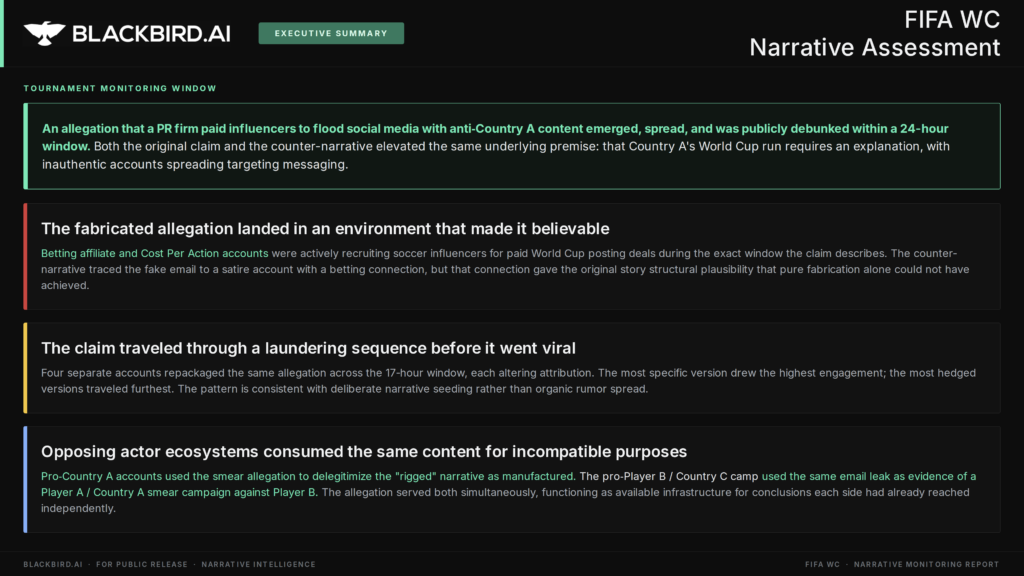
An unverified allegation that a PR firm was paying soccer influencers to flood social media with anti-Country A content emerged from a laundered origin chain across a six-hour window, building on suspicion that users had voiced for days about the volume and uniformity of rigged-path talking points. The cluster reached about 7,800 posts and around 467,000 engagements, peaking at about 1,000 posts per day. A counter-narrative traced the story to an AI-generated fake email from a satirical account within hours, yet the debunking entered the same amplification channels as the original claim and generated a second wave of engagement instead of closing the first. The fabrication landed as believable because real betting affiliates and Cost Per Action accounts were recruiting soccer influencers for paid World Cup posting deals during the exact window described in the claim. Pure invention could not have achieved that structural plausibility on its own.
Manipulated Narrative 2: The real target is a rival player
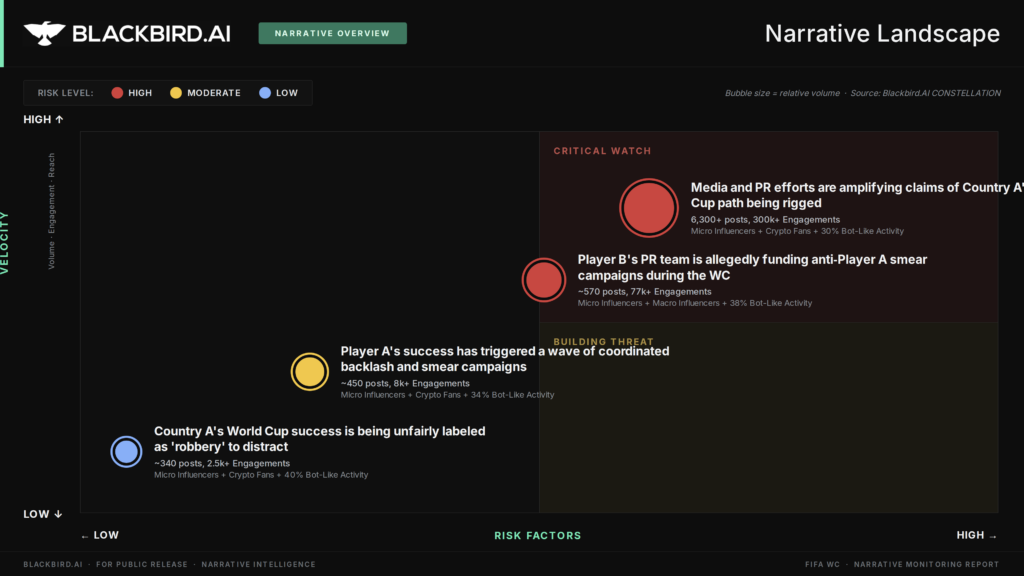
Opposing fan ecosystems consumed the same fabricated email for incompatible purposes. Supporters of Country A used the allegation to dismiss the rigged-path narrative as manufactured. Supporters of a rival soccer player inverted the claim, arguing that the smear campaign targeted the rival and their national team, and named the rival’s PR team as the party funding anti-Country A content. The inverted cluster produced about 570 posts and more than 77,000 engagements with 38 percent bot-like activity, and a single inversion post generated more than 14,000 engagements on its own. One artifact served two contradictory conclusions at once, functioning as available infrastructure for beliefs each side had reached before the email existed.
Manipulated Narrative 3: Country A is the Country B of football
A phrase comparing Country A to Country B emerged from a fringe fan account months before the tournament, during the European club season, and grew into a full political metaphor within nine hours, casting a prominent soccer player as Country B’s head of government and FIFA as the United Nations. The phrase sat dormant in ambient anti-Country A vocabulary until a contested knockout match triggered a second wave four times larger than the first, lifting the cluster to about 7,400 posts and around 57,000 engagements. The second wave differed in structure from the first: multiple independent posts appeared at once across several social media platforms and tagged high-reach sports journalists and mainstream outlets, a pattern consistent with an attempt to force media pickup rather than organic spread among fans. The phrase works across three audiences without changing its text, serving as a sports rivalry for one, a geopolitical protest for another, and an anti-FIFA institutional critique for a third. Each refereeing controversy reloads it with fresh evidence, no coordination required.
Manipulated Narrative 4: A prominent politician denigrated FIFA
The prior window’s largest cluster erupted when a prominent politician confirmed on social media that they had contacted FIFA’s president about a player suspension, and a senior government official confirmed separate talks with the governing body within hours of a knockout kickoff. Allegation, denial, and confirmation are compressed into a single news day. The narrative generated about 365,000 posts and more than 15 billion in total reach, peaking at about 91,000 posts per day, with liberal-leaning audiences condemning political interference and conservative-leaning audiences defending the reversal from opposite entry points. A foreign state-aligned media account with more than two million followers earned some of the highest engagement in the dataset, a signal that influence ecosystems concentrated at peak volume through deniable amplification channels rather than official outlets. Volume collapsed to near zero within 48 hours of the match because the narrative had no mechanism to sustain itself once the game ended. The frame it established, that political power bent FIFA’s rules, now anchors every subsequent governance story, including a formal ethics complaint and an investigation letter backed by more than 30 European lawmakers.
The Way Forward – Key Takeaways for Organization Leaders
- Authentic gestures are durable assets. The donation kept its narrative value for nine months and returned stronger. Acts of substance outlast campaign calendars.
- Fans want material worth standing for. The window’s largest cluster existed because supporters chose to make a values statement. Organizations that give audiences something real to attach to will find much of the storytelling done for them.
- Measure the upside. Narrative intelligence is often read as a defensive discipline, yet the same monitoring that flags a threat can catch an organic surge at ignition, giving communications teams the chance to amplify goodwill while it is moving.
The donation narrative will be forever tied to the 2026 World Cup. Blackbird.AI’s Narrative Intelligence platform measured the organic surge in real time, just as it measures risk. Manipulated narratives can rapidly harm organizations, but those that implement narrative intelligence can also benefit from the technology and ride a wave of positive consumer – and fan – sentiment.

Dan Patterson • Head of Corporate Communications
Dan Patterson is a strategic communications leader driving impact at the intersection of artificial intelligence, cybersecurity, and media. At Blackbird.AI, Dan leads communication and content strategy that breaks down complex AI and cybersecurity concepts for diverse business audiences. Prior, he was the national tech correspondent for CBS News.
Dan Patterson is a strategic communications leader driving impact at the intersection of artificial intelligence, cybersecurity, and media. At Blackbird.AI, Dan leads communication and content strategy that breaks down complex AI and cybersecurity concepts for diverse business audiences. Prior, he was the national tech correspondent for CBS News.

RAV3N Research •
The Blackbird.AI RAV3N Research Team is a cross-disciplinary unit of narrative intelligence analysts that publishes data-driven, evidence-based research on how narrative attacks created by misinformation and disinformation cause financial and reputational harm to public and private sector organizations, including global brands, Fortune 500 companies, government agencies, and executives. Using Blackbird.AI's Constellation Narrative Intelligence Platform, our analysts identify the influence behind narratives, the networks they touch, the anomalous bot behavior that scales them, and the cohorts and communities that connect them to surface the full picture of how narratives form and spread.
The Blackbird.AI RAV3N Research Team is a cross-disciplinary unit of narrative intelligence analysts that publishes data-driven, evidence-based research on how narrative attacks created by misinformation and disinformation cause financial and reputational harm to public and private sector organizations, including global brands, Fortune 500 companies, government agencies, and executives. Using Blackbird.AI's Constellation Narrative Intelligence Platform, our analysts identify the influence behind narratives, the networks they touch, the anomalous bot behavior that scales them, and the cohorts and communities that connect them to surface the full picture of how narratives form and spread.

Andrew Dougherty • Intelligence Analyst
Andrew Dougherty is an Intelligence Analyst at Blackbird.AI, specializing in fraud network investigations and subject intelligence. Andrew brings a background spanning public sector defense and security work, combined with private sector experience in brand protection and threat intelligence for enterprise clients.
Andrew Dougherty is an Intelligence Analyst at Blackbird.AI, specializing in fraud network investigations and subject intelligence. Andrew brings a background spanning public sector defense and security work, combined with private sector experience in brand protection and threat intelligence for enterprise clients.
About Blackbird.AI

Blackbird.AI is the Narrative Intelligence Detection and Response company protecting executives, organizations, and institutions from narrative-based disinformation attacks that cause financial, operational, reputational, and physical harm. Blackbird.AI’s Constellation Platform identifies the actors, networks, bots, and communities driving them; and turns those signals into early warning, decision intelligence, and coordinated response. Blackbird.AI brings Narrative Intelligence into the workflows where teams already operate, including cybersecurity, communications, legal, executive, and public-sector environments, with agentic response capabilities and MCP-enabled integrations that help organizations act faster. Founded by AI experts, threat intelligence analysts, and national security professionals, Blackbird.AI helps customers defend trust, strengthen resilience, and Own The Narrative. To learn more, visit Blackbird.AI.