



Seven Health Narratives Driving a Wave of Health Misinformation
Across the first half of 2026, seven linked narratives promised cancer cures, parasite causation theories, and pharmaceutical substitutes to an audience of more than 24,000 accounts. Automation played almost no part in it. People did the work.

Dall-E 3
Quick Answers
- What did the analysis examine? Seven health misinformation narratives were monitored on social media during the first half of 2026, with each rated across five risk signals and measured by post counts, authors, and engagement.
- How large was the activity? Roughly 198,000 engagements across about 31,200 posts from about 24,100 author accounts, counted across the seven narratives with overlap possible between them.
- Were the accounts automated? No. Bot-like activity was rated low across all seven narratives. The volume came from human accounts.
- Which narrative carried the most weight? Antiparasitic drugs promoted as cancer treatment, at approximately 108,700 engagements, more than four times the next narrative.
- Why does this matter to organizations? Health misinformation of this kind reaches patients, employees, and customers at the moment of a medical decision, and it names pharmaceutical companies, hospital systems, and regulators as the villains of the story.
- What is the recommended response? Monitor narrative formation rather than isolated posts, prepare context in advance of the moment of decision, and treat medical authority as a reputational asset that requires defense.
DOWNLOAD: Complimentary Gartner Emerging Market Quadrant for Narrative Intelligence
An individual who had just received a cancer diagnosis, searching social media in the spring of 2026, would have encountered within a few scrolls the claim that the disease is caused by parasites, that chemotherapy enriches hospital systems without curing anyone, and that a deworming tablet sold at farm supply counters offers a cure oncologists refuse to name. None of it rested on a completed clinical trial. All of it rested on an audience, and it was a substantial one.
Blackbird.AI RAV3N analysts monitored seven interlocking health narratives across social media during the first half of 2026. Together, the narratives generated approximately 198,000 engagements across about 31,200 posts from about 24,100 author accounts. Four of the seven carried a High Compass risk rating, the platform’s assessment of the gap between a claim and the verifiable record. Five of the seven were registered as high toxicity. Bot-like activity registered Low in every case, which distinguishes this cluster from campaigns built on automation. The narratives moved through communities organized around distrust of mainstream medicine, and several showed signs of coordinated promotion and inauthentic amplification layered on top of that organic base. The claims converge on a single structure: an inexpensive remedy exists, it works, and an institution is hiding it.
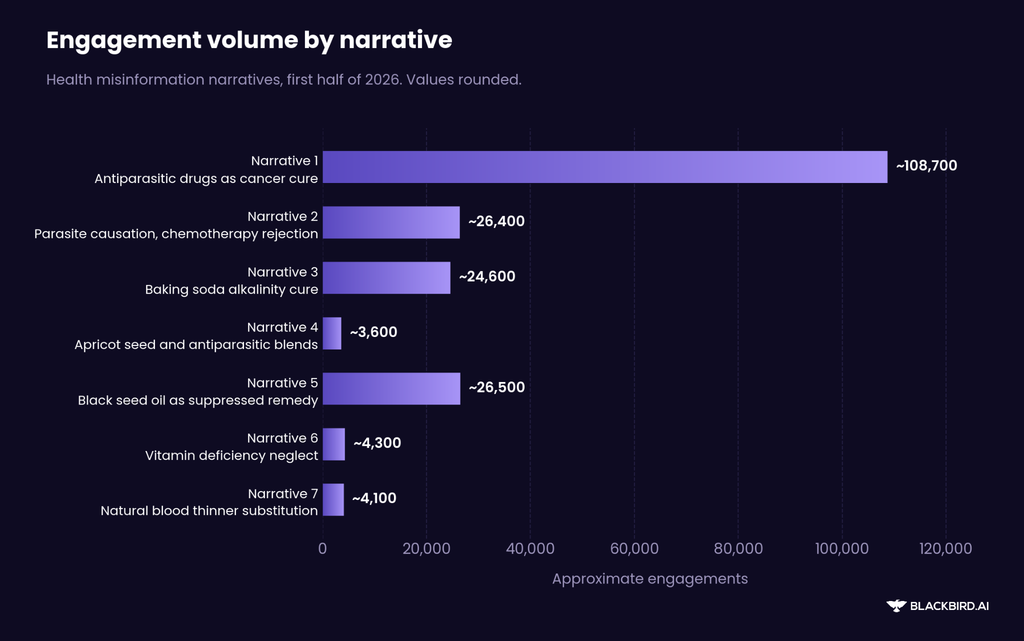
Figure 1. Approximate engagement volume for each narrative during the reporting period. Values rounded for public release.
Details
Narrative 1: Antiparasitic drugs promoted as cancer treatment
The largest narrative of the seven held that fenbendazole and related antiparasitic compounds treat multiple cancers. It produced approximately 108,700 engagements across about 16,200 posts from about 11,900 accounts, a volume more than four times that of any other narrative in the cluster. The platform rated it High for Compass risk, High for toxicity, and High for negative sentiment, with Low bot-like and Low anomalous scores, a profile consistent with authentic communities carrying the message at scale. Posts drew on selective readings of recent laboratory publications while omitting the absence of large human studies. Independent reporting from the Center for Infectious Disease Research and Policy, Pharmacy Times, and the Associated Press has documented the promotion of these drugs as cancer treatments without supporting clinical evidence, and clinicians have warned against substituting them for established care. The takeaway: the most consequential health narrative of the period required no automation, only volume and repetition.
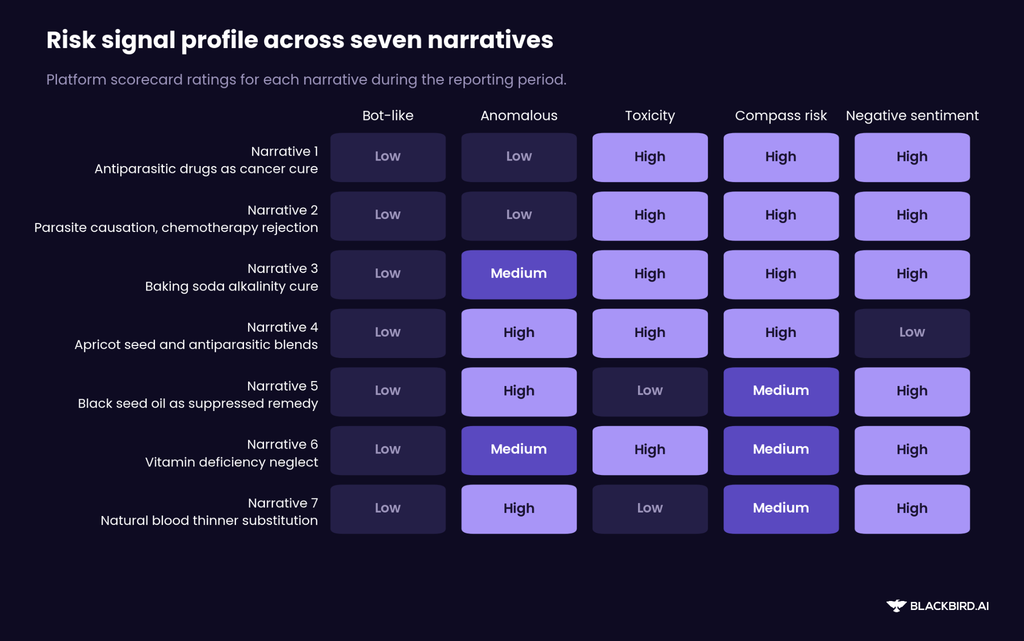
Figure 2. Risk signal ratings assigned to each narrative. Bot-like activity remained Low across all seven.
Narrative 2: Parasite causation and rejection of chemotherapy
The second narrative advanced two claims at once: that cancer originates from parasites and that chemotherapy is both ineffective and a vehicle for financial exploitation. It drew approximately 26,400 engagements across about 3,000 posts from about 2,700 accounts and earned the highest engagement-per-post ratio among the four High-risk narratives at roughly nine engagements per post. Risk signals returned High for toxicity, Compass risk, and negative sentiment. The National Cancer Institute attributes cancer to genetic mutation, environmental exposure, and lifestyle factors, and chemotherapy remains a standard treatment across many cancer types. Cost pressure in oncology care is a documented concern, and this narrative borrows that legitimate grievance to carry an illegitimate medical claim. The takeaway: the most durable misinformation attaches itself to a real institutional failure.
Narrative 3: Baking soda and body alkalinity as disease prevention
The third narrative held that alkalizing the body with sodium bicarbonate prevents disease, including cancer. It generated approximately 24,600 engagements across about 5,300 posts from about 4,300 accounts, the second-largest author base in the cluster. Signals returned High for toxicity and Compass risk, and negative sentiment, with a Medium anomalous rating indicating irregular distribution patterns. Research summarized by OncoDaily, Healthline, and Cancer Research UK notes that while sodium bicarbonate has been studied for its effect on tumor acidity in combination with other treatments, no clinical evidence supports it as a standalone cure, and the human body regulates pH within a narrow range that diet does not shift. The takeaway: a claim with a thread of laboratory plausibility travels further than one invented whole.
Figure 3. Post counts measured against unique author counts. Ratios near one indicate broad participation rather than concentrated repetition.
Narrative 4: Apricot seeds, black cumin seed oil, and antiparasitic blends
The fourth narrative combined natural products with off-label medication into a single cure claim and framed suppression by modern medicine as the reason the combination is unfamiliar. Volume stayed low at approximately 3,600 engagements across about 1,200 posts from about 870 accounts, though the anomalous rating returned as High, indicating distribution patterns inconsistent with organic spread. Compass risk and toxicity were both registered as High. The safety concern here is direct: apricot seeds contain amygdalin, which converts to cyanide in the body, and Cancer Research UK reports no proven anticancer effect. The National Center for Complementary and Integrative Health finds no conclusive evidence for black cumin seed oil as a cancer treatment, and ivermectin holds no FDA approval for that use. The takeaway: engagement volume is a poor proxy for physical danger.
Narrative 5: Black seed oil as a suppressed natural remedy
The fifth narrative presented black seed oil as a broad-spectrum remedy that modern medicine has suppressed for economic reasons. It produced approximately 26,500 engagements across about 4,400 posts from about 3,400 accounts, a reach comparable to that of the second-ranked narrative, despite a Medium Compass risk rating and a Low toxicity score. A prominent account with millions of followers amplified the claim, and the content showed signs of coordinated promotion. The Cleveland Clinic and Medical News Today report that research supports some anti-inflammatory and antioxidant properties, without establishing the oil as a replacement for conventional treatment, and WebMD finds no credible evidence for the suppression claim. The takeaway: a partial truth about a compound becomes the delivery vehicle for a false claim about an institution.
Narrative 6: Vitamin deficiency and the neglect of standard screening
The sixth narrative argued that vitamins and minerals are essential to health yet are overlooked in medical treatment, with an emphasis on testing for vitamins D and B12. It recorded the smallest footprint in the cluster, at approximately 4,300 engagements across about 310 posts from about 250 accounts, and the highest resonance per post of any narrative, at roughly 14 engagements per post. Toxicity returned High against a Medium Compass risk rating. The underlying premise is supported: the National Institutes of Health describes these micronutrients as necessary for normal body function, and the Cleveland Clinic emphasizes maintaining adequate levels. The contested element is the charge of institutional neglect, which varies depending on individual clinical practice and patient needs.
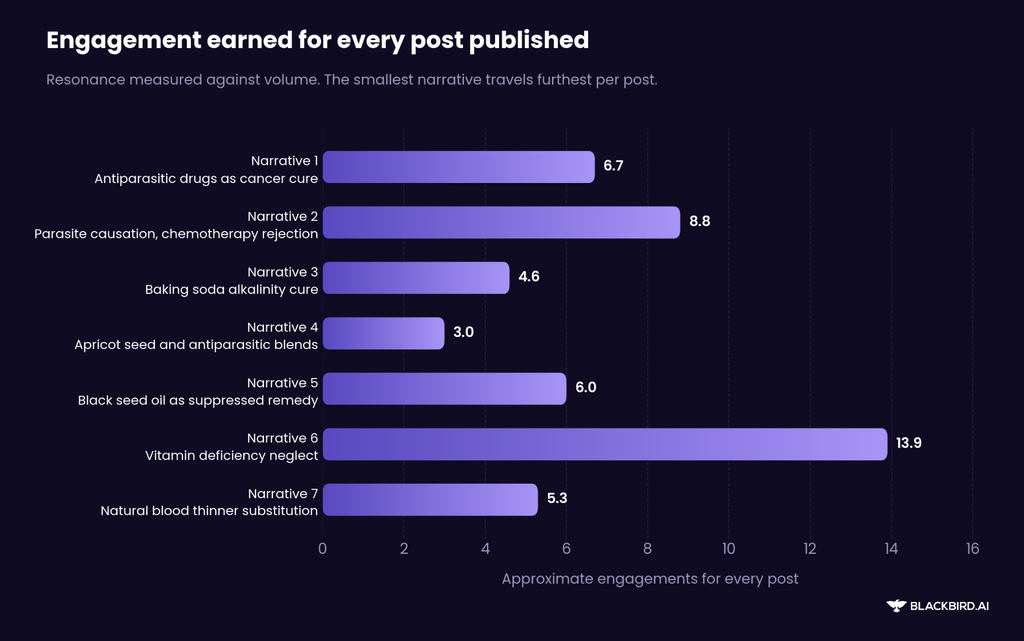
Figure 4. Engagement earned for each post. Narrative 6 achieved the highest ratio in the cluster, despite having the smallest post volume.
Narrative 6 also produced the clearest cohort picture in the dataset. The audience carrying it was divided across political and media affiliation groups rather than health communities, with the leading cohort responsible for 84 posts and three further cohorts at 52 each. Cohort names have been generalized for public release. The pattern is worth attention because it shows a health claim traveling through identity communities rather than patient communities.
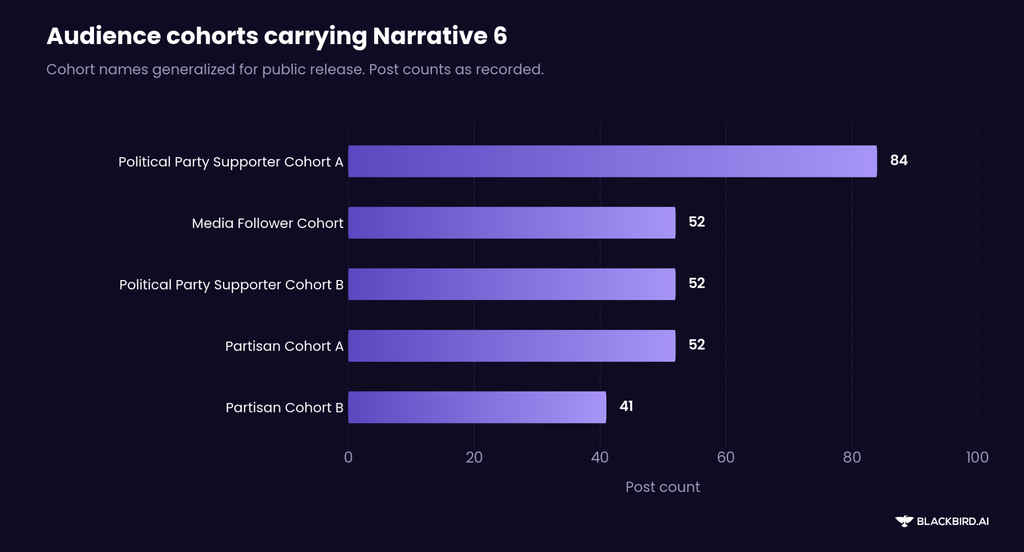
Figure 5. Audience cohorts recorded for Narrative 6, with cohort labels generalized for public release.
Narrative 7: Natural substitutes for pharmaceutical blood thinners
The seventh narrative promoted curcumin, nattokinase, and bromelain as alternatives to prescription anticoagulants, framing them as a threat to pharmaceutical interests. It recorded approximately 4,100 engagements across about 780 posts from about 750 accounts, with a High anomalous rating and coordinated activity across platforms. Compass risk returned to Medium. Memorial Sloan Kettering Cancer Center and other clinical sources note that these substances have some blood-thinning properties but are less studied and less regulated than pharmaceutical options, and their effects vary among individuals. The clinical risk lies in substitution without medical supervision, particularly for patients taking other medications. The takeaway: the smallest narrative in the cluster carries one of the most immediate physical risks.
The Way Forward: Key Takeaways for Organization Leaders
- Automation is not always what to look for. People did the work. Bot-like activity registered Low across all seven narratives, while the cluster still reached roughly 198,000 engagements. Detection strategies built to find networks of automated accounts will not find this pattern.
- Every claim names an institution. Each narrative pairs a remedy with a villain, whether a pharmaceutical manufacturer, a hospital system, a regulator, or the medical profession as a whole. Organizations in the health sector inherit a reputational exposure they did not create and cannot ignore.
- Analyze reach and risk separately. The narrative with the highest engagement per post was represented in about 310 posts, and the narrative carrying the most direct physical danger produced the second-smallest volume in the cluster. Prioritizing by volume alone will miss the claims most likely to cause harm.
The seven narratives examined here share an architecture that has proved durable across health topics: an accessible remedy, a suppressed truth, and an institution with a financial motive to keep the truth buried. That structure survives correction because each debunking supplies the already-convinced audience with fresh evidence of suppression. Organizations facing this pattern need visibility into narrative formation before a claim reaches the patient in the examination room, context prepared in advance rather than assembled after a story has traveled, and an understanding that the target of these narratives is trust in institutions. Blackbird.AI works with health, pharmaceutical, and public-sector organizations to identify and reduce narrative risk at the point of formation and to measure its spread across communities.

Dan Patterson • Head of Corporate Communications
Dan Patterson is a strategic communications leader driving impact at the intersection of artificial intelligence, cybersecurity, and media. At Blackbird.AI, Dan leads communication and content strategy that breaks down complex AI and cybersecurity concepts for diverse business audiences. Prior, he was the national tech correspondent for CBS News.
Dan Patterson is a strategic communications leader driving impact at the intersection of artificial intelligence, cybersecurity, and media. At Blackbird.AI, Dan leads communication and content strategy that breaks down complex AI and cybersecurity concepts for diverse business audiences. Prior, he was the national tech correspondent for CBS News.

RAV3N Research •
The Blackbird.AI RAV3N Research Team is a cross-disciplinary unit of narrative intelligence analysts that publishes data-driven, evidence-based research on how narrative attacks created by misinformation and disinformation cause financial and reputational harm to public and private sector organizations, including global brands, Fortune 500 companies, government agencies, and executives. Using Blackbird.AI's Constellation Narrative Intelligence Platform, our analysts identify the influence behind narratives, the networks they touch, the anomalous bot behavior that scales them, and the cohorts and communities that connect them to surface the full picture of how narratives form and spread.
The Blackbird.AI RAV3N Research Team is a cross-disciplinary unit of narrative intelligence analysts that publishes data-driven, evidence-based research on how narrative attacks created by misinformation and disinformation cause financial and reputational harm to public and private sector organizations, including global brands, Fortune 500 companies, government agencies, and executives. Using Blackbird.AI's Constellation Narrative Intelligence Platform, our analysts identify the influence behind narratives, the networks they touch, the anomalous bot behavior that scales them, and the cohorts and communities that connect them to surface the full picture of how narratives form and spread.
About Blackbird.AI

Blackbird.AI is the Narrative Intelligence Detection and Response company protecting executives, organizations, and institutions from narrative-based disinformation attacks that cause financial, operational, reputational, and physical harm. Blackbird.AI’s Constellation Platform identifies the actors, networks, bots, and communities driving them; and turns those signals into early warning, decision intelligence, and coordinated response. Blackbird.AI brings Narrative Intelligence into the workflows where teams already operate, including cybersecurity, communications, legal, executive, and public-sector environments, with agentic response capabilities and MCP-enabled integrations that help organizations act faster. Founded by AI experts, threat intelligence analysts, and national security professionals, Blackbird.AI helps customers defend trust, strengthen resilience, and Own The Narrative. To learn more, visit Blackbird.AI.