



The Verdict Came Before the Games: How Bad Actors Tried to Buy World Cup Narratives.
Blackbird.AI analyzed close to half a million posts about the "rigged World Cup" narrative and found authentic fan anger, leaked briefs offering influencers thousands of dollars to push a story, fake-quote narrative-production inventing statements from managers, and state-aligned media riding an engagement wave they never had to manufacture.

Gemini
This blog is part of a series of Blackbird.AI RAV3N Research posts about manipulated narratives impacting the 2026 World Cup. Read more:
- Millions of World Cup viewers fooled by fireworks: Argentina and Messi victims of 5 distinct narrative attacks, all from different actors
- How Generosity Became one of the Biggest Stories of the World Cup’s Final Weeks
- How a Narrative Attack Reshaped Mexico’s 2026 World Cup
- As the FIFA World Cup Comes to North America, Narrative Attacks Target Sponsors
- The World Cup Continues, FIFA Targeted By Narrative Attacks
Quick Answers
- Was the “World Cup is rigged” outrage driven by bots? No, and we checked with our own technology. Of the roughly 235,000 accounts pushing the line, 94% posted between one and four times. Templated copy-paste was a fraction of one percent. New accounts made up 14% of the amplifiers, compared with 22% and 24% for ordinary Messi and Ronaldo fans: the amplifiers are OLDER than the fans, and a swarm would invert that. We also ran our own bot classifier across all three populations, and the amplifiers came back indistinguishable from the fans, on a metric that flags one in six of EVERYONE because it really detects heavy posters. There is no swarm. Most of the outrage came from real people who were angry for genuine reasons.
- Was any of it paid? Somebody tried to buy leaked recruitment briefs, exposed in posts that have since passed seven million views, described per-match payments, impression bonuses, and flat-fee packages for influencers who would push “Argentina rigged” talking points, with the exact phrases to use. Whether anyone actually took the money, nobody can say. Those mandated phrases never surfaced at any meaningful scale. The transaction happens in a direct message, and the deliverable is a sincere-sounding opinion, so there is no disclosure and no fingerprint to count. Any tally of “paid posts” in a conversation this size is invented.
- Do you need a sponsor to profit from a fake quote? No, and this is what makes the problem persistent. Platform creator payouts reward engagement directly, so fabricated outrage earns rewards whether or not an advertiser is ever involved. Sponsorship stacks a second revenue stream on top. A paid campaign, therefore, rents direction rather than building reach, which is why the briefs are cheap and why the production line keeps running between campaigns.
- So what CAN analysts measure? Not who was paid. Who profits. Payment is invisible from the outside; incentive is not. Blackbird.AI’s RAV3N measured what the outrage actually earns the accounts producing it and found that Argentina-plus-rigging content returns roughly five times the views and far more engagement than anything else those accounts publish. That gradient is measurable, repeatable, and it does not require anyone to confess.
- Why does this matter beyond football? The same architecture (real grievance, an outrage economy that pays for amplifying it, political capture, state opportunism) is aimed at executives and corporations, elections, public health, financial institutions, and brands. Football offered a version with a scoreboard, which makes the manufactured layer easier to see.
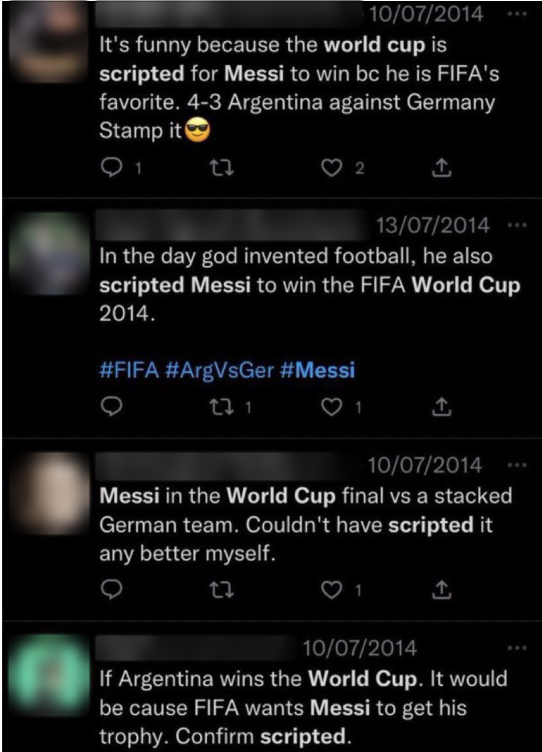
Three days before the 2014 World Cup final, a football fan posted his verdict on a match that had not been played yet: “If Argentina wins the World Cup. It would be cause FIFA wants Messi to get his trophy. Confirm scripted.”
Argentina lost that final.
Those posts resurfaced during this summer’s tournament, dug up by fans as receipts, and they read like a diagnosis. “The World Cup is scripted for Messi to win bc he is FIFA’s favorite,” another wrote, also in July 2014. The outcome disproved them, and it did not matter, because the claim was never about the outcome.
Twelve years on, the same chorus is running again, and this time it has a business model. Two days before Argentina played Switzerland this month, a page with 166,000 followers published a quote from the Swiss manager: “Our goalkeeper has already started training for penalties, we know there will be a penalty for Argentina.” He never said it. Swiss public broadcaster SRF covered the actual press conference. Yakin said nothing about penalties or referees. The fake claim has been seen more than five million times anyway.
Social media readers have since attached a note to the post: “Quote attributed to Murat Yakin is fabricated.” The post is still up.
Argentina was awarded no penalty.
In both cases, no controversial call had happened yet. The verdict existed first, and the evidence would be collected later.
The pattern is familiar in online debates over controversial topics: if my side loses, the contest was stolen. The conclusion is fixed in advance, and every event afterward gets sorted into “proof” or “cover-up.” This summer, that logic swallowed the world’s most-watched sporting event. Blackbird.AI’s RAV3N team spent a month measuring the World Cup narratives: close to half a million posts, from about 235,000 accounts, on one narrative alone. What the data show says less about football than about who profits when a crowd gets angry.
A disclosure, because it bears on how you read what follows: the author is a Messi fan. Every significant finding in this piece runs counter to that rooting interest. The outrage is authentic. There is no bot network. Nobody can prove who was paid. And RAV3N ran Messi-fan and Ronaldo-fan control groups through the same instruments precisely so the analysis would not rest on the analyst.
DOWNLOAD: Complimentary Gartner Emerging Market Quadrant for Narrative Intelligence
Fandoms trained on narrative for a decade
The narrative machinery is symmetrical. RAV3N monitored the corrupt-officiating claim across both fandoms, and it runs in both directions at once. “FIFA rigged the tournament for Ronaldo’s farewell,” from one camp. “FIFA protects Messi” from the other. Same vocabulary, same structure, opposite villains.
That symmetry is the legacy of a decade of greatest-of-all-time debate culture. Two fandoms learned that when the scoreboard disappoints, you do not update your beliefs. You update the criteria. The trophy that matters shifts. The stat that counts changes. It was harmless fan banter for years, right up until it was not, because it trained tens of millions of people in a habit: narrative beats outcome.
The anger was real, and that is the point
Argentina’s defeat to Egypt was a brutal way to lose a football match. Egypt led 2-0 late, then conceded three goals in about 13 minutes. There was a disallowed goal and a contested VAR review. No conspiracy is required to explain why Egyptian fans were furious.
FIFA’s head of refereeing reviewed the decisions and, in plain terms, rejected the claims of bias: “We believe that a foul is a foul.” Egypt’s federation filed a formal complaint anyway, and the team’s head coach alleged there “may have been pressure on the referee” to keep Argentina in the tournament, saying his side was cheated.
A team official responding to heartbreak with a conspiracy theory is an old story. What happened next is the new one.
Bad actors tried to buy outrage
As the knockout rounds began, several large football accounts published what they said were recruitment messages from PR agencies offering to pay them to push a specific storyline: Argentina’s run is rigged. One leaked brief, exposed in a post that has since passed seven million views, laid out the ask. Amplify “robbery,” “biased refs,” “media agenda,” and trend the hashtags. A second leak included payment terms: per-match-day rates, a bonus for reaching a million impressions, and a flat package fee for staying on message from the group stage through the knockouts, payable by wire or cryptocurrency, with a non-disclosure agreement attached.
RAV3N searched for a bot network in the “Argentina rigged” conversation but did not find one. The numbers are worth stating plainly because a bot swarm is what everyone first assumes.
94% of the accounts pushing the rigging line posted between 1 and 4 times. That is not what an operation looks like. Identical copy-pasted text came to a fraction of one percent of the corpus, below the baseline for an ordinary conversation. Of the hundred accounts driving the most reach, 61 matched Blackbird.AI’’s cohort database, and 60 of those are influencers.
And then the number that settles it. New accounts are the signature of an injected swarm, so RAV3N monitored the profile of every one of those accounts and of two control groups of ordinary Messi and Ronaldo fans. Among the accounts pushing the rigging line, 14 percent were new. Among the fans, it was 22% and 24%. The amplifiers are no newer than the fans. They are older: the median account age is about six years, compared with four for the fans.
A bot swarm would invert that ratio. This one is upside down.
Then RAV3N ran its own bot classifier across all three populations, so there would be something to compare against.
The influencers pushing the rigging line came back indistinguishable from the fans. And the classifier’s own behavior is the tell. It flags roughly one account in six as a bot, but it flags one in six of the fans too, because what it is really detecting is people who post a lot. The accounts it flags post a median of 29 times per day; everyone else posts 5 times per day. That is not automation. That is a person with a phone and a grievance.
There is no swarm here to find. We looked, with our own instruments, and there is nothing there.
Most of this outrage is real people, with real anger.
The leaked briefs do not describe bots, though. They describe paid influencers, and a paid influencer looks identical to an authentic loudmouth. That is the product being sold.
The analysis turned to fingerprints instead. Generic anger words are useless as evidence; “rigged” appears roughly 50,000 times in the corpus, in about one post in nine, and anyone can say rigged. But the briefs mandated strange, specific phrases: “Messi tax,” “VAR favoritism,” “dodgy decisions.” This specific language does not trend on its own, so if the campaign had landed, it should have left a mark.
It did not. “VAR favoritism” appears once in thirty days, on an account with seventeen views. “Messi tax” surfaces as ordinary fan slang on accounts drawing a few hundred views, and in half the cases, it does not carry the meaning the brief intended: one poster complains that Scaloni’s tactics lean too heavily on Messi, another refers to the family’s actual tax affairs. RAV3N built a test to catch the campaign landing. The test came back empty.
The carrier accounts looked damning at first. The biggest amplifiers included a meme aggregator with more than 2 million followers, sponsored by a gambling site, which posted a “daily reminder” that the tournament was rigged. Then came the unglamorous part of the work. Pulling the actual posting histories of those accounts removed most of them from the list: they turned out to be real people with multiple interests. Analysis that stops before this step ends up accusing ordinary fans of being operatives, and a lot of viral misinformation threads stop before this step.
Which brings us to the finding that matters most, and the one most reporting on this subject avoids.
Nobody can tell you who got paid. The transaction happens in a direct message. The deliverable is a sincerely worded opinion. There is no disclosure, no watermark, and no fingerprint because the entire product being sold is content that appears to be a person who is genuinely furious about a football match. An analyst who hands you a count of the paid posts in a conversation of this size is handing you a number they invented.
What can be shown is the economy beneath the surface, and it is stranger than a bought campaign.
- Around 8 percent of the top amplifier accounts carry gambling-affiliate sponsorships in their bios, a rate about 50 times that observed in comparable account populations. Outrage is their inventory. “Rigged” sells bets either way. Sponsorship is the visible tier, though, not the whole economy. No advertiser is required to profit from a fake quote. Every major platform now pays creators a share of ad revenue, and those payout formulas reward engagement, meaning replies, quote-posts and arguments, rather than accuracy. Outrage is the highest-yielding input available. A fabrication with five million views earns whether or not a sponsor ever wires a dollar, which is why the machine keeps producing between campaigns. The BBC found creators making thousands of dollars a month this way during the last US election cycle, posting a blend of true, false, and AI-generated material and re-sharing each other’s posts to lift the reach that sets the payout. Sponsorship, when it comes, stacks a second revenue stream on an audience the platform has already paid to assemble.
So the question worth asking was never who paid. It is who profits. And the accounts profiting most from Argentina’s misery turned out to be the ones manufacturing the evidence for it.
The fake-quote factories
Start with the pages that manufacture the evidence. Exactly two of them do the bulk of it: a pair of similarly named “fan” pages operating as fake-quote production lines, with a siren emoji, a name-brand footballer, an invented complaint about Argentina, and wire-service formatting. Note what they are not. RAV3N ran both through its bot classifier, and both came back “Not Bot.” They post about twice a day. This is not automation; it is a person running a business, choosing the highest-yielding lie each morning. A fabricated Zlatan Ibrahimovic quote claiming that FIFA awarded Argentina eight penalties in twelve World Cup games pulled in 3.8 million views; fact-checkers found no record of it, and his actual tournament commentary praised Messi. The Switzerland manager quote from the top of this piece is the most-liked post in the entire investigation: more than five million views and over 400,000 likes. Note the craftsmanship: Switzerland’s keeper is drilling penalties for hours a day because the team just won a shootout, and the manager did call Argentina “vulnerable.” All of that was reported, but the rigging line was grafted on. The most durable fabrications attach themselves to a true story.
These pages do not stop at inventing the quote. One fabricated a statement from Cape Verde’s goalkeeper, let it run to about four million views, then posted the goalkeeper’s “denial” of the fake quote two days later, itself fabricated, with a fresh insult attached. The denial pulled more than two million additional views. Every layer of the loop is inventory. Both pages run promotions for the same betting site, both boosted the same official promo post within hours of each other, and one’s profile invites direct messages for promotional deals. Their disclosed betting ads pull tens of thousands of views. Their fabricated rigging quotes pull millions. The fake outrage is not a sideline. It is the whole business, and it gets paid twice: once by the platform, for the attention it captures, and again by the sponsor, for the audience that attention assembles.
RAV3N measured what actually pays. Across 238 posts pulled from the two pages, the fabrication habit is not Argentina-specific: the pages invent quotes about Ochoa, Bielsa, Thierry Henry, and others. But Messi and Argentina account for 19 percent of what they publish and 59 percent of the attention they earn. Narrowed to the rigging frame specifically, Argentina plus a referee, a penalty, a conspiracy, the split is stark: 9.7 percent of output, 39.3 percent of all views. The median rigging post about Argentina draws 77,203 views and 5,466 likes. The median post about anything else draws 15,023 views and 119 likes. Same accounts, same week, same format, forty-six times the likes. The pages do not fabricate because they hold a grievance against Argentina. They fabricate Argentina because, of everything available to invent, it is the highest-yielding.
The gradient does not stop at the fabricators. It runs through everyone who touches the story, including the people exposing it. The post that leaked the PR brief, the one quoted earlier in this piece, has now passed seven million views. That is more than the fabricated Switzerland manager quote at the top of this piece, and nearly double the fabricated Zlatan quote. The most-viewed artifact in this investigation is not a fabrication; it is the exposure of one.
That is the uncomfortable shape of the thing. Outrage pays, and outrage about the outrage pays better. This article is not exempt from it either. The point is not that everyone involved is compromised. It is that nobody in the loop has to be bought, because the incentive already points the same way for all of them. That is what it means to say the machine was already running for free.
In fairness, one of the two pages does label itself: Ball Zone’s bio reads “Home of football jokes – Satire.” That label would carry more weight if it ever appeared on the posts themselves, the only place most readers ever encounter them. Not one of these posts carries it. What they carry is a siren emoji, a still from a real broadcast of a real manager, wire-service formatting, and no punchline. The disclaimer sits on the profile; the artifact is built to travel without it. And the pages know it travels, because one of them published a fabricated “denial” of its own fake quote, which only works on readers who believed the original. The companion page, Goals Zone, makes no satirical claim at all. It calls itself a “Fan Account.”
The off-field grievance
This is the escalation path that appears in every domain RAV3N monitors.
Within days, the refereeing complaint mutated into something uglier. The Egyptian head coach had hinted at the referee’s “background.” Online, that hint became a campaign. The official’s page on a crowd-sourced reference site was vandalized to falsely label the French referee, François Letexier, as Jewish. From there, it became explicit. Fabricated posts claimed Argentina’s president was Benjamin Netanyahu’s cousin and that “Argentina plays for Israel.” A single stadium clip of one fan waving an Israeli flag was recast as “evidence.” One post pairing a 2013 photograph of Messi with Netanyahu to the refereeing controversies drew more than 300,000 views on its own. Messi, who has said nothing about any of this, was recast as a geopolitical actor so that communities carrying real and painful political grievances could be recruited into a dispute over a penalty.
Taken as a body of content, the antisemitic layer never went viral, and it did not need to. In our corpus, it underperforms the average post in engagement. What it did was open a seam, and the actors who came next already had the reach.
The fake-quote factories worked the same seam from the opposite end. Where the antisemitic smear recruited hatred against the referee and against Argentina, the factories aimed an invented racism story at Messi himself. One of the most-viewed fabrications of the tournament claimed that Cape Verde’s goalkeeper accused him of refusing to exchange shirts with Black players. More than four million views. Two different hatreds, put to the same use: turning real communal identity into ammunition for a row about a refereeing decision.
Once a sports story becomes a political story, the professionals show up. State-aligned media accounts, which RAV3N monitors continuously, did not invent any of this. They did not have to. They amplified the corruption framing, wrapped it into their standing “Western institutions are rigged” storyline, and rode the engagement they could never have manufactured. Iran’s president, Masoud Pezeshkian, posted that the host nation was “bending rules, bullying rivals, creating obstacles, and cheating,” a single post that cleared about 800,000 views. Meanwhile, AI-generated videos claiming Argentina “paid the ref,” one of them watermarked with the editing tool that made it, pulled millions of views on short-form video platforms.
A football match. Then a conspiracy. Then an identity-based smear campaign. Then state propaganda. Under two weeks, start to finish.
The grievance was composed before the match
The quarterfinal against Switzerland produced the cleanest test of the pattern. In the 72nd minute, video review showed Breel Embolo going down before Paredes ever touched him. He had already been cautioned, so the simulation call sent him off, and Switzerland lost 3-1 with ten men.
There was a genuine argument to be had about the decision, and a former FIFA referee questioned the protocol used to reach it. Almost none of the outrage was about that argument. It was “FIFA aren’t even hiding this corruption anymore.”
The outrage did not come from the match. The fabricated quote from the Swiss manager was posted two days before the game, and no penalty was awarded. The day before kickoff, the same page invented a quote from Switzerland’s captain complaining that Argentina’s opponents “can get a red card anytime.” He never said that either. Xhaka’s actual words at that press conference, per SRF: “I’m a big fan of the South American teams.” Then a red card came, correctly, and a sentence written before the fact looked like prophecy.
Four hours after the final whistle, the same account swapped the names.
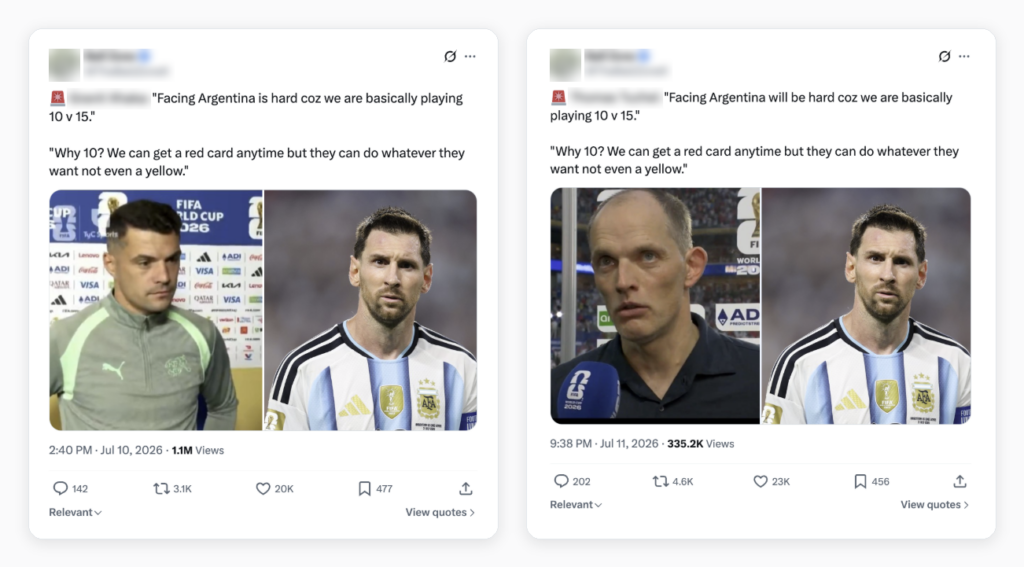
No one briefed the account at half past one in the morning. It re-aimed on its own, because outrage about Argentina is the vein that pays. England plays Argentina in the semifinals, and the grievance is already circulating.
The page will say it is satire, and its bio does, too. But recycling one invented sentence onto a second manager is not a joke with a target. It is a template with a schedule.
Twelve years ago, it took one fan three days to prejudge a final. It now takes a production line four hours, and it gets paid either way: by a sponsor if one turns up, by the platform if one does not.
The Way Forward – Key Takeaways For Organization Leaders
The scandal here is not fake outrage. The outrage was real, and some of the grievances were at least arguable. The scandal is that a market exists to buy it, that the product is built to be indistinguishable from sincerity, and that in the end the buyers were almost beside the point. The machine was already running, and repetition did the rest. Hear “rigged” enough times, from enough different-looking sources, and it stops feeling like a claim and starts feeling like context.
- Stop asking who paid. Start measuring who profits. Payment is invisible from the outside: the transaction happens in a direct message, and the deliverable is a sincere-sounding opinion. Incentive is not invisible. It is measurable, repeatable, and does not require anyone to confess.
- The outrage economy is subsidized by default, so waiting it out does not work. A sponsor is not required. Platform creator payouts reward engagement directly, which funds a standing production capacity for fabricated outrage; a paid campaign then rents direction rather than building reach. That is why the briefs are cheap, and why the machine was already aiming at the next match before anyone had bought the next campaign. An organization can outlast a campaign. It cannot outlast the subsidy.
- Grievance is the entry point, and escalation is fast. Narrative attacks attach themselves to real, arguable grievances, then mutate into identity-based hate and state propaganda within days. Organizations that wait for the narrative to “blow over” are watching the first stage of a longer campaign.
- The architecture is portable, and most targets have no scoreboard. A refereeing dispute had a factual answer: the team lost. Elections, banks, vaccines, and brands face the same stack (real grievance, an outrage economy, political capture, state opportunism) with no referee report to check. Measuring the narrative before the verdict hardens is the one reliable defense.
The tournament will end, a champion will lift the trophy, and the “rigged” chorus will move on to its next venue. The machinery documented here will move with it. “It’s rigged” was once a joke fans told each other after a bad call. It has become a habit of mind, installed through repetition and maintained by an industry that profits from the installation. The organizations that fare best against that industry will be the ones that treat the verdict-before-the-evidence pattern as a detectable signal rather than background noise, because the campaign against them will, on the surface, look like a crowd that made up its own mind.

Naushad UzZaman • Chief Technology Officer
Naushad is the CTO and Co-founder of Blackbird.AI and leads a team of highly skilled experts, data scientists, and engineers who discover emergent threats to get ahead of real-world harm. UzZaman is responsible for developing Blackbird.AI’s Narrative Intelligence Platform, and along with his team, he has built a unique series of scalable ML, generative AI, and network analysis solutions that detect rare risk signals of threats.
Naushad is the CTO and Co-founder of Blackbird.AI and leads a team of highly skilled experts, data scientists, and engineers who discover emergent threats to get ahead of real-world harm. UzZaman is responsible for developing Blackbird.AI’s Narrative Intelligence Platform, and along with his team, he has built a unique series of scalable ML, generative AI, and network analysis solutions that detect rare risk signals of threats.
About Blackbird.AI

Blackbird.AI is the Narrative Intelligence Detection and Response company protecting executives, organizations, and institutions from narrative-based disinformation attacks that cause financial, operational, reputational, and physical harm. Blackbird.AI’s Constellation Platform identifies the actors, networks, bots, and communities driving them; and turns those signals into early warning, decision intelligence, and coordinated response. Blackbird.AI brings Narrative Intelligence into the workflows where teams already operate, including cybersecurity, communications, legal, executive, and public-sector environments, with agentic response capabilities and MCP-enabled integrations that help organizations act faster. Founded by AI experts, threat intelligence analysts, and national security professionals, Blackbird.AI helps customers defend trust, strengthen resilience, and Own The Narrative. To learn more, visit Blackbird.AI.