
What is a TrustOps Council and Why Does It Matter to Your Team?
As AI-generated content, deepfakes, and coordinated disinformation pose new risks to organizations, Gartner recommends establishing a cross-functional Trust Council to govern how teams prepare for and respond to threats to information integrity and organizational trust.

Dall-E 3
Quick Answers
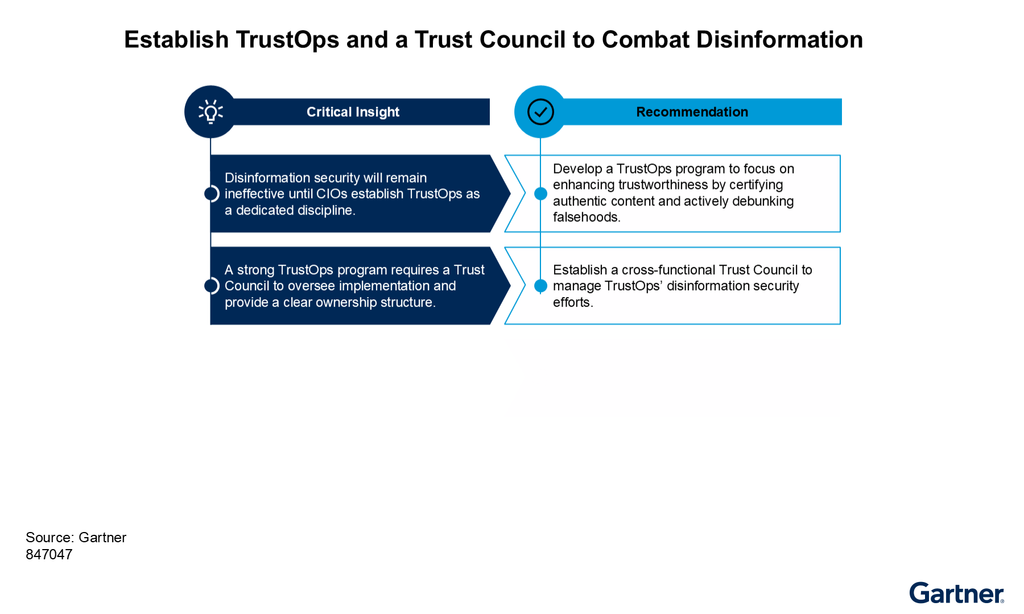
What is TrustOps? Gartner® defines TrustOps, or trust operations, as a holistic approach to enhancing organizational trustworthiness and transparency while mitigating risks from disinformation and harmful associations. It includes policies and practices to verify and certify content authenticity and detect and debunk false or misleading content.
What is a Trust Operations Council? A TrustOps Council is the cross-functional governance body responsible for establishing policies, responsibilities, education, technology, and response processes for an organization’s TrustOps program.
Why does a Trust Council matter and who should participate? A Trust Council establishes clear ownership and a coordinated approach to disinformation risk across the enterprise. Gartner® recommends a cross-functional council of a maximum of eight to 10 participants to serving as the central governance body, including representation from risk/compliance, IT and cybersecurity, legal, marketing, sales and product development.
READ: GARTNER®: EVERY ENTERPRISE NEEDS A TRUST COUNCIL TO COMBAT THE DELUGE OF AI DISINFORMATION
When a deepfake impersonates your CEO or a false narrative about your company spreads online, who owns the response? Communications may face a reputational crisis, CISOs and security teams may react to the cyber threat, and legal teams may face potential liability. Without clear ownership, cross-functional teams can lose critical time deciding who should act.
In its March 2026 report, Every Enterprise Needs a Trust Council to Combat the Deluge of AI Disinformation, Gartner® recommends establishing a cross-functional Trust Council to close that gap. This group governs trust operations, or TrustOps, bringing together leaders across communications, cybersecurity, legal, risk, and other functions to set policies, assign responsibilities, and coordinate responses to disinformation. For your team, that means knowing who verifies a threat, who makes decisions, and when to escalate—before an incident puts those responsibilities to the test.
| Department | Role in the Council |
| IT & Cybersecurity | CISOs and CIOs oversee technical identity management and detect threat vectors. |
| Marketing & PR | CMOs and communications leads handle brand containment and public-facing narratives. |
| Legal & Compliance | Evaluates regulatory exposures, handles copyright/deepfake legal issues, and crafts response boundaries. |
| Human Resources | Manages employee training, handles internal leaks, and builds internal cultural resilience. |
| Executive Leadership | Serves as the final escalation point for high-stakes business continuity decisions. |
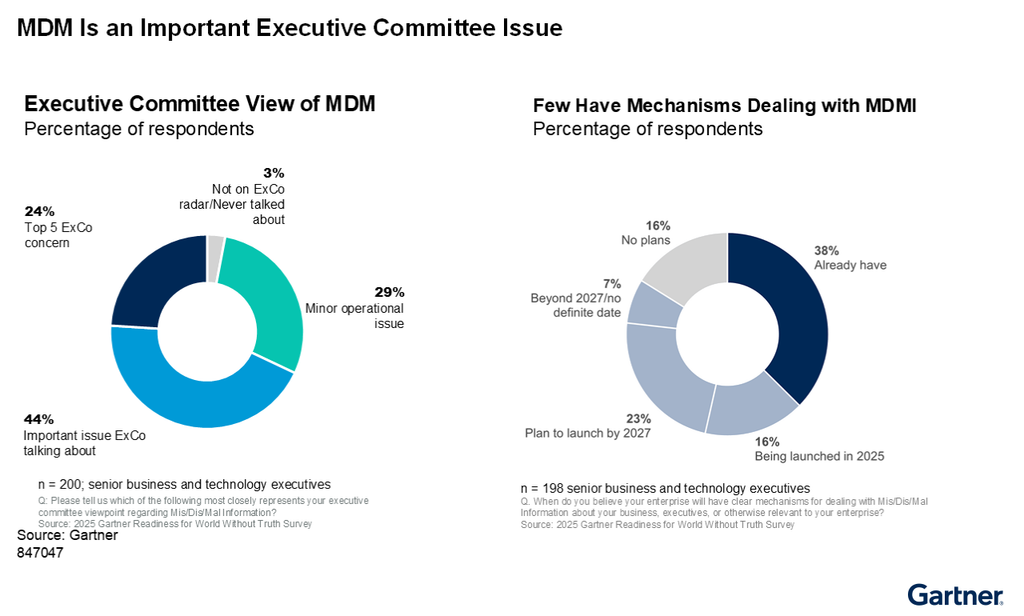
AI has made it easier to create manipulated media, impersonate executives with deepfakes, and amplify harmful narratives across the information ecosystem. At the same time, responsibility for managing disinformation risk often spans communications, cybersecurity, legal, risk, and other functions, which can blur ownership and decision-making. In our understanding, Gartner® argues that this governance gap is one reason disinformation issues can fall between teams. The Gartner® 2025 Readiness for World Without Truth Survey found that 72% of respondents identified misinformation, disinformation, and malinformation as very or relatively important issues to their executive committees. However, only 30% said it was a top five concern.
The financial stakes are rising too. Gartner® predicts that by 2028, enterprise spending on battling misinformation, disinformation, and malinformation will surpass $30 billion, cannibalizing 10% of marketing and cybersecurity budgets to combat a multifront threat.
Gartner® also predicts that by 2027, 50% of enterprises will be investing in disinformation security products or services and TrustOps strategies, up from less than 5% in 2025. As those investments grow, governance becomes essential to turning TrustOps from a set of disconnected activities into an operational capability.
“Every enterprise needs to create a trust council.”
How does narrative intelligence support TrustOps?
Narrative intelligence helps teams monitor harmful narratives and understand the actors, networks, and behaviors driving their amplification. For a Trust Council, that gives communications, cybersecurity, risk, legal, and leadership teams shared intelligence to assess emerging activity and coordinate a response. Gartner® specifically includes identifying harmful narratives among the capabilities organizations need to address disinformation.
“Identify harmful narratives about their organization, industry, or executives quickly, and act swiftly and effectively to address them.”
– Gartner®, by Dave Aron, Andrew Frank, Apeksha Kaushik, Every Enterprise Needs a Trust Council to Combat the Deluge of AI Disinformation, March 2026
How can organizations start building a TrustOps Council?
“The first step CIOs should take is to ensure there is a trust council governance body in place to decide how the enterprise will handle the disinformation issue.”
Narrative intelligence can support that work by helping teams monitor harmful narratives, identify the actors and networks driving them, and coordinate response across functions. Blackbird.AI’s Constellation Narrative Intelligence Platform provides these capabilities.
READ: GARTNER: EVERY ENTERPRISE NEEDS A TRUST COUNCIL TO COMBAT THE DELUGE OF AI DISINFORMATION
The Way Forward: Key Takeaways
For organizations building a TrustOps program, we believe the Gartner® guidance points to three priorities:
- Establish clear cross-functional ownership through a Trust Council. Give a defined group responsibility for governing disinformation risk across the organization.
- Build repeatable TrustOps policies and response processes. Define how teams verify information, monitor harmful narratives, escalate incidents, and coordinate a response.
- Test and measure TrustOps preparedness. Use simulated disinformation incidents to evaluate response capabilities and measure effectiveness over time.
As AI-generated content and coordinated narrative attacks create risk across more parts of the enterprise, TrustOps provides a framework for turning fragmented responsibilities into a coordinated approach to protecting organizational trust.
Gartner®, Every Enterprise Needs a Trust Council to Combat the Deluge of AI Disinformation, Dave Aron, Andrew Frank, et al.,17 March 2026
Gartner®, Tech FutureSight: Without Narrative Intelligence, AI Disinformation Attacks Will Win, Alfredo Ramirez IV, Apeksha Kaushik, et al., 1 August 2025
Gartner®, Emerging Market Quadrant for Narrative Intelligence — Startup Vendors, Alfredo Ramirez IV, Apeksha Kaushik, et al., 24 September 2026
Gartner®, AI Vendor Race: Blackbird.AI Is the Company to Beat for Disinformation Narrative Intelligence, Apeksha Kaushik, Alfredo Ramirez IV, 24 July 2026
Gartner is a trademark of Gartner®, Inc. and/or its affiliates.
Gartner® does not endorse any company, vendor, product or service depicted in its publications, and does not advise technology users to select only those vendors with the highest ratings or other designation. Gartner® publications consist of the opinions of Gartner® business and technology insights organization and should not be construed as statements of fact. Gartner® disclaims all warranties, expressed or implied, with respect to this publication, including any warranties of merchantability or fitness for a particular purpose.

Amanda Burkard • Marketing Manager
Amanda Burkard is a Marketing Manager at Blackbird.AI, where she supports content development, demand generation, event coordination, and marketing operations. Outside of work, Amanda is an accomplished Irish dancer. She holds a B.A. in Psychology from the University of Virginia.
Amanda Burkard is a Marketing Manager at Blackbird.AI, where she supports content development, demand generation, event coordination, and marketing operations. Outside of work, Amanda is an accomplished Irish dancer. She holds a B.A. in Psychology from the University of Virginia.

Dan Patterson • Head of Corporate Communications
Dan Patterson is a strategic communications leader driving impact at the intersection of artificial intelligence, cybersecurity, and media. At Blackbird.AI, Dan leads communication and content strategy that breaks down complex AI and cybersecurity concepts for diverse business audiences. Prior, he was the national tech correspondent for CBS News.
Dan Patterson is a strategic communications leader driving impact at the intersection of artificial intelligence, cybersecurity, and media. At Blackbird.AI, Dan leads communication and content strategy that breaks down complex AI and cybersecurity concepts for diverse business audiences. Prior, he was the national tech correspondent for CBS News.

RAV3N Research •
The Blackbird.AI RAV3N Research Team is a cross-disciplinary unit of narrative intelligence analysts that publishes data-driven, evidence-based research on how narrative attacks created by misinformation and disinformation cause financial and reputational harm to public and private sector organizations, including global brands, Fortune 500 companies, government agencies, and executives. Using Blackbird.AI's Constellation Narrative Intelligence Platform, our analysts identify the influence behind narratives, the networks they touch, the anomalous bot behavior that scales them, and the cohorts and communities that connect them to surface the full picture of how narratives form and spread.
The Blackbird.AI RAV3N Research Team is a cross-disciplinary unit of narrative intelligence analysts that publishes data-driven, evidence-based research on how narrative attacks created by misinformation and disinformation cause financial and reputational harm to public and private sector organizations, including global brands, Fortune 500 companies, government agencies, and executives. Using Blackbird.AI's Constellation Narrative Intelligence Platform, our analysts identify the influence behind narratives, the networks they touch, the anomalous bot behavior that scales them, and the cohorts and communities that connect them to surface the full picture of how narratives form and spread.
About Blackbird.AI

Blackbird.AI is the Narrative Intelligence Detection and Response company protecting executives, organizations, and institutions from narrative-based disinformation attacks that cause financial, operational, reputational, and physical harm. Blackbird.AI’s Constellation Platform identifies the actors, networks, bots, and communities driving them; and turns those signals into early warning, decision intelligence, and coordinated response. Blackbird.AI brings Narrative Intelligence into the workflows where teams already operate, including cybersecurity, communications, legal, executive, and public-sector environments, with agentic response capabilities and MCP-enabled integrations that help organizations act faster. Founded by AI experts, threat intelligence analysts, and national security professionals, Blackbird.AI helps customers defend trust, strengthen resilience, and Own The Narrative. To learn more, visit Blackbird.AI.